In early 1949, the victorious Communist army had approached the Yangtze River, posing a threat to Nanking, the capital of the Kuomintang, and the Yangtze River waterway. At that time, the British Embassy requested the Royal Navy to send a ship to be stationed on the Yangtze River near Hsiaguan in Nanking, in order to prepare for the possibility of evacuating the British citizens. Shanghai then sent a destroyer escort ship, "HMS Consort".
As the head of British naval intelligence in China, I have strong objections to this arrangement. I understand the feelings of the Chinese people after World War II. When the Western powers voluntarily announced the abolition of unequal treaties with China in 1942, the right to navigate inland waterways was theoretically also abolished. Now, a British warship is suddenly lying across the Yangtze River, ostensibly to protect overseas Chinese. In the eyes of the Communist army, which is experiencing a surge of anti-Western sentiment, this is seen as a restoration of Western imperialism and collusion between the Communists and the Kuomintang to obstruct the Communist army's crossing of the river. This will definitely cause a lot of trouble.
Beyond simply understanding the Chinese perspective, the embassy, from a naval standpoint, overlooked the fact that sending warships up the Yangtze River to Nanking without guaranteeing military superiority on the north bank was extremely dangerous. Warships would struggle to maneuver and evade enemy fire in the narrow river, and in the event of a conflict, they would likely be damaged by Communist artillery. Even more serious was the possibility that if the Communists blockaded the Yangtze, the ships and crew could be captured – a humiliation the Royal Navy could not afford!
(Figure 6-8-1) The Communist army launched the Yangtze River Crossing Campaign on April 21, 1949, and announced the blockade of the Yangtze River near Nanking. The intrusion of British warships at this time was tantamount to adding fuel to the fire.
At that time, the United States had already voluntarily withdrawn all its ships from the Yangtze River, which made me sense something unusual. It seemed that the United States was beginning to fawn over the new Chinese regime. I originally thought that because the United States supported Chiang Kai-shek's civil war, it would certainly not be accepted by the Chinese Communist Party, and Britain could take the opportunity to replace it and restore its former status as the big brother. However, if the matter of sending ships into the Yangtze River was not handled well, the label of imperialism might be thrown back at the United States, allowing it to reap the benefits.
I expressed my concerns to the embassy, hoping to withdraw the warship to Shanghai and prohibiting it from entering the Yangtze River without my consent. After understanding my concerns, the embassy agreed to withdraw the "HMS Consort". At this time, I was assigned to Hong Kong to handle the recovery of the "Lingfu". Unexpectedly, while I was away from Shanghai, another escort destroyer, the "HMS Amethyst", forcibly sailed up the Yangtze River under the pretext of troop rotation. It engaged in a shelling with the Communist army in Chenkiang and was hit and ran aground. This is the "Amethyst Incident" that shocked the world.
This incident was entirely the fault of Lieutenant Commander Bernard Skinner, captain of the "HMS Amethyst". Upon hearing the Communist order to blockade the Yangtze River, he deliberately led his ship to break through the blockade, resulting in multiple hits from Communist artillery fire at Chenkiang, the stop before Nanking. This resulted in 17 deaths and 20 injuries, with the reckless Lieutenant Commander Skinner himself killed. The "HMS Consort", upon hearing the news, rushed from its anchorage in Nanking to provide support, but was also subjected to heavy Communist artillery fire, suffering 10 deaths and 12 injuries, including its captain. It eventually limped towards its Shanghai base.
Following the incident, the Far East Fleet did not attempt to resolve the matter through diplomatic channels. Instead, Vice-Admiral Alexander Madden, the fleet's deputy commander, personally led the flagship "HMS London" and the escort destroyer "HMS Black Swan" into the Yangtze River early on the 21st to attempt to rescue "HMS Amethyst". This only added fuel to the fire, and a larger-scale gun battle broke out on the spot. On that day alone, fifteen men were killed and thirteen were wounded, including Captain P.G. Cazalet of the "HMS London" and Vice-Admiral Madden. The Black Swan had seven men wounded.
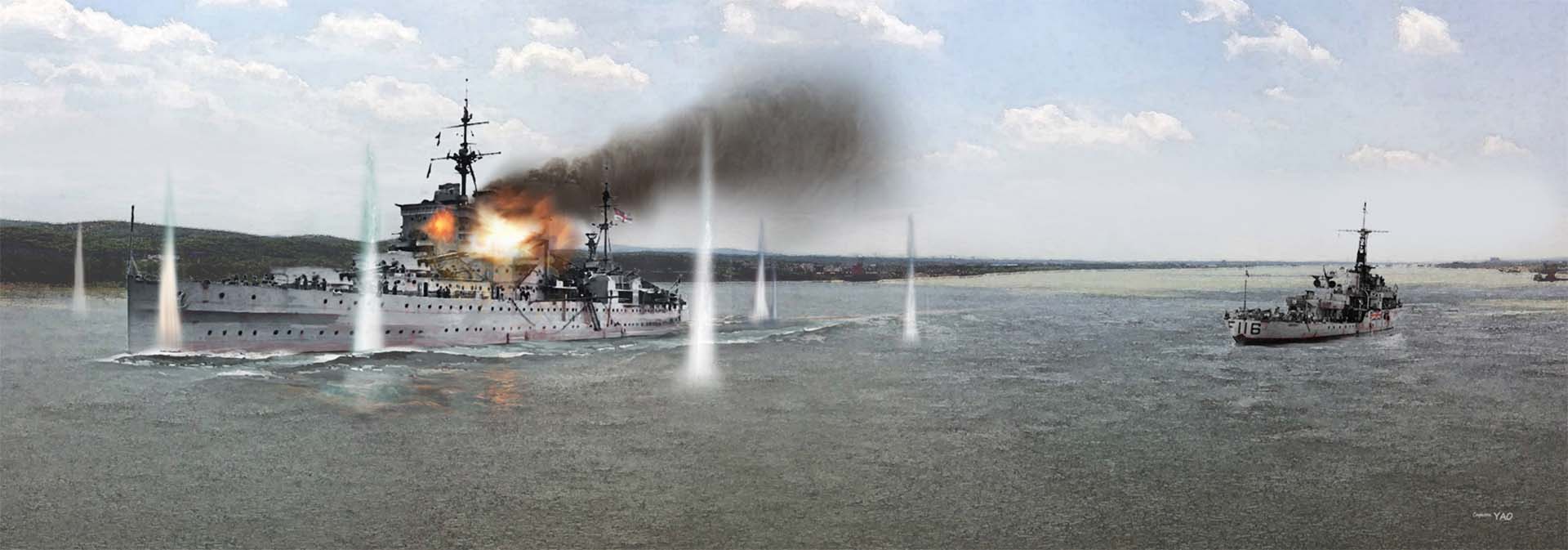
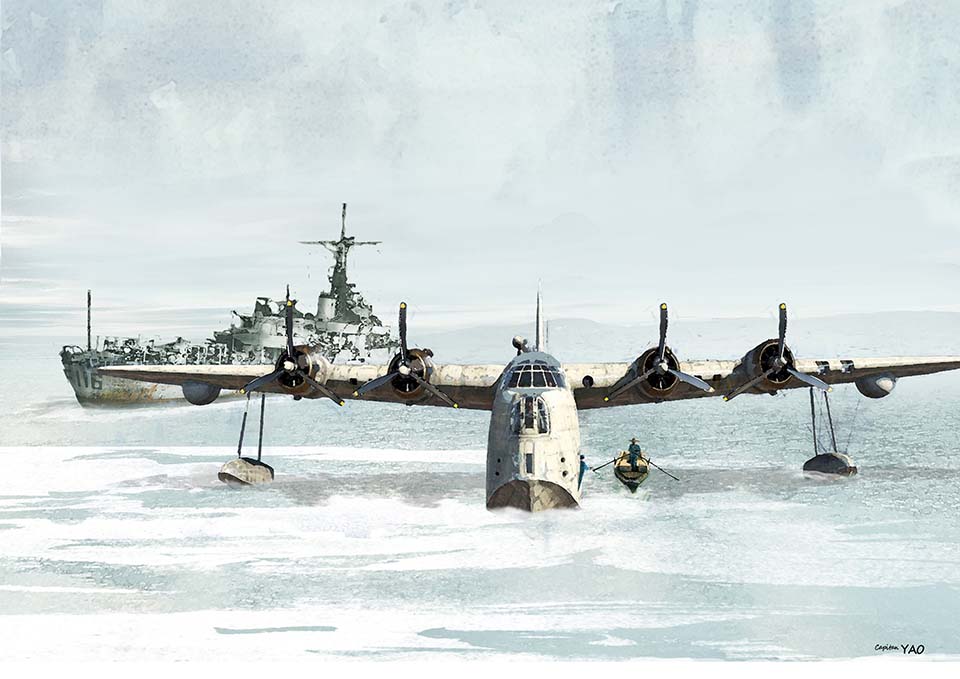
(Figure 6-8-2) The heavy cruiser "HMS London", accompanied by the destroyer "HMS Black Swan", entered the Yangtze River to attempt to rescue "HMS Amethyst", but was damaged by artillery fire from the Communist army. I felt it was necessary to get to the scene to understand the situation, but at that time no one dared to board the British ships. At this time, a Royal Air Force Sunderland seaplane was dispatched from Hong Kong to deliver medical supplies to the "HMS Amethyst" and evacuate the wounded. I boarded the plane and flew to the scene, but was called back to Shanghai by Lieutenant General Madden midway because it was too dangerous.
(Figure 6-8-3) A Royal Air Force Sunderland seaplane attempts to deliver medical supplies to the "HMS Amethyst" and evacuate the wounded.
Having no other choice, I had to sail my "China Pearl II" along the river, first to Nanking, and then find a boat to go downstream in the hope of reaching Chenkiang. From Shanghai to Nanking, I could see smoke and fire everywhere, with Communist troops swarming across the river at several ferry crossings using sailboats, rafts, and various other means of transport. As I passed over Chenkiang, I finally saw the "HMS Amethyst" stranded on the sandy beach on the south bank of the river, while the Communist artillery positions were on the north bank.
When the plane landed at Nanking Ming Palace Airport, the scene was chaotic. Refugees surrounded and even clung to the plane, making it impossible for it to take off. The Kuomintang army was blowing up and repairing the hangars and the planes that could not take off. But I had already thought of this. I brought a co-pilot with me and asked him to fly the plane back to Shanghai as soon as I got off the plane.
After jumping off the plane, I looked around and saw abandoned cars everywhere inside and outside the airport. I randomly jumped into an abandoned military jeep and drove towards the embassy. At this time, Nanking had fallen into anarchy, and the roads were filled with refugees like stray dogs and scattered soldiers looting and pillaging. I sped to the embassy by the river. Sandbags had been piled up on both sides of the high steps, and several British soldiers had set up a machine gun and were staring down.
Ambassador Ralph Stevenson personally received me and told me about the situation in Nanjing over the past few days. He mentioned something quite strange: the Nationalist government, with Sun Ke as Premier, had already moved to Kuangchow, but the American Ambassador, John Leighton Stuart, had not followed him south. Instead, Stalin had ordered the Soviet Embassy to move to Guangzhou with Sun Ke. This was very unusual. Ambassador Stevenson said he had received intelligence that Stuart was using the excuse of his plane needing repairs to stay in Nanjing, possibly attempting to contact and negotiate with the Communists. The Ambassador asked me what the intelligence group could do in this matter.
In a briefing at MI6 headquarters in London in 1944, I mentioned that in order to preserve Hong Kong, it was necessary to develop a more normal relationship with the new Chinese government. I also personally spoke with Mao Tsetung in Chungking in 1945. I have reason to believe that these ideas must have influenced the top leadership on both sides. I also predicted that the United States, because of its support for Chiang Kai-shek in the civil war, would be listed as the Communist Party's number one enemy and would find no opportunity in the new China.
But Mr. John Leighton Stuart, the missionary born in Hangzhou, former president of Yenching University, and current U.S. Ambassador to China, does not seem to think so, even though August I Ward, the U.S. Consul General in Shenyang, was detained by the CCP on espionage charges in late 1948 and remains so to this day, resulting in the famous "Ward case".
The problem was that the Chinese Communist Party's position at the time was not to recognize the diplomatic status of any Western embassy or consulate personnel in China, treating them only as ordinary foreign residents. This was to avoid the impression that continuing diplomatic relations with the Kuomintang government would imply recognition of the various unequal treaty commitments made by the Kuomintang government to Western countries. Therefore, I understand that the new Communist regime could only establish new diplomatic relations by sending new personnel, and the old embassies could not be allowed to continue. The United States did not understand this principle, and thus encountered obstacles everywhere.
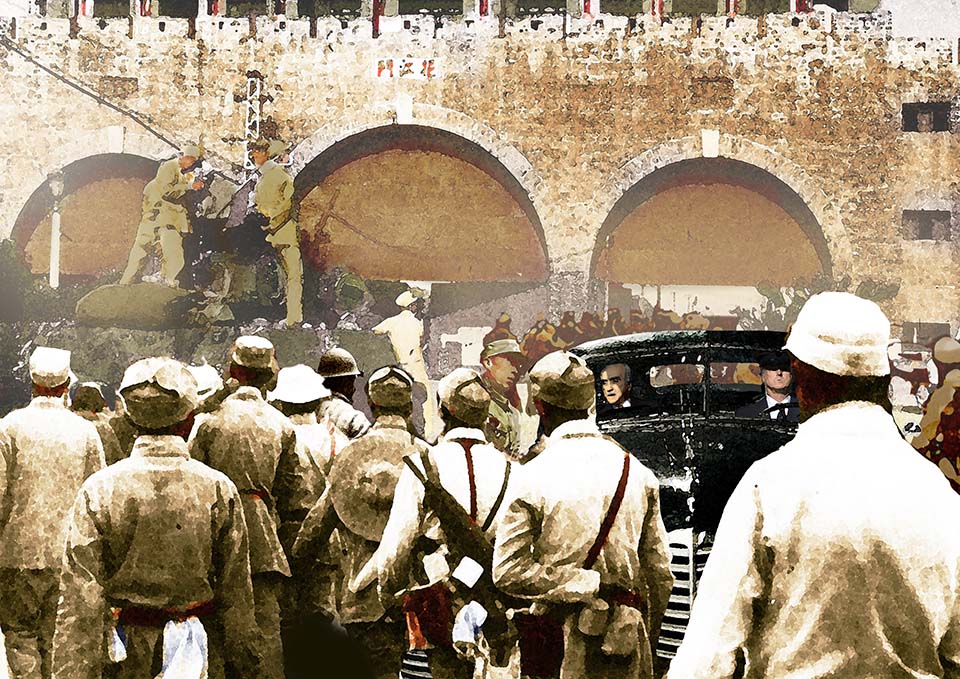
(Figure 6-8-4) Ambassador Stuart stayed in Nanking hoping to negotiate diplomatic relations with the Communists, but was ordered to return home after news of the humiliation he suffered at the hands of the Communist army reached Washington.
"Regarding the question about Stuart, please allow me some time to consider before answering, but I must deal with the Amethyst matter first." I said to Ambassador Stevenson, "Captain Lieutenant Commander Skinner has been killed in action. I would like to appoint Lieutenant Commander John S. Kerans, the embassy's deputy naval attaché, to act as captain of the ship and serve as the negotiating point with the Communist forces. I request your approval."
Actually, I already had an idea about Stuart's problem, but it was really inappropriate to bring it up in front of the ambassador, because it was a bit underhanded and didn't fit the image of a gentleman in the British Empire. My plan was to find some gangsters to impersonate Communist soldiers and humiliate him, then spread the news to the United States to fuel anti-communist sentiment among right-wing members of Congress, and perhaps they would voluntarily withdraw from China.
I was focused on the "HMS Amethyst" and forgot about this incident. Later developments unfolded exactly as I had predicted, only without my involvement. On April 25th, a small group of Communist troops mistakenly entered the US Embassy in Nanking and had a verbal altercation with Stuart. The US Embassy initially kept a low profile, unwilling to publicize the incident for fear of jeopardizing the situation. However, I seized the opportunity to embellish the story through international media in Shanghai and relay it back to the US. The US Congress was in uproar, with right-wing members like Joseph Raymond McCarthy strongly demanding that the State Department order Stuart to return home immediately and forbid any contact with the CCP regime. The timeline for establishing normal diplomatic relations between Washington and Peiking was thus delayed by a full thirty years, and Stuart's dream of becoming the first US ambassador to the People's Republic of China was shattered.

On the morning of the 23rd, my deputy military attaché, Lt Cdr Kerans, and I drove from the embassy to Hsiaguan Wharf hoping to find a boat to sail to the place where the "HMS Amethyst" was stranded in Chenjiang. However, we couldn't find any boats at all. It turned out that in order to prevent the Communist army from crossing the river and requisitioning them, the Kuomintang had already hidden all the civilian boats in the Sancha River. Just as we were worrying, a jeep drove up. Inside was Rear Admiral Lin Zun, the commander of the Kuomintang Navy's Second Fleet. 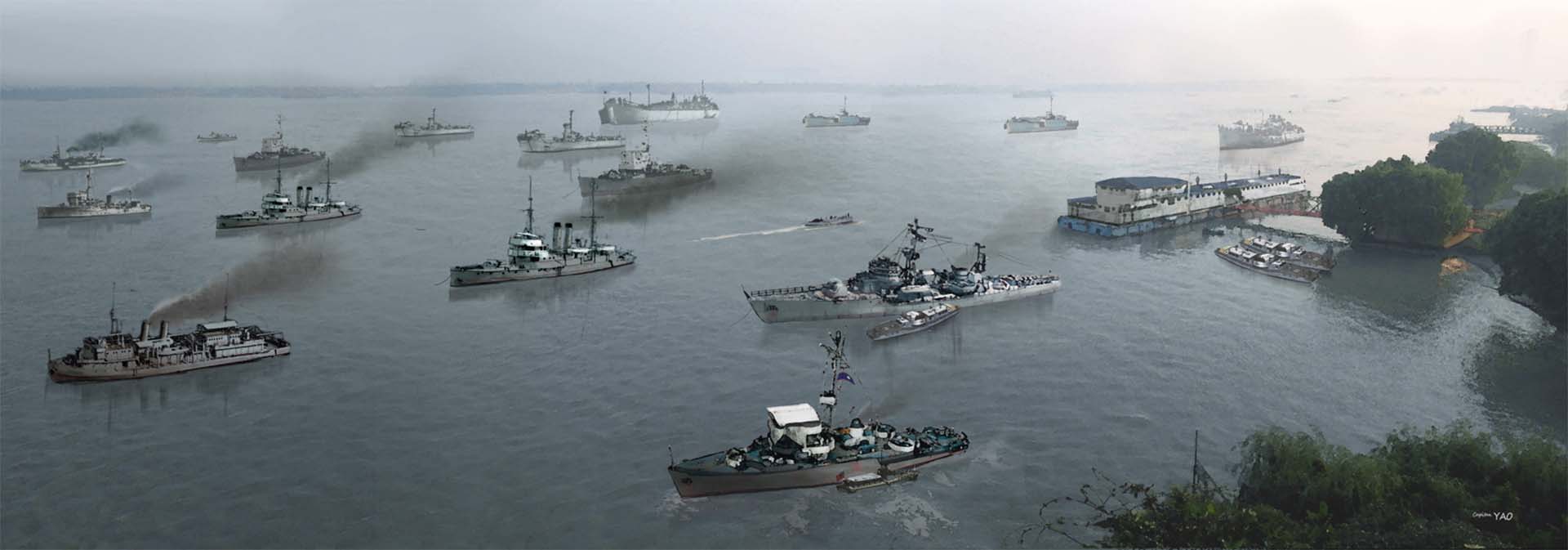
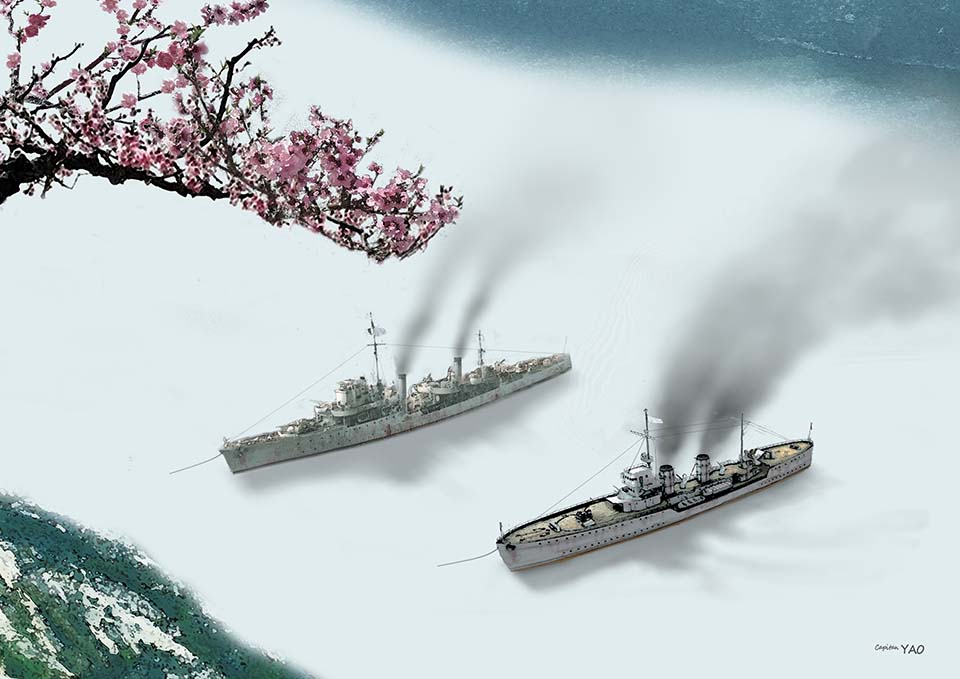
(Figure 6-8-5) The Second Fleet's ships gathered on the Nanking section of the Yangtze River. "Captain Draken? What are you doing here?" Lin Zun asked the jeep driver to stop the car. "Hey old classmate, do you have a ride with me?" Lin Zun hesitated for a moment before replying, "Come on up, let's go into the base first!" So Lt Cdr Kerans and I squeezed into the back of his jeep and went into Hsiaguan Wharf together, where we saw the minesweeper "Yungkia" moored on the shore with Rear Admiral Lin Zun's flag flying over it. On the bus, I told Lin Zun that I was in a hurry to get to the anchorage of the "HMS Amethyst" in Chenkiang and hoped that I could catch a boat. "Please don't misunderstand, my ship has an important mission today and it's really inconvenient for me to go, but I can send a gunboat to take you there," Lin Zun said. "Then I would be extremely grateful!" I replied. While waiting for the staff to dispatch a boat, Lin Zun told me that he had just returned from meeting with Kui Yungking at the Navy Headquarters. Kui had already fled to Shanghai by plane this morning. Before leaving, Kui asked him to lead all the ships to break through the Communist blockade to Shanghai. Kui also said that even if he only took one ship out, he would recommend him as a vice admiral and deputy commander-in-chief, and ask Chiang Kai-shek to award him the highest honor, the Order of the Blue Sky and White Sun. "Pah!" He spat into the river and said, "I begged him to lead the fleet out, but he refused and ran off by plane first. Can I work for a boss like that?" I became suspicious. Wasn't he going downstream like me? Why wouldn't he let me board the ship and instead sent a gunboat? Just then, a small gunboat docked, and Kerans and I thanked Lin Zun and boarded the boat to continue downstream. This is a 25-ton inland river patrol boat received from the Japanese army after the war. It has a shallow draft but is quite fast. There are several machine guns on board, and the sailors are nervously aiming at the opposite bank. This is not surprising, as the Communist army has begun to cross the river, and a single shell could capsize this small gunboat. The gunboat refused to go any further when it got close to the "HMS Amethyst". Kerans and I had to go ashore and walk to the nearest shore to the "HMS Amethyst". The ship had already seen us arrive and launched a small boat to take us aboard. After boarding, I immediately summoned all the officers and men who remained on board and announced that Lt Cdr Kerans would be the acting captain. Now the "HMS Amethyst" finally had a leadership center. After getting a general understanding of the situation on the ship, I planned to return to Shanghai by land early the next morning. Late that night, there was heavy artillery fire on the river again. I thought that the Communist army on the other side was firing at our ship again. When the captain and I went up to the bridge, the watch officer said that a group of Chinese warships had just passed downstream at high speed and exchanged fire with the Communist army on the shore. "It's probably Lin Zun's fleet that broke through!" I said to Lt Cdr Kerans.
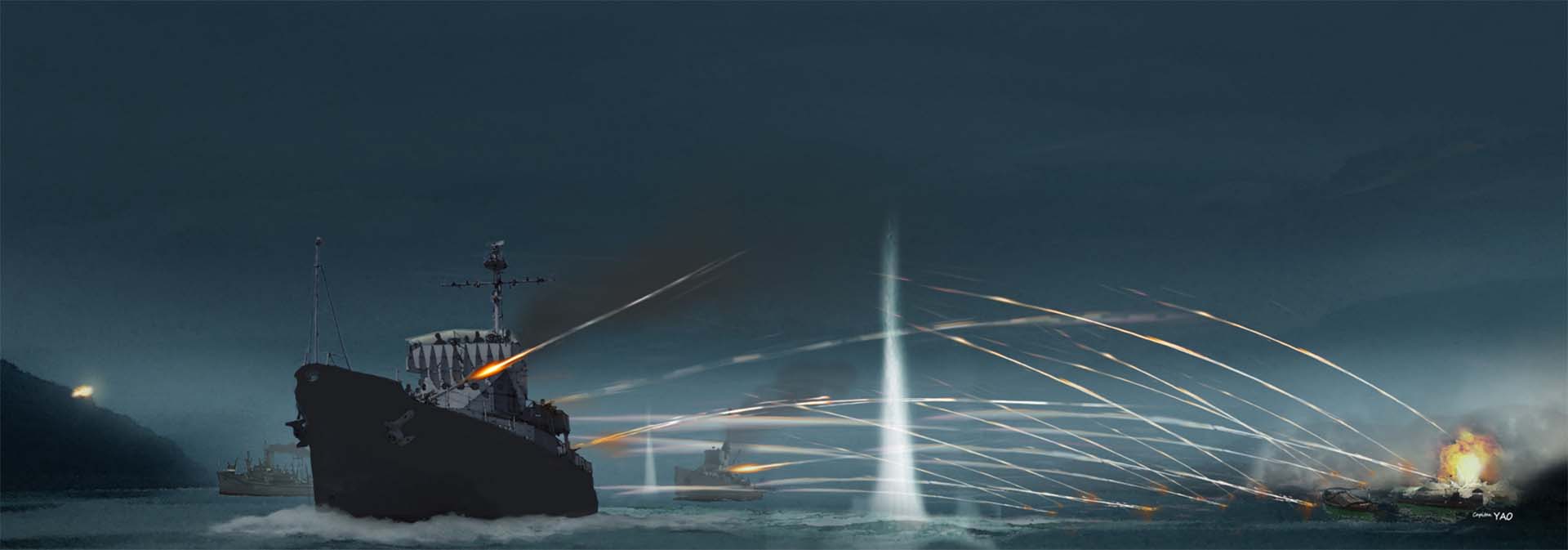
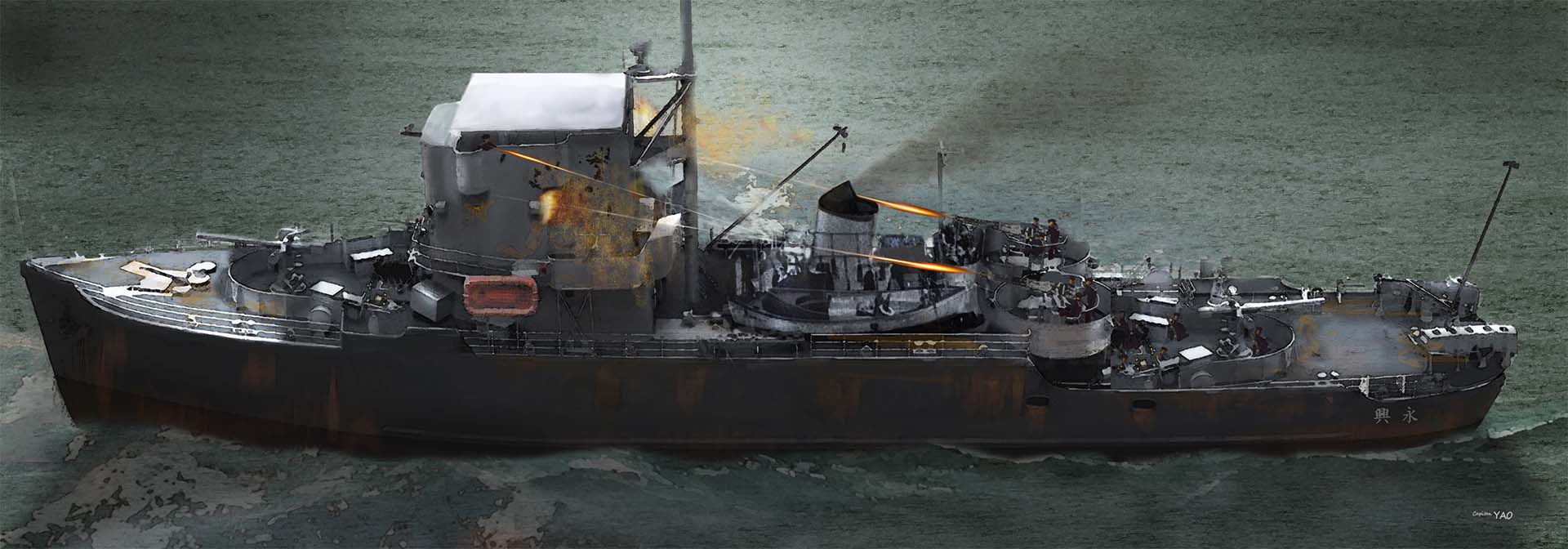
(Figure 6-8-6) Major Chen Qingkun led the "Yongjia" and other ships to break away from the Second Fleet that had defected to the Communists. 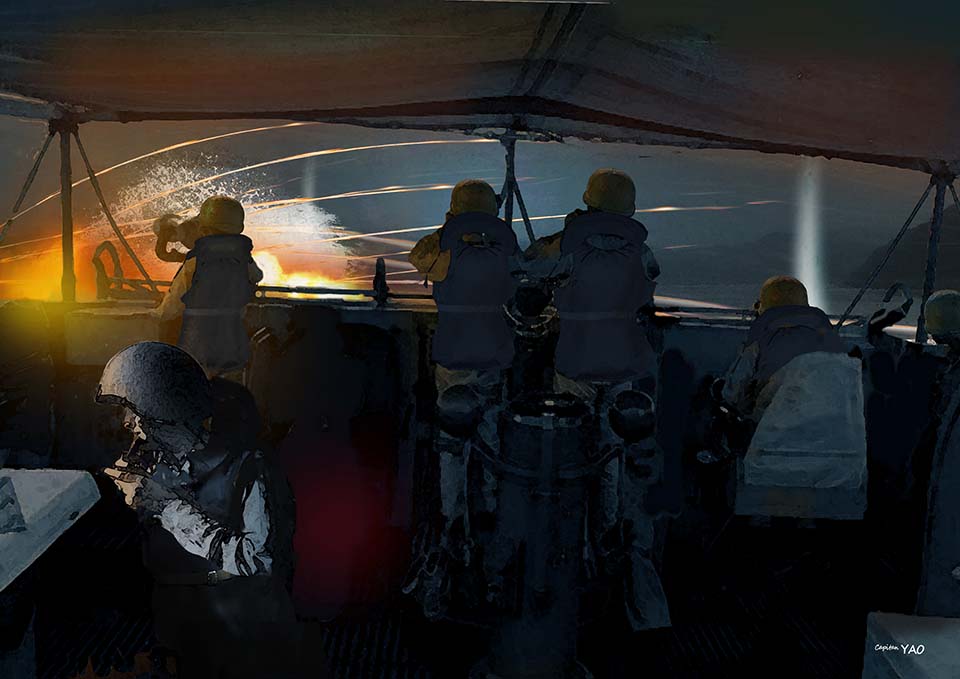
(Figures 6-8-7) Lt Cdr Chen Chingkun led the "Yongkia" ship to break through the enemy lines under heavy fire from the Communist army.
Lin Zun had likely been plotting to defect to the Communists for a long time. When he first became the commander of the Second Coastal Defense Fleet, he asked Kui Yungking to transfer many ships originally belonging to the First Fleet and the River Defense Fleet to his command, citing the reason that the defense line of capital was too long and the forces were insufficient. This brought the vast majority of China's ships under his control, with the aim of getting more Kuomintang ships to defect to the Communists with him.
On the morning of the 23rd, shortly after Lin Zun met me at the Hsiaguan Wharf, he boarded the "Yongkia", convened a meeting of captains, and announced his defection to the Communists. He then transferred to the flagship "Huian." Unexpectedly, the "Yongkia" took advantage of his departure and forgetting to lower the Rear Admiral's flag to set sail. Some ships that had already agreed to defect, unaware of the situation, assumed the commander had changed his mind and followed him. As a result, some ships broke away from the fleet and escaped to Shanghai. Lin Zun was an indecisive person who was at a loss when faced with a situation, and he simply let the ships leave without stopping them.
The intelligence team immediately compiled the figures, which included three American-supplied minesweepers, namely "Yungkia", "Yunghsiu" and "Yungting", the American-supplied medium landing ship "Meiheng" and the transport ship "Wuling" which was a Japanese reparation. In addition, the old gunboat "Yuntsi" and the repair ship "Hsingan", which was converted from an American-made tank landing ship, were destroyed by the Communist army's artillery fire en route. Just before they arrived in Shanghai, the ships "Yatsen" and "Hsinyang" also broke through from Kiangyin and arrived in Shanghai.
Lin Zun's defection to the Communists included two Japanese reparations warships, "Huian" and "Gian," three river defense gunboats received from the Japanese surrender, "Antung," "Kianghsi," and "Taiyuan," two US-aided landing ships, "Meisheng" and "Liankuang," and two old-style gunboats, "Chutung" and "Yungsui," totaling nine warships, along with sixteen other vessels including gunboats, patrol boats, and landing craft, and more than 1,200 officers and soldiers. Later, six of these warships were sunk by Kuomintang aircraft.
The defection of an entire fleet is virtually unprecedented in the history of naval warfare. Kui Yungking, who had been dismissed but retained in his post just two months prior due to the defection of the "Chungking," was utterly humiliated this time. Fortunately, several ships managed to break through and return, which Kui seized upon. Lt Cdr Chen Chingkun, the captain of the "Yongkia," who led the defection, was awarded the Order of the Blue Sky and White Sun, the highest honor in the Kuomintang, by Chiang Kai-shek. I suspect this medal was originally intended for Lin Zun?
(Figure 6-8-8) The ships "Yatsen" and "Hsinyang" were detained in front of the Kiangyin Fort and dared not move.
When I returned to Shanghai, I visited this small fleet in Wusong, which Western media called the "Firecracker Fleet." I asked them in detail about their breakout process because I was racking my brains to save the "HMS Amethyst" from danger and hoped to find inspiration from the "Firecracker Fleet."
As mentioned earlier, the ships "Yatsen" and "Hsinyang" were the ones I salvaged intact from the Japanese wreckage for the Chinese government after the war. The captain at the time was Lieutenant Commander Song Changzhi, a protégé of Shen Honglie from the Tsingtao clique. When Lin Zunyun plotted his mutiny, the "Yatsen" and "Hsinyang" were anchored in Kiangyin.
Coincidentally, the Kiangyin fortress rebelled, and its cannons pointed at the two ships, demanding surrender. Left with no other option, Song Changzhi raised a white flag in a feigned surrender. At dusk, taking advantage of the shifting of anchor, they suddenly set sail and headed towards Shanghai overnight.
The "Yatsen" and "Hsinyang" were the main battleships, and Song Changzhi's contributions were no less than Chen Chingkun's. However, the incident of raising a white flag caused great controversy, thus disqualifying him from receiving the Order of the Blue Sky and White Sun. Although this shadow followed Song throughout his life, his career afterwards was quite successful. He rose through the ranks to become Commander-in-Chief of the Taiwan Navy, Chief of the General Staff, and Minister of National Defense, becoming the first person in the Kuomintang Navy to reach such a high position, seemingly unaffected by the white flag incident.
On my way back to Shanghai by land, I passed by the Kiangyin Fortress. It was the evening of the 24th. The fortress had been occupied by the Communist army two days earlier. The "Yatsen" and "Hsinyang" had also escaped their anchorage and headed to Shanghai on the evening of the 22nd. I squeezed through the crowd of refugees. The incident of Song Changzhi raising the white flag was brought up again in the 1980s and almost became a political storm. I will talk about it later.
(Figures 6-8-9) The "Yunghsing" ship mutinied, and the two sides exchanged gunfire at the bow and stern. 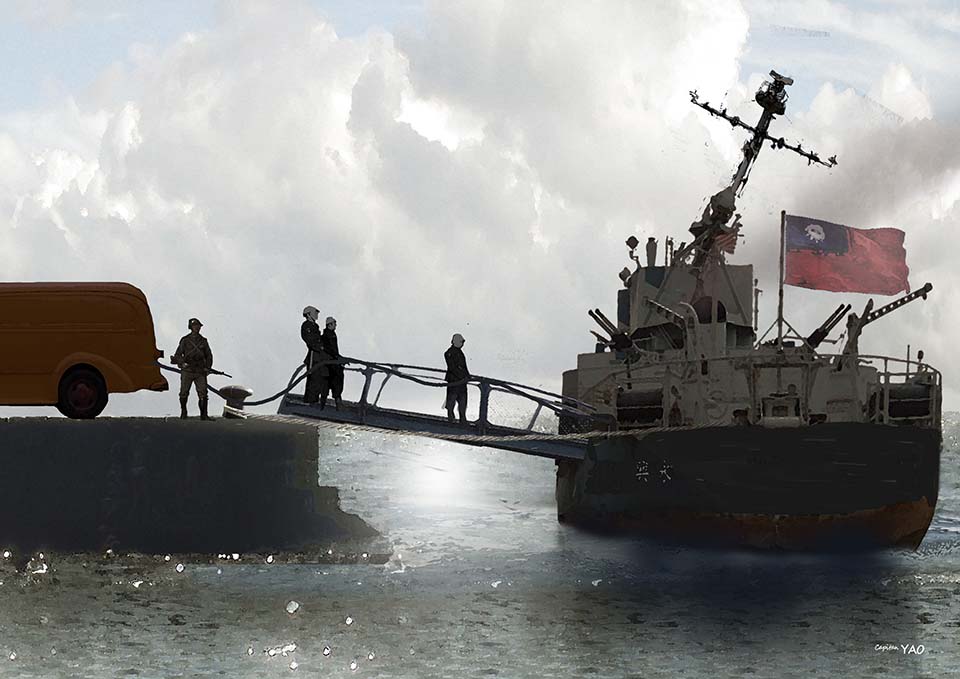
(Figure 6-8-10) Shanghai special police drilled holes in the bulkhead of the "Yunghsing" ship and injected gas to poison all the traitors.
On May 1, a little over a week later, another Kuomintang naval vessel, the "Yunghsing," mutinied in Taicang, Jiangsu. The traitors occupied the bridge and coerced Lieutenant Commander Lu Weiyuan, the captain, to sail the ship to Northeast China to defect to the Communists. Lu refused and was shot dead. His dying screams, broadcast over the ship's public address system, enraged the other officers and men. They crawled out from the stern through the bilge passage and turned the 40mm guns on the aft deck to fire fiercely at the bridge. One traitor was killed in the bridge, another jumped overboard to escape but was shot dead by the sailors with submachine guns. The remaining three traitors locked themselves in the communications room. The ship was towed back to Shanghai, where special police drilled holes in the bulkhead and poured gas into the ship to poison all the traitors.
The "Yunghsing" was one of the eight ships that Lin Zun received from the United States. It was an iron-hulled minesweeper (AM) with its stern minesweeping equipment removed and guns installed for use as a patrol vessel. Two ships were received from the United States that year, the other being the "Yungtai".
After the mutiny, the "Yunghsing" ship was renamed "Weiyuan" by Kui Yungking in memory of the murdered Captain Lu Weiyuan. I even boarded that ship during the Quemoy Artillery Battle in 1958.
The mutinies within the Kuomintang navy continued throughout 1949, only subsiding when the two sides faced off across the Taiwan Strait. Due to the recurring mutineer incidents, Kui Yungking launched a frenzied and bloody purge within the navy, painting a bloody red stain on the waning Kuomintang regime.
As April transitioned into May, the "HMS Amethyst" remained stranded in Chenkiang. The weather grew increasingly hot, and supplies on board dwindled, making life increasingly difficult for the officers and men remaining on board. On May 27th, the Communist army liberated Shanghai, and the entire waterway from the lower reaches of the Yangtze River to its estuary was now under their control. Even if the "HMS Amethyst" managed to escape, it risked being intercepted by Communist artillery fire along the way, making its chances of escape seem extremely slim. I never believed that the Communist Party would break with Britain over the "HMS Amethyst," but both sides had face-saving issues. For the Royal Navy, the idea of "His Majesty's ship" being surrounded and disarmed was absolutely intolerable. As a last resort, they would have to sink it themselves and send the crew to prisoner-of-war camps, which would mean that both sides were on the verge of war, and Hong Kong's status would immediately be in jeopardy. For the CCP, how can it explain to the general public that an imperialist warship, which invaded its territory and fired upon and killed many PLA soldiers, simply lets it leave without admitting its mistake or apologizing? However, they are about to establish a new nation in Peiking and hope that mainstream Western countries like Britain will recognize them and establish diplomatic relations. It would not be worthwhile to break the agreement over a escort destroyer that mistakenly entered the territory. So what to do? When faced with these kinds of problems, I usually write the proposition and the answer on opposite sides of a piece of paper, then connect them one by one with a pencil to see the intersection and causal relationship between them. At this point, I noticed a gap in the equation: the "HMS Amethyst" cannot be captured, cannot self-destruct, and... We couldn't just leave openly, but no one said we couldn't "sneak away." At that moment, I remembered the example of Song Changzhi's "Yatsen" using the evening to move its anchorage and escape! By sneaking away at night, the PLA artillery could pretend they hadn't seen anything, thus providing an explanation to the public. The Royal Navy regained control of its warships and personnel, saving face and reputation. Both sides found a way to back down, and the matter was resolved without a trace. This is an Eastern way of resolving issues, not something Westerners, who insist on going to court and presenting evidence to get everything perfectly clear, can understand. I suggested to the fleet that they escape under cover of night, but this was met with strong opposition from Admiral Brind and Vice Admiral Madden, among others: "That would be a huge blow to the Royal Navy's reputation! Wouldn't that be tantamount to admitting that we were wrong?" "Even if we manage to escape at night, it will be almost dawn by the time we reach Shanghai. Wouldn't we be wiped out by the Yangtze River estuary forts?" Admiral Brind even passionately declared his intention to personally oversee negotiations with the CCP aboard the ship, stating that if no agreement could be reached, he would force the ship to set sail, even at the cost of shipwreck and loss of life; the Navy Department, upon learning of this, prohibited his actions. I quickly realized that if this matter was orchestrated by the fleet's high command, the Communist forces might lose face and perceive it as a London conspiracy. Only by defining it as a spur-of-the-moment decision by the on-site commander could I avoid any negative consequences. I decided to ignore the fleet and secretly instructed Acting Captain Lieutenant Commander Clens via coded telegram to prepare in secret and act according to circumstances. Since Lieutenant Commander Clens was originally an embassy military attaché rather than a fleet officer, and we had a relatively close relationship, I still wielded some influence. Lt Cdr Kerans telegraphed back to me, saying that the Communist army had just notified me of its approval for the "HMS Amethyst" to retrieve 56 tons of fuel from the British naval oil depot at Lower South. I was taken aback and didn't know what was going on, but I had a vague feeling that my guess was correct. At that moment, I remembered that when I met Mao Tsetung in Chungking on September 27, 1945, Chou Enlai had given me a secret contact method. I immediately sent a telegram, and sure enough, I received a reply soon after. The poem sent was a Tang Dynasty poem by Li Bai: "I departed from Baidi City amidst colorful clouds at dawn, returning to Kiangling a thousand miles away in a single day. The cries of monkeys on both banks never ceased, yet my light boat had already passed countless mountains!" What does this mean? But it seems to have a hidden meaning, so I notified Lt Cdr Kerans to prepare.
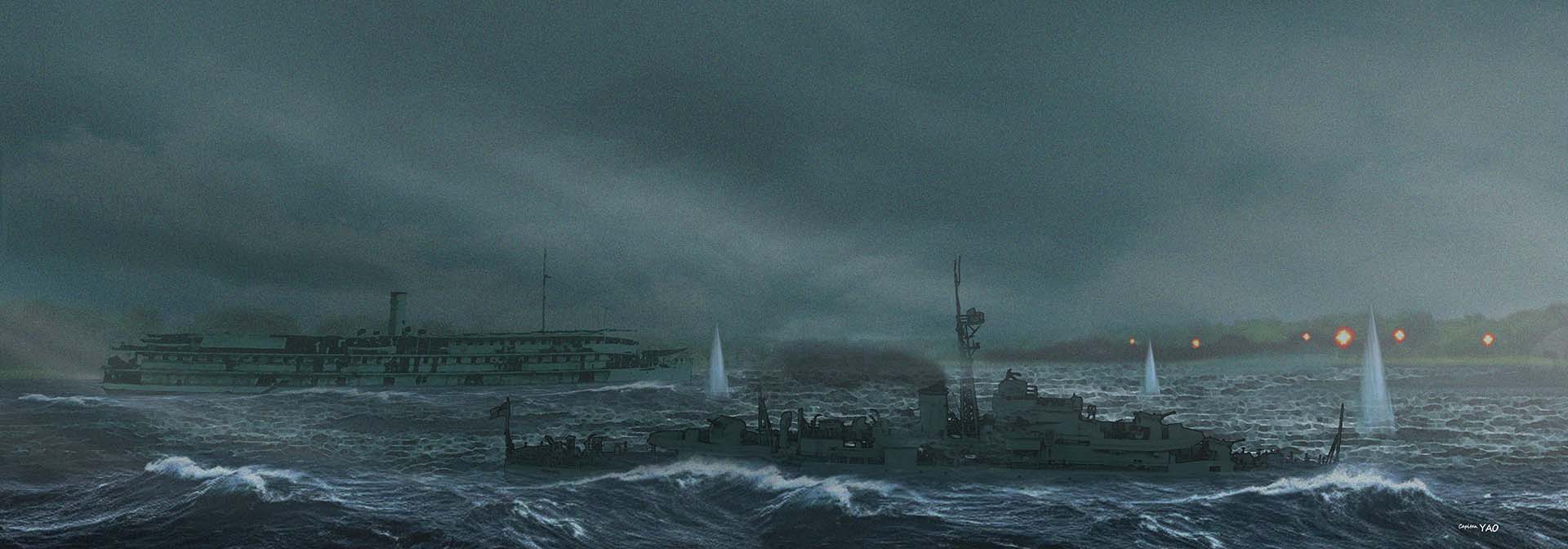
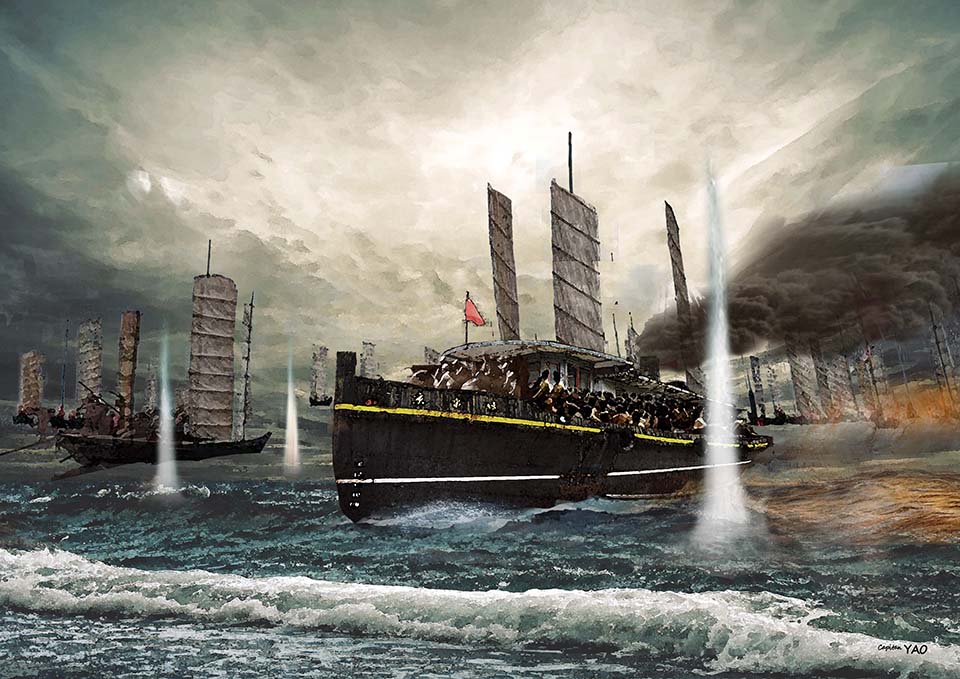
(Figure 6-8-11) "HMS Amethyst" took advantage of the typhoon night and escaped under the cover of the passing the passenger steamship "SS Kiangling Liberation" . The "Kiangling Liberation"? What a coincidence! When news of the "HMS Amethyst"'s escape reached London, the whole of Britain was overjoyed. I think the Chinese authorities also breathed a sigh of relief, because leaving in this way was indeed the best solution to the deadlock. Otherwise, whether the "HMS Amethyst" blew itself up, was destroyed by the PLA's artillery, or was captured by the PLA, it would affect the establishment of normal diplomatic relations between the two sides. London decided to characterize the escape of the "HMS Amethyst" as the personal decision of acting captain Lt Cdr Kerans , thus allowing the British government and the Royal Navy to distance themselves from the matter. The Chinese authorities also tacitly agreed not to pursue the matter further, and neither side mentioned compensation or apologies. A momentous event was thus resolved. On January 6, 1950, Britain, as originally planned, announced its recognition of the new Chinese government and sent a chargé d'affaires to establish diplomatic relations. The entire "Amethyst Incident" resulted in 45 British naval personnel killed, one missing, and 93 wounded, making it the deadliest single incident for the British Navy since World War II. Some of the dead, including Lt Cdr Skinner, the captain of the "HMS Amethyst" were buried at sea, and 23 were buried in a cemetery in Shanghai, where I was also present at the ceremony. The "Amethyst Affair" was touted as a heroic event by the British government, hoping to uplift the spirits of the British Empire in the post-World War II era. The "HMS Amethyst" was warmly welcomed by the local British community along its journey from Hong Kong back to its homeland. British film producers also decided to make a movie about the "Amethyst Affair," and filming began immediately upon the "HMS Amethyst"'s return to Britain. The fact that the decorated ship itself would play a role was a major selling point. However, an overdose of explosives used for special effects during filming damaged the ship's structure, forcing it to be decommissioned after the movie was completed.
|