On October 3, 1948, I accompanied Rear Admiral Chou Hsianchang, Chief of Naval Staff, to the Wusong Naval Base in Shanghai to board the "Chungking" cruiser. Admiral Chou issued an urgent order to Captain Teng Chaohsiang to sail to Tanggu Port in Tiantsin and await orders. I accompanied the ship because I was representing the British Navy to observe the battle and monitor the ship to ensure it did not take any actions that would affect the interests of the British Empire. At 3 PM on the 5th, after the cruiser arrived off the coast of Tanggu, President Chiang Kai-shek, accompanied by Minister of National Defense Hsu Yongchang, Navy Commander-in-Chief Kui Yungking, and his guards, boarded the ship by a small steamer. After inspecting the band and honor guard, he entered the cabin and gave Captain Teng the order to sail to Huludao.
I was also in the cabin at the time. Chiang Kai-shek saw me, frowning and silent. He recognized me, but the presence of a British officer supervising the naval operations on his flagship was probably quite jarring. En route to Huludao, Chiang Kai-shek read the "Code of Conduct for Party Members" to the officers and sailors via the ship's public address system. I listened with other officers in the officers' cabin, and I could see that they all looked expressionless and listless. On the afternoon of the 6th, Chiang Kai-shek disembarked and went to Huludao to inspect the army troops preparing to attack the Communist forces at Tashan. Since that was no longer within my scope of duties, I remained on the ship.
Chiang Kai-shek didn't return to the ship until the next day. Upon boarding, he immediately ordered a return voyage to Tanggu. He seemed displeased, and soon his voice could be heard reprimanding Kui Yungking and Teng Chaohsiang. Chiang, wearing white gloves, had been inspecting the ship and found dust on the instruments, deeming it a sign of lax naval management and erupting in fury. Teng tried to explain, but Kui tugged at his sleeve, stopping him. He retreated, his face flushed and neck bulging, and we met in silence in the corridor. After disembarking at Tanggu New Port, Chiang Kai-shek boarded a special train to Peiping and then flew to Shanghai by special plane.
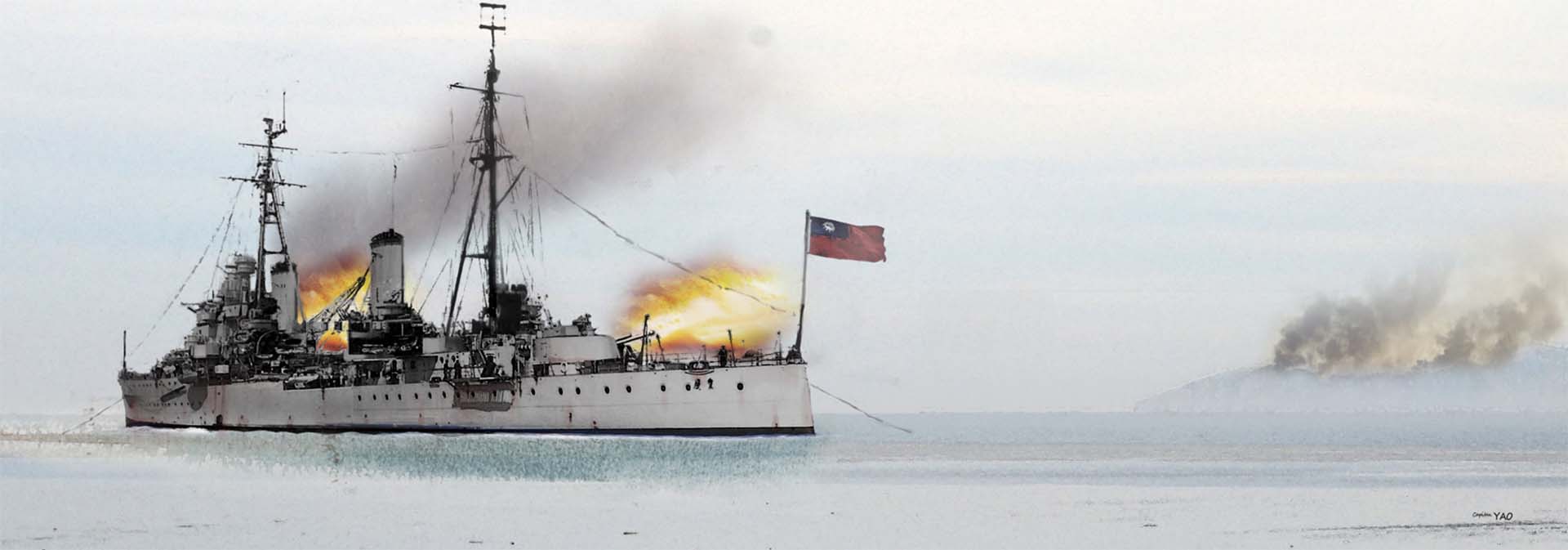
(Figure 6-7-1) The "Chungking" cruiser bombarded the Communist army's positions at Tashan. This operation would eventually target the biggest tiger in Shanghai: Soong Mei-ling's most beloved nephew, Kung Ling-kan, who was also the son of Soong's brother-in-law, former Premier Kung Hsiang-hsi. Soong Mei-ling complained to Chiang Kai-shek, who was torn between his wife and son and had no choice but to interrupt his planned trip to Shanghai to mediate. It's easy to imagine Chiang's anger at such an important military operation being interrupted because of a family matter. Kui Yungking and Teng Chaohsiang became the first targets of his anger. After sending Chiang Kai-shek off, the "Chungking" returned to Huludao. Since Chiang Kai-shek was not present, the task of firing the cannons was taken over by Kui Yungking. Ten days earlier, the "Chungking" had already anchored both fore and aft on the shallow waters off Huludao to stabilize the ship. The gunnery officer had aimed at the location of the Communist army's position on Tashan, a land target, and was waiting for Kui's order. In coordination with the army's actions, the entire ship went into combat readiness on the morning of the 10th. I was also on the bridge watching the "Chungking"'s first actual combat since arriving in China. At this moment, Kui holding binoculars, ordered the guns to fire. The six six-inch guns at the bow and stern simultaneously emitted orange flames, and the shells flew towards the distant land. Seeing a cloud of smoke rise, Kui smiled. After a salvo from the main guns, I saw through the binoculars that tens of thousands of army troops were charging towards the Communist army's positions. Observing the attacking Kuomintang army through my binoculars, I seemed to see the scene of the Japanese army's "Banzai Charge". I couldn't help but ask the army liaison officer on the ship. I learned that the unit was the 95th Division, which was the unit that landed in Kaohsiung at the end of November 1945 and was under the command of Huang Tao's 62nd Army. At that time, the 95th Division recruited many Taiwanese who had served in the Japanese army, so its combat style was very Japanese.
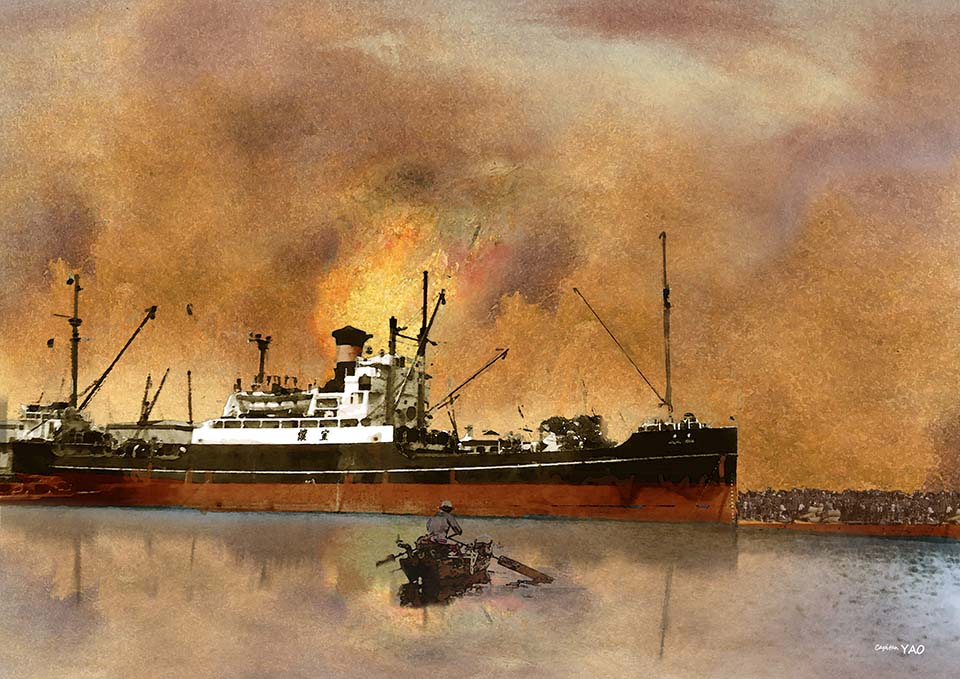
(Figure 6-7-2) The "SS Shuanhuai" was in Yingkou Port when it was preparing to evacuate the 52nd Army, which caused serious casualties.
Kui assumed the Communist positions would crumble immediately. Soon after, an observer reported that the army was beginning to retreat. Incredulous, Kui picked up his binoculars again and saw a large group of wounded soldiers tumbling and crawling down from the Communist lines. Then, the ground Army Commander Chue Hanqian, telegraphed requesting further fire support. Kui furious, personally went down into the gun turret and fired several shots, but to no avail. It turned out the Communist firepower was even more intense than the Nationalist firepower, employing a Soviet Red Army-style "artillery doctrine."
After several days of repeated fighting, the 95th Division suffered more than two-thirds casualties and was no longer able to launch an attack, so it had to retreat. Then the Communist army launched a counter-offensive, and by early November, the Kuomintang army had hastily withdrawn from Yingkou Port.
On the night of November 1st, while the China Merchants Steam Navigation Company's "SS Shuanhuai" was transporting the evacuating 52nd Army in Yingkou, a fire broke out in the bilge of gasoline, which triggered an explosion of ammunition, causing heavy casualties. After the Kuomintang army withdrew, the entire Northeast was occupied by the Communist army.
The "Chungking" returned empty-handed to the Kiangnan Shipyard in Shanghai for repairs. By then, I had already returned to Shanghai. This voyage of the "Chungking" not only failed to complete its mission, but also dealt a severe blow to the morale of the officers and men. Captain Teng also harbored resentment towards Chiang Kai-shek, sowing the seeds for the later defection of the entire ship.

Upon hearing this, I jumped up from my chair and immediately drove off to investigate. On the way to Wusong Naval Port, I kept thinking about it. I had always had this premonition that something would happen to the "Chungking" sooner or later, but I couldn't put my finger on why.
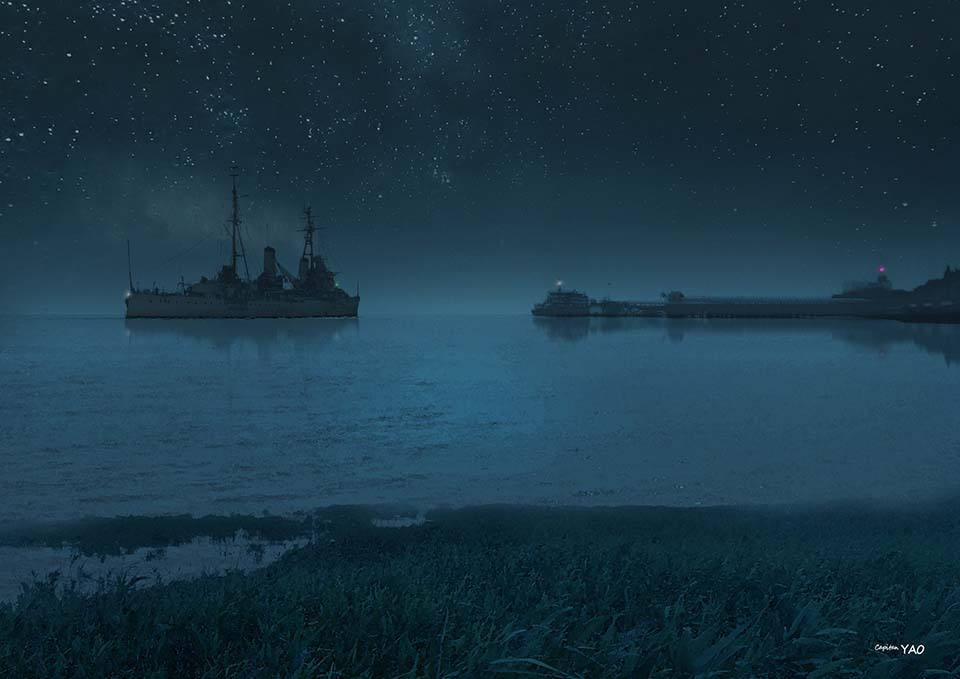
(Figure 6-7-3) The mutineer "Chungking" cruiser secretly sailed out of the Yangtze River estuary.
The defection of the "Chungking" was a bolt from the blue for Chiang Kai-shek, because if the Communist army, which was originally unable to land, were to acquire this warship, the Kuomintang army, which could no longer defeat the Communist army on land, would now be at a disadvantage at sea!
As expected, once news of the "Chungking" ship's defection to the Communists spread, all Kuomintang naval vessels rushed back to port to avoid it, fearing an unexpected encounter at sea. Previously, the Kuomintang army had been confident during the civil war that the Communists lacked a navy, frequently utilizing naval maneuvers, bombardments, resupply, and evacuations along the coast, moving freely and effectively, leaving the Communist army helpless. But now the situation had completely changed. If the Kuomintang navy continued to retreat, even its land-based combat capabilities would crumble.
However, when I arrived at the Wusong base, the situation was not very clear. I only knew that the ship had lost contact after leaving the Wusong base two days earlier, on the morning of February 25. However, according to a report from the U.S. Navy, the ship was found to be near Yantai, Shantung. Since the area was occupied by the CCP and radio calls could not be made, it was judged that the ship had defected to the CCP.
Soon after, Kui Yungking, his face ashen, arrived at the Wusong base from Nanking. He had heard that Chiang Kai-shek had just dismissed him from his post as commander-in-chief, but allowed him to remain in office in an attempt to atone for his crimes. I was there on behalf of the British government, and Kui dared not neglect me, leading me into the chart room to explain the situation.
"The principal ordered me that if I couldn't save the Chungking, I had to sink it," Kui said.
"You absolutely mustn't do that! That's a Royal Navy ship with a distinguished service record!" I protested.
"None of our existing ships can match the Chungking. Once the Communists get their hands on it, we won't even be safe at sea."
"You don't need to worry about that. From what I understand, Captain Teng and his men haven't been trained to fight naval battles at sea. That's different from firing a few shots at Communist positions on land," I explained. "Besides, getting a warship out to sea isn't that easy. I don't believe the Communists can get so much heavy oil for boilers and shells from there. As long as we control the supplies and prevent them from flowing into Communist territory, that ship will be a useless piece of scrap metal in a few months."
"Do you think I don't know all this? The Chungking just completed its annual overhaul at the Kiangnan Shipyard, was fully fueled, and loaded with 1,000 six-inch shells, 500 four-inch shells, and 1,500 machine gun shells!"
I think my words may have touched a nerve with him, as he's been criticized for not understanding the navy. Kui blushed and rattled off a string of words: "Moreover, let alone months, we can't even wait a few days. Several besieged areas rely on our navy for supplies, and the troops need to be moved by ship. If the ships can't go to sea..."
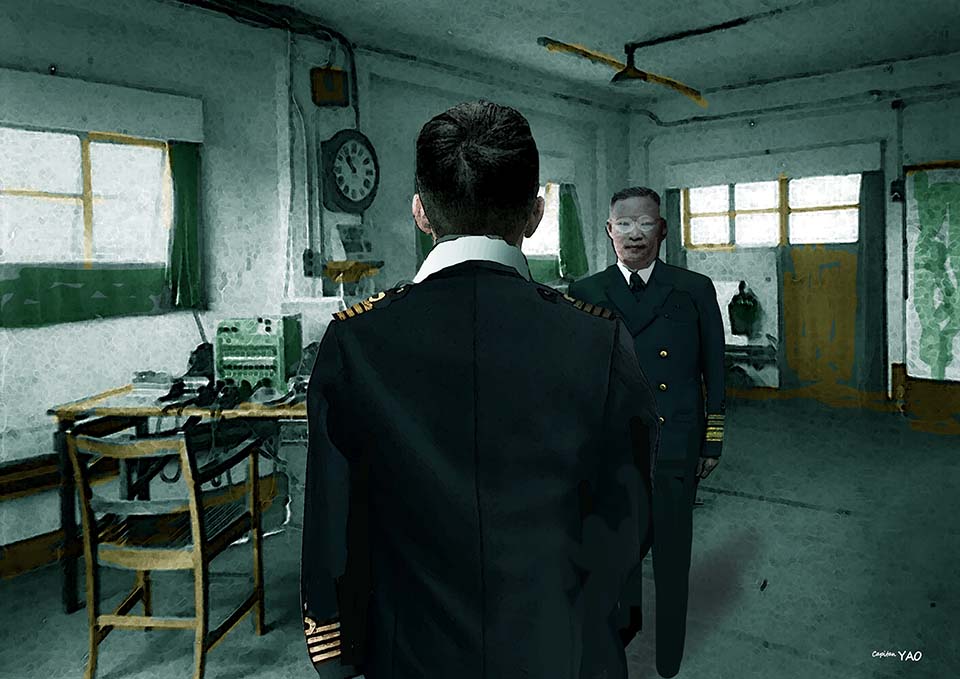
(Figure 6-7-4) Kui Yungking and Paul Draken met in the office of Wusong Naval Base.
Only then did I realize the extent to which the Kuomintang's military situation had deteriorated. It was already dark, and after a long, silent stare at each other in the dimly lit room, Kui finally stammered, "Besides, the bombing of the Chungking was an order directly given to the Air Force by the Commander-in-Chief. What could I, a person awaiting punishment, say?"
"I don't think Captain Teng is the type to defect..."
Upon hearing me mention Teng Chaohsiang, Kui's face suddenly contorted with rage, veins bulging, and he gritted his teeth, saying, "That traitor Teng Chaohsiang, I'll tear him to pieces! And those Fookianese! Alas! I had already planned to replace them all with people from Tsingtao, but I was too late!"
Kui categorized Teng with the Fookian clique. In fact, Teng was from the Canton Navy, having only served as an instructor at the Mawei Naval Academy for a few years. However, like most Fookian officers who had studied at the Royal Naval Academy in the UK, he had his own views on fighting the civil war. When I traveled to China with Teng on the same ship, he told me about the story of Sa Chenping, the Qing Dynasty naval admiral during the Xinhai Revolution in 1911. Sa Zhenbing was also an alumnus of the Royal Naval Academy and had already risen to the rank of commander-in-chief of the Ch'ing Dynasty's naval fleet. During the Wuchang Uprising in 1911, Admiral Sa led the main fleet of China to the Yangtze River outside Wuchang to bombard the revolutionary army inside the city. At that time, the revolutionary army's firepower was completely outmatched.
At this moment, the Han Chinese officers on the ships demanded that Admiral Sa declare an uprising and support the republic. Admiral Sa had been educated in England for many years and naturally understood the true meaning of democracy and republic. However, it was impossible for him to support a civil war. Unable to persuade each other, he chose to leave the fleet and take a small boat to Shanghai to retire.
Teng told me this story. Was he trying to emulate Admiral Sa? He didn't approve of the civil war, but that didn't mean he was willing to lead the Communist army to fight against the Kuomintang, just as Sa was unwilling to lead his fleet in an uprising to turn back and fight the Ch'ing Dynasty. No matter which side he helped, it was still a civil war, so there was no difference, unless he was a fanatical Communist, but I don't think Teng was.
I recommended Teng Chaohsiang to the Royal Navy for his position as captain of the "Chungking" because the case was handled by my classmate, but I never told anyone, including Teng.
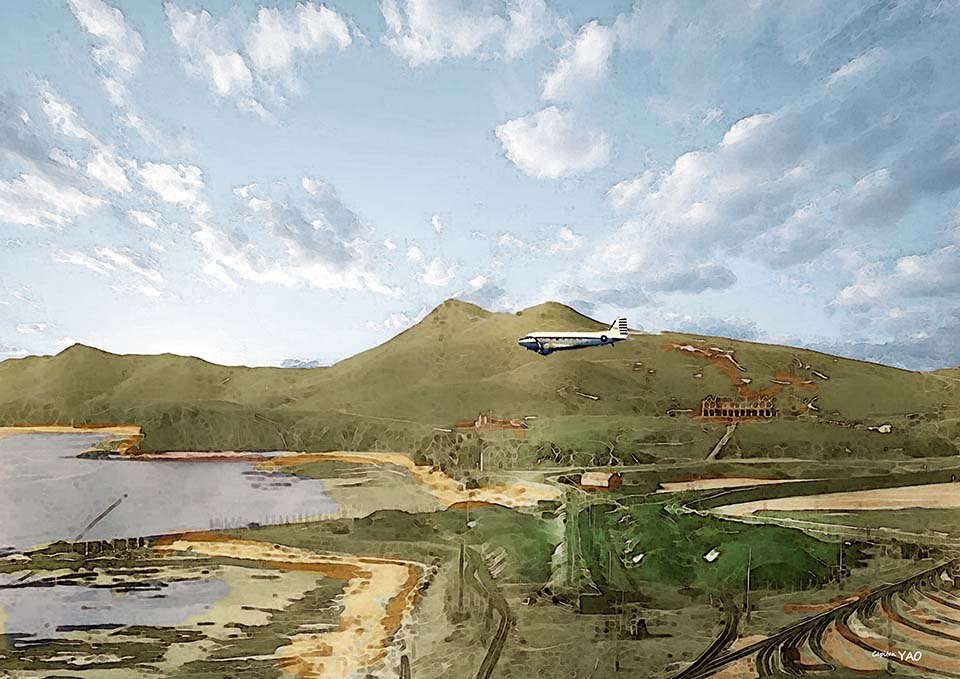
(Figure 6-7-5) An Air Force C-47 transport plane flew slowly at low altitude from the inland area of Huludao towards the port to investigate the whereabouts of the "Chungking" cruiser.
Because the Chinese Air Force lacked experience in bombing naval vessels, the air raid on March 3rd failed. Some veteran pilots, knowing of my experience bombing the Kiangnan Shipyard in Shanghai in 1927 and sinking the "Feiying" on Hainan Island in 1932, suggested seeking my assistance. Coincidentally, I also wanted to personally witness the fate of the "Chungking", so we reached an agreement: I would assist as an advisor in exchange for a set of aerial photographs of the air raid's outcome. Due to my sensitive position, as before, I could only operate in secret, denying everything to the outside world.
The first problem to solve was reconnaissance. After the "Chungking" hid in Huludao, the Kuomintang Air Force went to reconnoiter it every day but could not find it. I suggested that a slow-flying civilian aircraft would be easier to spot and less noticeable. I even offered to fly my own "China Pearl II" to do the reconnaissance for them, but the Air Force declined due to some concerns. In the end, they sent one of their own C-47 transport planes.
On March 16th, I boarded this C-47 transport plane and flew north towards Huludao, arriving in the afternoon. We deliberately chose to enter from the inland direction, as there was absolutely no reaction on the ground, not even a single anti-aircraft shot. The pilot, Major Kiang, seemed bored and got up to go to the back for coffee, leaving me in the pilot's seat. From 8,000 feet above, I looked into the empty harbor with only a few small boats, nothing at all, and felt quite suspicious, muttering to myself, "Such a long pier without a single boat, it looks a bit strange."
Upon hearing my words, Captain Wang, the co-pilot, turned to look out the window and said, "Strange, when did a slanted angle appear at the Huludao dock?"
Have you ever been to Huludao Port?
"Yes! I've fished at the breakwater here before, but I don't think the pier had this angle back then?"
"Let's circle around again and enter from low altitude. I want to take more close-up photos of the dock to take back," I said to Captain Wang. At this moment, the Major Kiang was also called back to the cockpit.
So we circled around again at a low altitude of 500 feet, taking many photos of the pier. Only then did the ground respond and fire a few anti-aircraft shells. After returning to base and developing the film, we found that there was indeed a problem with the pier.
"Look at this!"
(Figure 6-7-6) The camouflaged branches and fishing nets on the "Chungking" are easily ignited.
Under the magnifying glass, I could see glimpses of the white-gray bridge peeking out from under the cover of branches and fishing nets. It turned out that the entire "Chungking" ship had been repainted with black-gray paint, but the unfinished parts gave it away. I also noticed that the camouflaged branches appeared to be pine branches and wheat straw, which gave me an idea.
"Pine branches and wheat stalks, combined with fishing nets, will set on fire if they hit her. If the gasoline in the small boats on the ship hasn't been unloaded, the fire will be difficult to extinguish. But the question is, how can we hit her with the bomb?"
My question is valid. Chiang Kai-shek assigned the task of bombing the "Chungking" to the 8th Squadron. However, the 8th Squadron's B-24 heavy bombers were specifically designed for high-altitude horizontal carpet bombing, and it was not appropriate to use them to bomb warships. At that time, the Chinese Air Force did not have a dive bomber squadron.
Under pressure from Chiang Kai-shek, the Kuomintang Air Force had no time to think about such things. On the 18th, Chen Kiashang, commander of the Second Air Force Region, personally led four B-24s to bombard the area with 500-pound and 1,000-pound bombs, but to no avail. On the 19th, seven more B-24s were dispatched, but still failed to hit the target. The reason was obvious: the massive B-24s dared not fly low. Dropping free-falling bombs from thousands of feet to hit a warship that was only 51 feet wide was like a camel passing through the eye of a needle—absolutely impossible.
I then suggested to Chen Kiashang: "We could send a C-47 transport plane to circle at low altitude to observe the impact point, and then notify the B-24s at high altitude to make corrections. Also, don't follow the lead aircraft's instructions to have the wingman drop bombs with the lead aircraft; instead, make corrections one by one. This might work. The "Chungking" is currently piled high with flammable materials; one hit should be enough!"
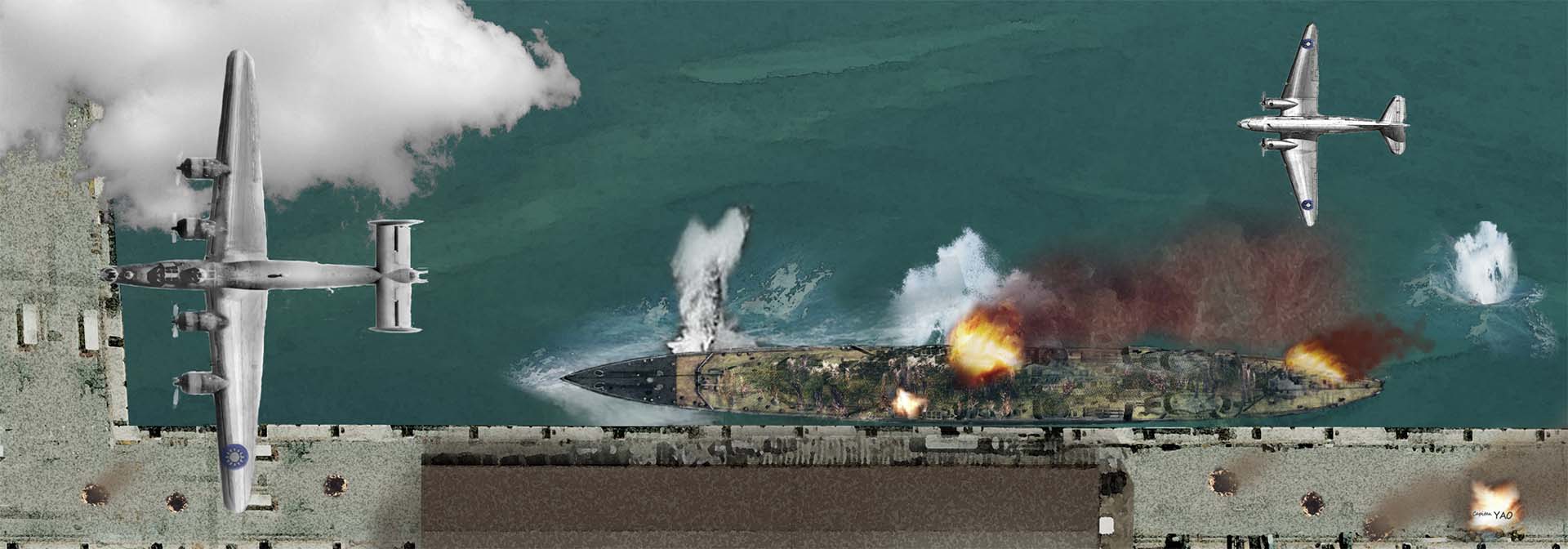
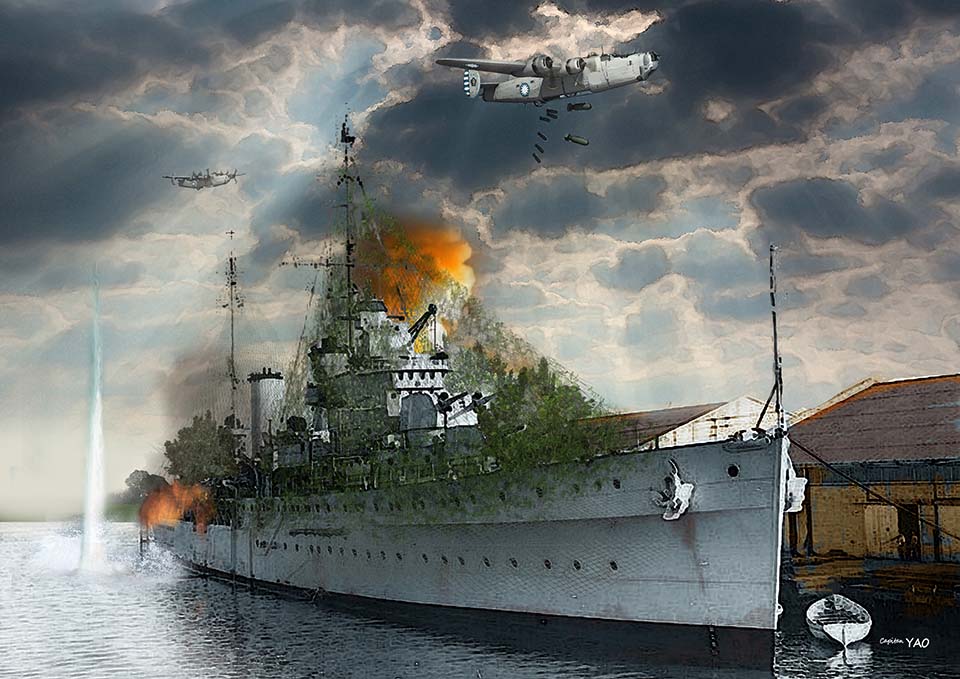
(Figure 6-7-7) Kuomintang Air Force B-24 heavy bombers flew over Huludao Port to bomb the "Chungking" cruiser, while C-47s flew low alongside to observe the impact point. The next day, a reconnaissance plane took aerial photos of the "Chungking", which had been hit and capsized in Huludao harbor. The original was presented to the Kuomintang superiors, and I obtained a copy to send back to headquarters. You can imagine the expressions on the faces of the Senior Admiralty in London after seeing these photos.
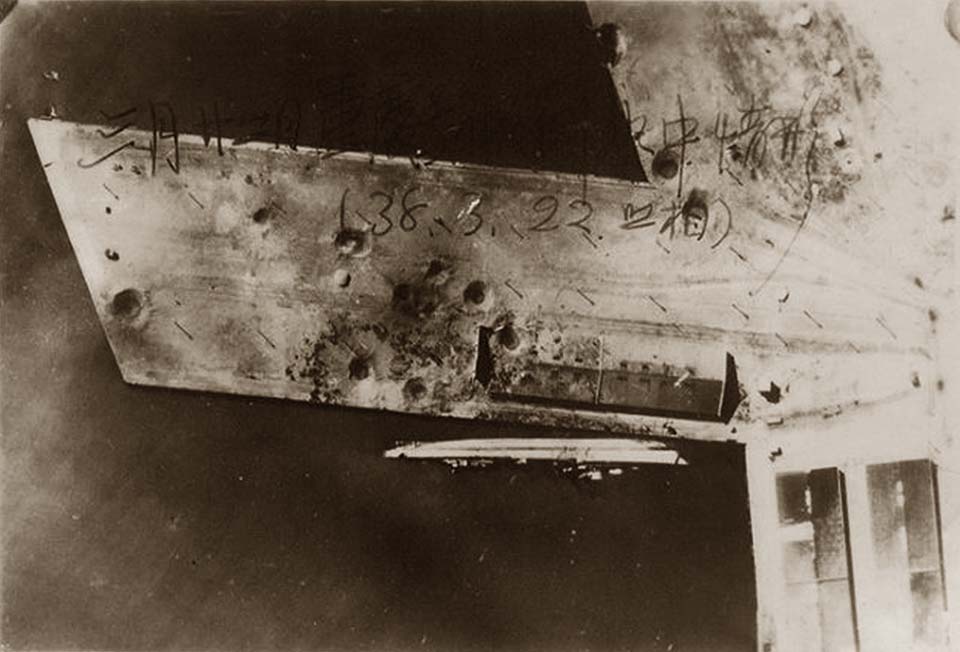
(Figures 6-7-8) A photo taken by the Kuomintang Air Force showing the "Chungking" ship capsizing on its right side in Huludao Port.
The Air Force, of course, wouldn't listen to such words, because they wanted to take credit for it. However, the defection and bombing of the "Chungking" ship had already embarrassed the Kuomintang government, and there was nothing to celebrate. So, no medals were awarded to the Air Force, and the matter was dropped.
In June, our Hong Kong intelligence group obtained information about a former sergeant-in-chief on the "Chongking" who had escaped from Northeast China. A British citizen of Chinese descent, he had originally worked as a car mechanic at Ford Motor Company in Liverpool. He had been hired as a sergeant-in-chief on the "Chungking" and was taken to Huludao with the mutinous ship before escaping from Northeast China to Hong Kong. He was apprehended by us because he needed to obtain a new passport to return to Britain. He brought with him firsthand information about the mutiny on the "Chungking," which helped to unravel many mysteries. The following is his account:
"The twenty-odd men who instigated this mutiny were all soldiers below the rank of sergeant; not a single one was an officer of the rank of lieutenant or above… The main reason was that the captain was neither aware of nor prepared for a 'surprise attack' beforehand, and the mutiny broke out hastily… By the time the other officers and men realized something was amiss, they were already under threat of force and had their weapons disarmed."
"The captain knew they were going to betray the government and defect to the CCP. The captain remained unusually calm and tried to reason with the traitors, but the traitors not only refused to listen, but also said that if the captain did not give the order to set sail, they would blow up the armory and destroy the entire ship. At this critical moment, Captain Teng found that all the ship's telephone communications were cut off and that he had lost contact with all parties. He knew that the traitors had taken control of the entire ship. Finally, under the repeated surveillance and urging of the traitors, he gave the order to set sail."
My guess was right. Captain Teng not only did not cooperate, but also tried to resist, but failed. Mai Huankun also described the situation when the Kuomintang air force bombers attacked: "The soldiers completely lost their will to fight, abandoned their posts and left the ship, rushing ashore in a hurry, fearing that they would not be able to escape quickly enough. The Communist troops on the ship who were still directing the interception of the Kuomintang planes also hurriedly dealt with them. They stopped firing cannons at the planes and immediately set up machine guns to straf the fleeing soldiers. As a result, the ship fell into a state of great chaos."
It turns out the Communist army had hoped these men would fight in the "Chungking," but seeing this situation, they knew there was no hope, so they decided to scuttle the ship to save it for the future. Mai Huankun was the one who carried out the order: "Under the engine department, there is a 'sinking control' department. This department is responsible for managing the ship's emergency repairs and safety water pipes. This department is especially important during combat. I was the head of this department, so this time, the decision was made to scuttle the ship, making me the executioner of the Chungking."
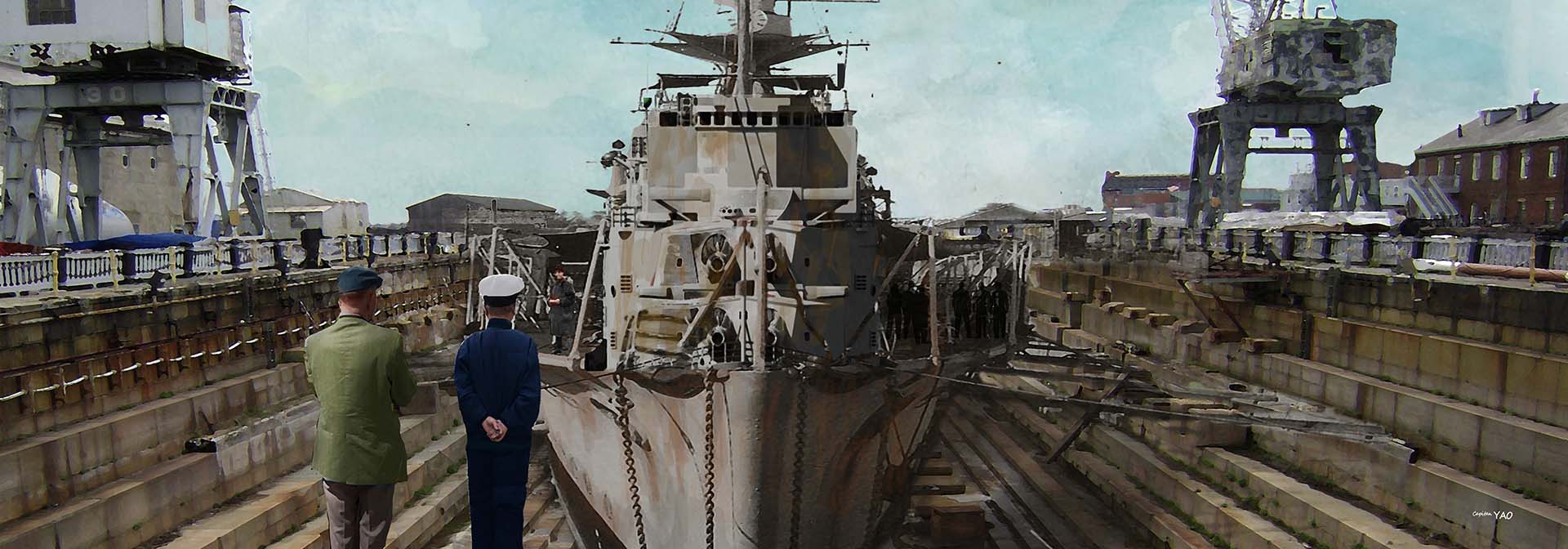
(Figures 6-7-9) After being salvaged, the "Chungking" cruiser was sent to the Dalian Shipyard for repairs. It's a real pity that the famous warship "Chungking" ended its life in such a pathetic way. If the "Chungking" had been in the hands of my mentor Shen Honglie, the outcome might have been different. I think he would have led the ship to sneak into Shanghai under cover of night and catch it off guard, just like in 1927. However, this is just my imagination. The time and space are different, and it is difficult to speculate on history by making assumptions. After all, what happened in history was more due to chance.
As we discussed earlier, the difference between the "Lingfu" and the "Chungking" is that the "Lingfu" was leased rather than donated, and I will begin my research from this point. The "Lingfu" was originally the Royal Navy's escort destroyer "HMS Mendip," which was received and returned to China from Portsmouth Naval Base on May 29, 1948, at the same time as the "Chungking". Since the "Chungking" had already been agreed to be donated free of charge to offset the six Chinese customs patrol vessels requisitioned before the war, the British were unwilling to back down on the "Lingfu" and insisted on changing it to a lease, with the lease term set at eight years.
The "Lingfu" was a Hunt-class escort destroyer, built by Swan Hunter shipyard in the UK. It was launched on April 9, 1940, and commissioned on October 12, 1940. The ship was 280 feet long, 29 feet wide, and had a draft of 14 feet, with a standard displacement of 1,000 tons and a full load displacement of 1,415 tons. Its propulsion system consisted of two heavy oil boilers powered by Parsons turbine engines, twin-shaft propulsion, 19,000 shaft horsepower, and a top speed of 27.5 knots. Armament included two twin turrets with four 4-inch guns, two 40mm Pom Pom anti-aircraft guns, and two Oregon 20mm anti-aircraft guns.
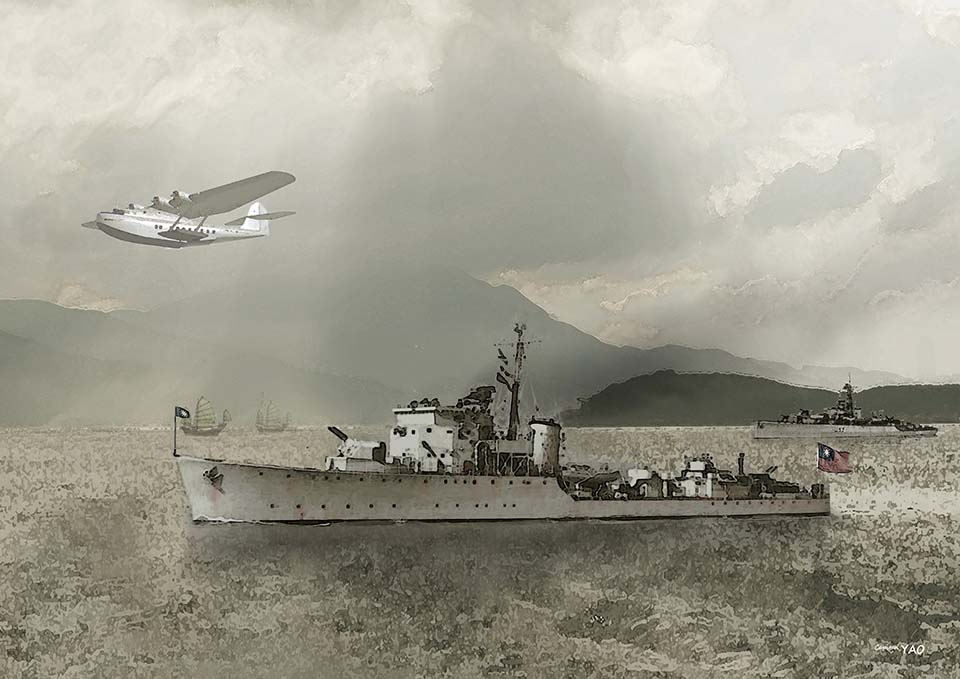
(Figures 6-7-10) The "Lingfu" was ordered to come south from Shanghai to anchor at Baietan in Kuangchow, where it would be kept under the watch of the British Consulate.
At that time, the "Lingfu" had already been ordered by the British to be transferred to the Fourth Naval District in Kuangchow for safekeeping in order to prevent similar incidents from happening again due to the defection of the "Chungking". On March 24, the ship set sail from Shanghai and headed south, and was monitored and escorted by Royal Navy warships along the way. I also arrived in Kuangchow at the same time.
I carefully studied the lease agreement for the "Lingfu" and found several key points. Firstly, if the British needed the ship, it should be returned within three months after notifying the Chinese side. Secondly, any movement of the ship must be notified to the local British consulate three days in advance; otherwise, it would be considered a breach of contract. I felt these two points could be utilized.
The "Lingfu" ship arrived in Kuangchow and anchored on the Baietan River. Its purpose was simply to make it visible to the British consulate on the shore. However, after a few weeks of doing nothing, the crew could not stand it and military discipline gradually loosened. Rear Admiral Yang Yuanzhong, the commander of the Fourth Military Region, saw that this could not continue. So in mid-April, he arranged a training voyage to Hainan Island. Before setting sail, the ship stopped at the Hong Kong naval base for refueling.
"The opportunity has come!" I reported to the local naval commander, Commodore Robertson, in Hong Kong: "Sailing to Hainan Island violates the charter agreement. According to the contract, we can take back the ship. It is currently anchored in Hong Kong for refueling. This is a rare opportunity. Please order its seizure immediately."
"Are you really going to do this, Captain Draken?" The commander asked with some skepticism. "I heard they're going to Hainan Island for training activities, and they already reported it to the consulate in Kuangchow three days ago. Aren't these all within the scope of the contract?"
"That depends on whether we want to take back this warship immediately," I said. "If we do, we should come up with any reason we can find, no matter how far-fetched, as soon as possible. Otherwise, I don't think Kuangchow can hold out for more than a few days. Are we going to ask the Communists for it then?"
Commander Robertson agreed to my suggestion and ordered troops to seize the "Lingfu". Admiral Yang, however, informed Captain Cheng Tiankie that he would refuse to hand it over. The two sides were deadlocked and the situation dragged on for a full month. During this period, the "Amethyst Incident" occurred, which shocked the world. The artillery of the Communist army, which was preparing to cross the Yangtze River, damaged the British destroyer "HMS Amethyst" which was heading towards Nanking, causing the ship to run aground on the riverbank. The next day, the Communist army engaged in battle with the flagship cruiser "HMS London" and the destroyer "HMS Black Swan," which came to reinforce them. Both sides suffered casualties.
Admiral Sir Eric James Patrick Brind, commander of the Royal Navy's Far East Fleet, personally traveled from London to Shanghai to oversee the rescue of the "HMS Amethyst". As the highest-ranking intelligence officer on the ground, I could not abandon my post, so I also left Hong Kong with the Admiral and returned to Shanghai. At that time, Kui Yungking had already fled from Nanking to Shanghai. After assessing the situation, I persuaded the Admiral to raise the issue of returning the "Lingfu" to Kui again. Kui who was already overwhelmed by the mutiny of the Second Fleet in Nanking, had no time for deep thought and immediately agreed and drafted the official document to be handed over to the British.
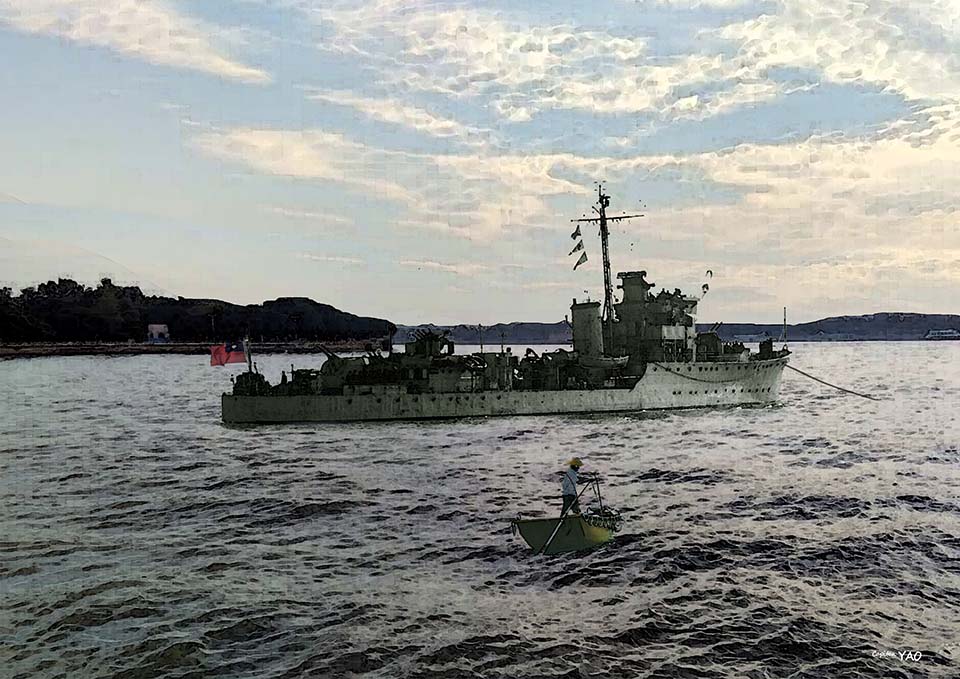
(Figures 6-7-10) The "Lingfu" sailed from Kuangchow to Hong Kong for refueling, but was detained by the British Navy.
I called Robertson in Hong Kong to tell him that the official document and telegram had been sent. I heard him say in a very smug tone, "Great! I'll immediately send my chief of staff to Kuangchow with the document to find Admiral Yang and request immediate handover. Once he sees Commander-in-Chief Kui's document, how could Admiral Yang not obediently comply?"
"Yang Yuanzhong? I'm afraid it won't be that easy."
Yang Yuanzhong was a graduate of the Tsingtao Naval Academy. In June 1932, when he was still a student, he visited Taiwan aboard the "Chenhai" training ship. I was also on board at the time, so we were old acquaintances and knew him to some extent. Soon after, Robertson telegraphed back that Admiral Yang refused to hand over the responsibilities because Kui had not given him direct orders. The chief of staff had been turned away and was on his way back.
"The Chinese value face very much! I think the admiral should invite him to dinner on the flagship; it's only natural to show some courtesy when people meet! Also, as long as we can get the warship back, we can be a little more accommodating with formalities, giving the Chinese officials a way to save face. That should probably resolve the issue." I advised him, "The Amethyst incident is a very complicated matter right now; don't let something as small as getting the Lingfu back affect the bigger picture."
As I had predicted, things unfolded much as I had described. Admiral Berlind invited Yang to Hong Kong for lunch on his flagship. The two sides finally reached an agreement: the British agreed to allow the "Lingfu" to sail around the sea before returning to port, thus avoiding the humiliation of being detained on the Chinese side. The deadlock was thus resolved.
The handover ceremony of the "Lingfu" was held on May 27, 1949, at the Hong Kong base. Rear Admiral Yang and Commodore Robertson jointly presided over the ceremony. Robertsonhad a stern face from beginning to end. Now he finally understood what the Chinese people's face-saving issue was. After the ceremony, Captain Cheng led more than 40 crew to Taiwan the next day. The remaining 73 people had already left Hong Kong to return to the mainland and join the CCP before the warship was handed over.
After being recovered, the "Linfa" was sold by Britain to the Egyptian Navy on November 15 of the same year, initially named "Mohamed Ali El Kebir" and later renamed "Ibrahim El Awal". On October 31, 1956, the Second Israeli-Egyptian War broke out, and the "Ibrahim El Awal" was captured by Israel and renamed "Haifa" to continue serving in the Israeli Navy. This warship, which served under four different national flags, was reportedly decommissioned in 1972.
|