After Japan's surrender, the Allied forces established the General Headquarters (GHQ) in Tokyo, with Marshal MacArthur as Supreme Commander. Originally, all four powers were supposed to send occupation forces to Japan after the surrender, but because General MacArthur, the Supreme Commander, strongly disliked communism and insisted on prohibiting any Soviet Red Army troops from setting foot on Japanese soil, the Soviet Union protested. MacArthur then cancelled the British and Chinese occupation forces, leaving only the US military as the sole occupation force (along with an Australian brigade). Therefore, the British government had to conduct the occupation of Japan through the Allied Commission.
During the Allied occupation, Field Marshal MacArthur was the de facto ruler of Japan, essentially an underground emperor, and even drafted the postwar Japanese constitution; therefore, the Allied Commission effectively became a rubber stamp. British intelligence officers stationed in Japan merely used the Allied Commission's diplomatic status to facilitate their work; the Commission itself had little real power.
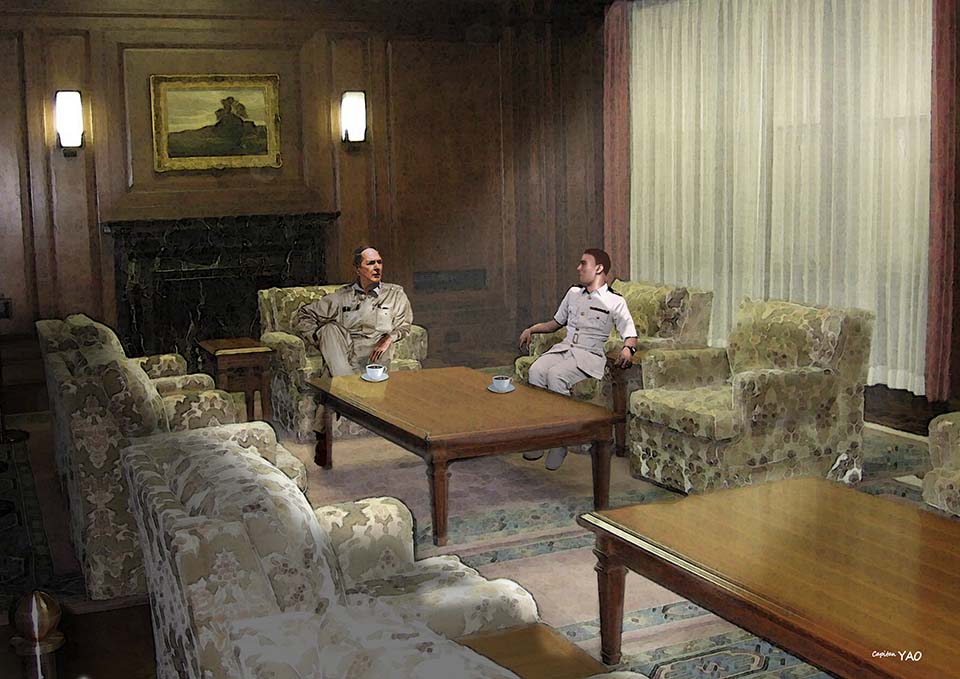
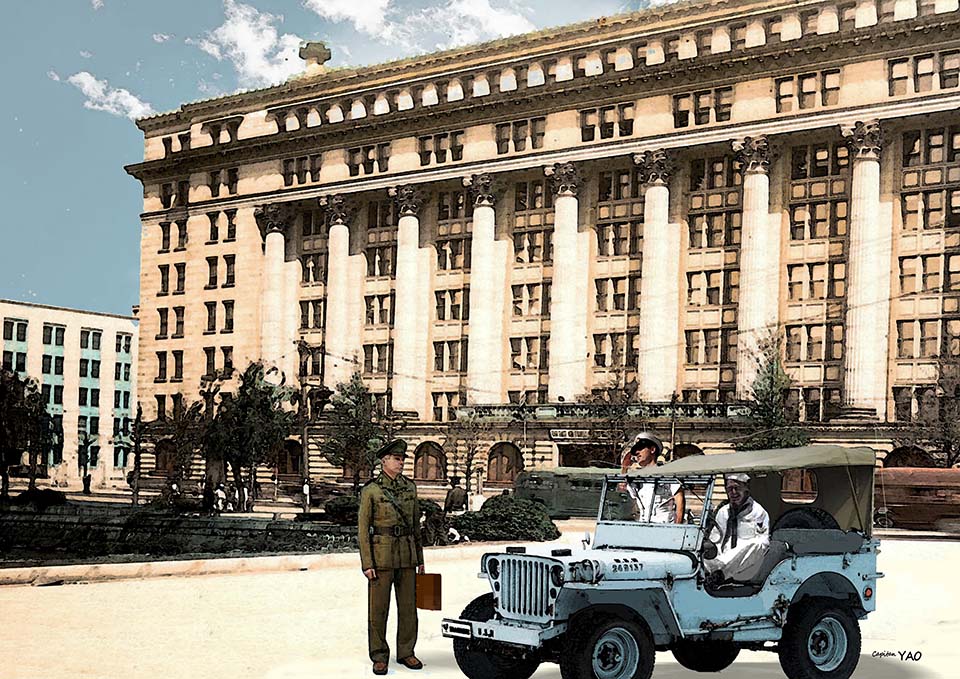
(Figure 6-3-1) Captain Draken met with Marshal MacArthur at the Allied headquarters in Tokyo.
Speaking of Marshal MacArthur, my father was serving as the British Consul in Yokohama when he and his son visited Japan to observe the Russo-Japanese War. As a result, they had known each other for forty years. I took advantage of this connection to visit this "underground emperor," with the sole purpose of seeking some convenience for my work. At that time, the American military controlled everything, and it would have been impossible to move an inch without doing so.
Marshal MacArthur was in high spirits that day. He greeted my father and spoke at length about his views on the Communist Party. During our conversation, I discovered that this "Generalissimo" was somewhat arrogant, and arrogance often leads to a lack of realistic judgment. He reminded me of Churchill, who lost his seat in last year's election. Public opinion is like flowing water; the war had already ended, would the people still need a Generalissimo? Later developments proved I wasn't being overly pessimistic. However, I managed to get him to agree to full support from the US intelligence units, so I could travel freely throughout Japan, which made my colleagues stationed there very envious.
I had a deep understanding of the Japanese Navy before the war. Now that Japan had surrendered, the once-mighty Combined Fleet had long since vanished. With the assistance of American intelligence, many previously classified Japanese documents became available to me, allowing me to analyze and compare them to reconstruct the war records. This sparked my interest in historical research. Although I lacked an academic background in this field, I was fortunate to have a treasure trove before me to explore at will. Some of my Japanese assistants at the time later became experts in this area, writing and publishing books, making the study of the pre-war Japanese Navy a prominent field of study. For example, Shizuo Fukui, a former lieutenant commander in the Japanese Navy's shipbuilding division, had many personal collections and firsthand experiences that greatly helped me.
I also had the opportunity, under the guise of conducting research, to visit various ports and see the Japanese warships that remained after the war. These warships, whose names I had only heard of but never actually seen, were truly awe-inspiring upon first sight. However, at that time, all the Japanese warships had been disarmed; many had been dispatched overseas to repatriate Japanese nationals, and some were engaged in mine clearance work around Japan. I heard that after the repatriation mission was completed, these warships would be distributed among the four nations as war reparations.
I visited Tokyo in 1923 when I was sixteen, just in time for the Great Kanto Earthquake. I also visited Japan several times in the 1930s, so I am quite familiar with the city. At that time, Tokyo, except for the Imperial Palace and its surrounding area, was almost completely razed to the ground by American bombers. Life was very difficult for the Japanese after the war, but for Allied personnel, it was heaven: low prices, high social status, gentle women, easy work, and a place they never wanted to leave.
Unfortunately, my work was mainly focused on China, so I could only come here every one or two months by hitchhiking from Shanghai on an American plane.
Speaking of "heaven" reminds me of Dr. Richard Sorge. I already knew that he was hanged by the Japanese government on charges of espionage before the end of the war. I wanted to find his grave but could not. I could only pray for him to rest in peace, if he believed in God.

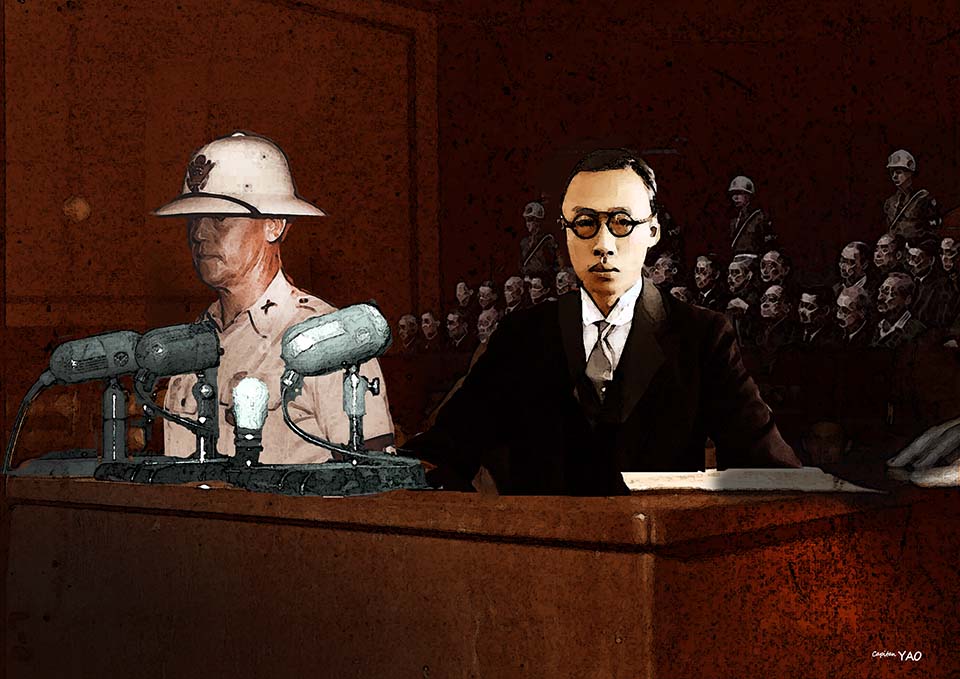
On August 16, 1946, I attended a hearing at the Tokyo Military Tribunal because a very special witness, Puyi, was being summoned. He was being held by the Soviet Union in Siberia at the time and had flown to Tokyo specifically to testify. This was the first time I had seen him since he ascended the throne as Emperor of Manchukuo in 1934—a gap of twelve years. Since I was probably one of the few Allied officers who had interacted with Puyi, and possibly the only one who had known him since childhood, the Allied legal team was extremely grateful. They had requested information from me well in advance so they could use Puyi's testimony to deliver statements detrimental to the Japanese military during their questioning.
(Figure 6-3-2) Puyi's testimony at the military tribunal of the Allied Powers in Tokyo led to Kawashima Yoshiko and Doihara Kenji being sentenced to death by military tribunals in Nanking and Tokyo, respectively.
In court, the opposing lawyers tried to portray him as someone who lied or exaggerated to protect himself, in order to undermine the credibility of his testimony, but Puyi skillfully deflected these attempts. Of course, I knew he was doing it to protect himself; the constant anxiety and double life of the Manchukuo emperor had long since honed his ability to portray himself as two-faced. Testifying in court was a piece of cake for him, but I wouldn't expose him, because we needed to use his testimony to convict the Japanese militarists, and he did that very well.
Getting a chance to attend the hearing was no easy feat, as everyone wanted to catch a glimpse of the emperor. Puyi testified for eight consecutive days, and every day was packed. Scalped tickets for the public gallery were selling for as much as 800 yen each, roughly equivalent to two months' salary for an average person. Because I was an advisor to the prosecution, I was able to get in. Unfortunately, Puyi was taken away immediately after his testimony, and I didn't have a chance to speak with him alone. Even if I had, what would I have talked about? Wanrong? I was the one who made him a cuckold!
Not only in Tokyo, but also in China at the time, large-scale trials for war crimes were being conducted. The targets included not only Japanese soldiers but also so-called "traitors"—Chinese who collaborated with the Japanese during the war. The most prominent representative, Wang Kingwei, had already died in Japan before the end of the war, escaping trial. However, all his officials, high and low, were arrested, and all those of high rank were to be executed. This included Ting Mocun, who was responsible for the killing of Cheng Pingru. Ting originally thought he could escape because of his close ties with high-ranking officials in Chungking. Even while on medical parole, he had the leisure to visit Shuanwu Lake. Chiang Kai-shek was furious upon hearing this and ordered that he be sentenced to death. In fact, Cheng Pingru's death was not at Ting Mocun's behest, but the Central Bureau of Investigation and Statistics (Chungtung) wanted revenge for their precious darling, so Ting Mocun had to die. It is said that when he was taken to the execution ground, his legs went weak, and a bullet entered through the back of his head and exited through his eye socket, shattering his glasses.
The war between China and Japan was not as clearly divided as commonly imagined. Many within the Wang Kingwei regime in Nanking had secret connections to Chungking, and not all Chungking officials remained steadfast in their positions; some frequently defected to the Japanese. This resulted in many "traitors" remaining hesitant at the end of the war, fantasizing about regaining their former wealth and status. Only a very few with foresight managed to escape beforehand, such as Hu Lancheng. Tai Li's banquet in Peiping for all the "traitors," where he announced an arrest list on the spot for a complete sweep, was a classic intelligence operation. However, Kawashima Yoshiko did not attend and thus escaped. Had Tai Li not discovered this and questioned Ma Hansan, ordering his re-arrest, Kawashima might have escaped. Kawashima believed herself to be a Manchu, not a Chinese; since she was not Han Chinese, how could she be accused of being a "traitor"? At this point, Puyi's testimony at the Tokyo Metropolitan Court of Justice was crucial. If he tried to extricate himself by shifting the blame to the Japanese and emphasizing that Manchukuo was established under Japanese coercion, then Manchukuo would be a puppet regime, and the people of Manchukuo would still be Chinese citizens. In that case, Kawashima Yoshiko might not be able to escape the charge of being a "traitor."
Puyi's testimony led to the death sentences of Kawashima Yoshiko and Doihara Kenji by military tribunals in Naning and Tokyo, respectively. Doihara was a very cautious man who had always operated behind the scenes, making it difficult to find evidence of his direct involvement in the crimes. Ultimately, he was convicted of the relatively abstract charge of "war conspiracy," the actual reason being his instigation of the 1931 Manchurian Incident and the establishment of Manchukuo. He was classified as a "Class A war criminal" by the International Military Tribunal for the Far East and executed by hanging in 1948.
In late 1944, shortly after the Allied liberation of France, I rushed to Paris to search the German Naval Code Headquarters. From there, Grand-Admiral Karl Donitz commanded thousands of Nazi submarines lurking in seas around the world via cipher machines. During the search, I discovered some very unusual cables sent by several Nazi submarines that were still stationed in Japanese-occupied ports in the Far East. They mentioned seeing the Japanese loading an astonishing amount of gold and other treasures onto ships while anchored in Singapore and Penang, Malaya. This was because Southeast Asia was no longer safe, and the Japanese wanted to transport the gold to the Philippines for safekeeping, intending to smuggle it back to Japan later. The submarine captain noted that this was said by the Japanese commander who had entertained them after he was drunk; he also mentioned sending several tons as ballast back to Germany!
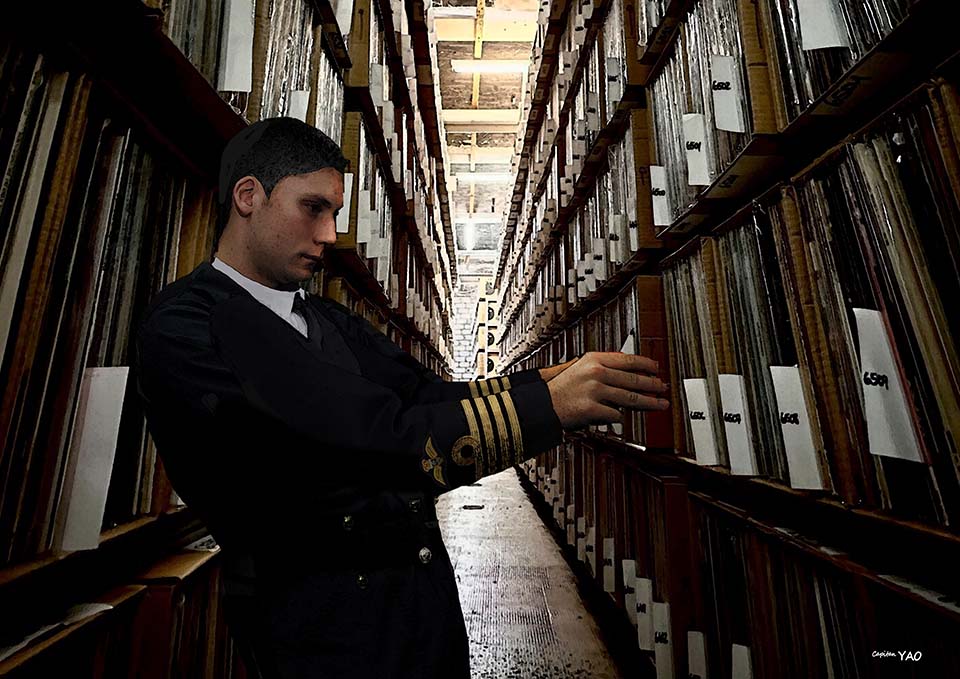
(Figure 6-3-3) Paul Draken is searching for gold documents in the archives of the former Japanese Navy.
At first, I thought this was just the German submarine captain's drunken ramblings. Sending such nonsensical messages to the European headquarters from thousands of miles away using a precious cipher machine would surely have earned him a severe reprimand from Admiral Dunitz. But when I had the opportunity to access the Japanese Navy's intelligence database, I found that I actually found corroborating information.
That was a coded telegram sent from the Japanese commander stationed at the Manila port to Tokyo, stating that the ship had delivered a shipment of important supplies from a certain location on a certain day. The telegram used a very strange code name to describe the supplies, and no one knew what it referred to. It was measured in tons, so some people said it might be tin ore or rubber? But I've seen intelligence reports from German submarine captains in Paris. Comparing the time, location, and especially the ship's name, I believe that the code name refers to gold.
When I used this code name to check other telegrams, I found that there were many similar operations during that period. The total amount of telegrams found was several hundred tons, referring to those that had been safely transported to the Philippines, not including those that were sunk en route.
Hundreds of tons of gold? This is not impossible: I have long known that gold collecting has been popular throughout East Asia, from India and China to Southeast Asia, for thousands of years, and the amount is probably unimaginable. Since 1937, the Japanese have plundered an unimaginable amount of gold in mainland China alone. After 1941, the occupied territories, including Hong Kong, Vietnam, Burma, Singapore, Malaya, and Indonesia, were also major gold collection countries. The Japanese even sent special financial officials to oversee these places, systematically looting them, causing the wealth accumulated by these countries over thousands of years to be plundered by the Japanese overnight.
According to the data, some of the gold was transported to the Philippines but for various reasons it was not able to be transported out and was buried on the spot. I also found that a batch of about 40 tons of gold and 12 tons of platinum, plus an astonishing number of diamonds, was shipped directly from Singapore, but they did not reach the Philippines or Japan. Most likely, they were sunk by a US submarine en route. I remember the name of the ship, "Awa Maru". I will mention the details later.
At that time, many countries had begun to demand the return of wartime looted property from Japan, but Tokyo responded invariably that there was no evidence to support their claims. In fact, the Japanese government after the war probably did not know the whereabouts of this batch of gold, because in the chaotic period before and after the end of the war, many officers in charge either died in battle or committed seppuku, and few people knew that these documents existed, and even if they did, they did not understand what the codes on them meant.
I secretly took photos of the documents and smuggled them out. At the time, the American intelligence officers stationed in Japan only knew how to arrest Japanese war criminals and hang them during the day and sleep with Japanese women at night. No one was willing to spend time like I did on these piles of waste paper, so they never cared what I was doing inside. Sometimes they even mocked me for being crazy.
After the war, a craze swept across various regions for digging up Japanese treasures or salvaging gold-bearing shipwrecks, but very few were truly successful; most were scams perpetrated by fraudsters to lure investors. Although I possess authoritative information, it doesn't mean I can immediately travel to the Philippines to dig for treasure. That's no easy task. For now, I can only keep the information safe and patiently wait and observe
p>
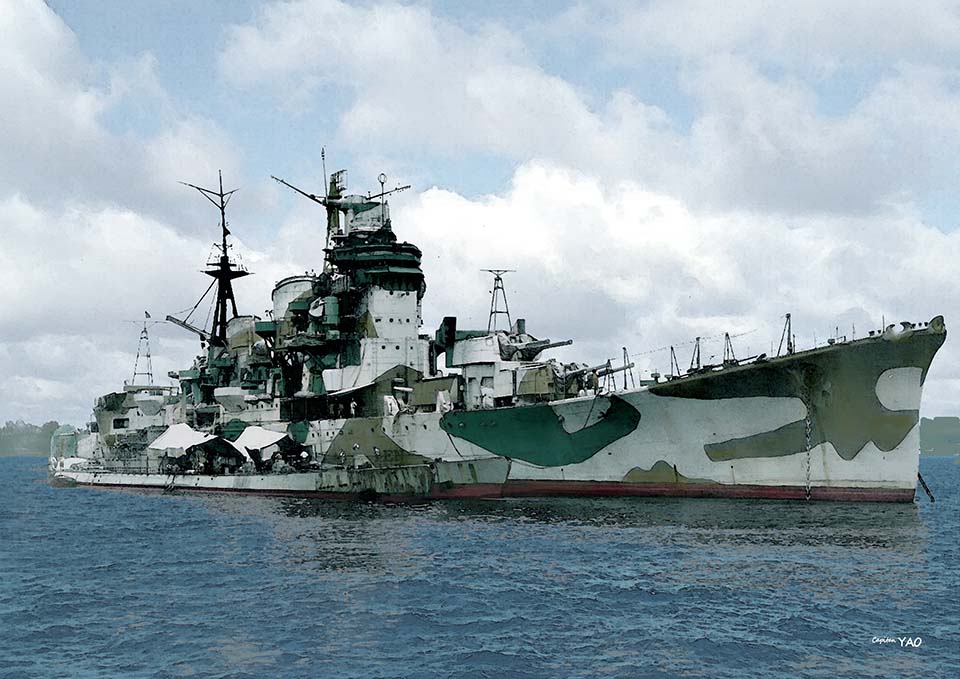
(Figure 6-3-4) After Germany surrendered, the submarines "U-181" and "U-862" were taken over by the Japanese Navy in Singapore and renamed "I-501" and "I-502" respectively, moored next to the heavy cruiser "Myoko".
While comparing German and Japanese archival materials, I paid particular attention to the submarine "U-181". In 1944, she traveled thousands of miles from Europe to the Far East, using her massive hull to carry unidentified supplies to and from various ports in Southeast Asia, and to exchange goods with Japanese ships. The cargo transported by a submarine was certainly not ordinary; it was either important strategic materials such as uranium for making atomic bombs, technological equipment such as radar and related blueprints, or high-value valuables such as gold. "U-181" was seized by Japan in Singapore in May 1945 after Germany's surrender, and her crew was imprisoned in a prisoner-of-war camp. "U-181" was renamed "I-501" and joined the Japanese Navy. After Japan's defeat, it was taken over by the British and scuttled.
One of the officers on board, Otto Giese, had a legendary life. He had previously served on the German ocean liner "SS Columbus", which was surrounded and scuttled by the Royal Navy in the Caribbean when the war broke out. Passengers and crew were taken away by American warships, but Giese and some crew members escaped and crossed the American continent to board a Japanese ocean liner in an attempt to return home to fight. They were intercepted by Royal Navy cruiser off the coast of Japan in what is known as the "Asama Maru Incident."
Giese left behind a lot of eyewitness accounts and even photos of the U-181's combat patrols in the Far East and its contact with the Japanese, which were very helpful to my investigation. After the war, I met him in Germany. In addition to learning about the rumors of Japanese gold in Southeast Asia at the end of the war, he himself was the one who operated the cipher machine on the submarine, so we had common topics. At that time, I also encouraged him to write and publish his legendary experience.
I also helped China recover another naval-related item, not a ship, but the anchor of the "Chenyuan". The "Chenyuan" and "Tingyuan" were German-built ironclad warships, and were the two most powerful warships in the Beiyang Fleet at the time. In 1895, at the end of the Sino-Japanese War, the Beiyang Fleet was besieged by the Japanese army in Weihaiwei. The "Tingyuan" was hit by a Japanese torpedo boat and ran aground in the bay. It was later destroyed by the Ch'ing army itself, while the "Chenyuan" surrendered to Japan along with another Beiyang Fleet warship. 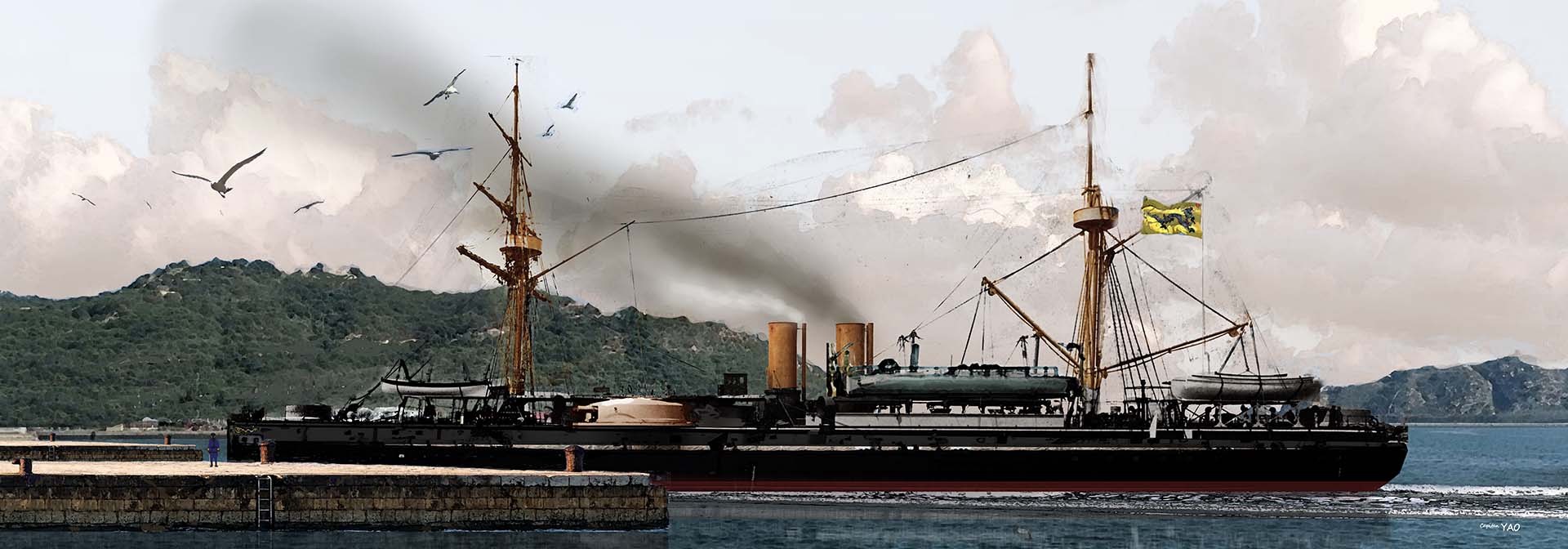
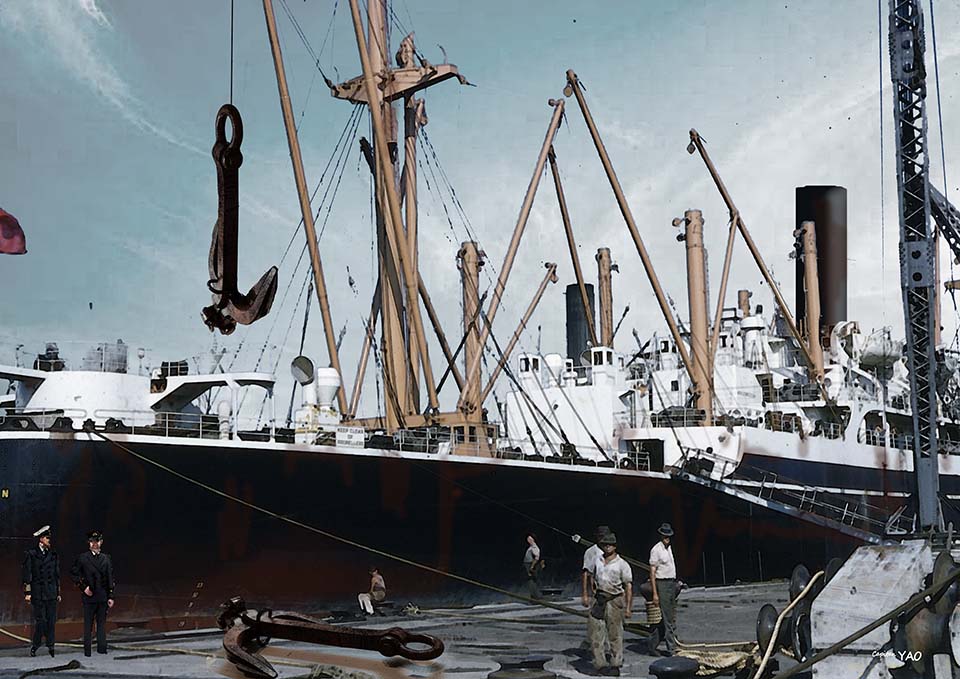
(Figure 6-3-5) The "Chenyuan" ironclad battleship during the Beiyang Fleet era in Arthur Port. This matter was handled by Lieutenant Commander Chung Hanbo, the naval attaché of the Chinese military delegation, but it was flatly rejected by the US naval commander of the Second Allied Group. The reason given was identical to Churchill's response to Chiang Kai-shek's demand for the return of Taiwan after the war at the Cairo Conference: the return of items should only be limited to those related to the current war, and should not be retroactive to settle historical scores. I had frequent dealings with the Chinese delegation, and Lt. Cmdr. Chung recognized me. On one occasion, he brought up this issue and asked for my opinion. I thought to myself, if the spoils of the Sino-Japanese War cannot be reclaimed, then logically Taiwan should not be returned to China either, since they were both consequences of the same war. Now that Taiwan has been returned to China, returning the anchor is not without precedent. The negotiations at the Cairo Conference clearly demonstrated this. Unless the Allied military officers in the US disagreed with their own president's decision, could China also overturn its promise to leave Hong Kong under British administration? Is this a responsibility that a mere captain could bear?
(Figure 6-3-6) The two anchors of the "Chenyuan" and "Kingyuan" were transported from Tokyo to Shanghai, China by the merchant ship Longshun, which was returned by Japan.
However, I couldn't let Lt. Cmdr. Chung use that reason to appeal; it would raise suspicions of leaking the contents of the Cairo Conference. Although everyone knew that Taiwan had been returned to China, the negotiation process was still classified, and I didn't want to take that risk. I decided to go to MacArthur. If I could get things sorted out internally first, Lt. Cmdr. Chung, as long as he had a plausible reason, shouldn't be given any trouble. Chung said he wanted to persuade me by arguing that "to prevent the resurgence of militarism, it must be eradicated at its source, not just limited to this war."
I actually went to MacArthur and explained the above reasoning to him. He hadn't expected the matter to be so far-reaching. Since that was the case, insisting on those so-called principles was meaningless, so he immediately ordered the passage. The next day, Chung went to the Second Group of the Allied Command again, intending to appeal, but the officer on duty told him that it was already going through the administrative process, and he hadn't expected it to be completed so quickly. The anchors, anchor chains, and ten shells from the ships "Chenyuan" and "Kingyuan" were handed over at the Shibaura Wharf in Tokyo on May 1, 1947. The anchor chains and shells were transported back to Shanghai, China by the customs anti-smuggling ship "Feihsing" and the two anchors were transported back by the merchant ship "Longshun." Chung and I watched the two ships leave at the wharf. These two ships had also been captured by the Japanese during the war and returned after the war. The anchor of the "Chenyuan" was first placed at the Tsingtao base and later moved to the Military Museum in Peiking for display.
I later learned that the "Chenyuan" actually had another anchor still in Japan, and many of the "Tingyuan" battleship's relics were also in Japan, including the rudder, railings, and doors. However, since the "Tingyuan" was salvaged after the war by the Ch'ing government itself, and a Japanese company won the bid, it was a private commercial activity. All the salvaged items belonged to private individuals, and the government had no right to claim them.
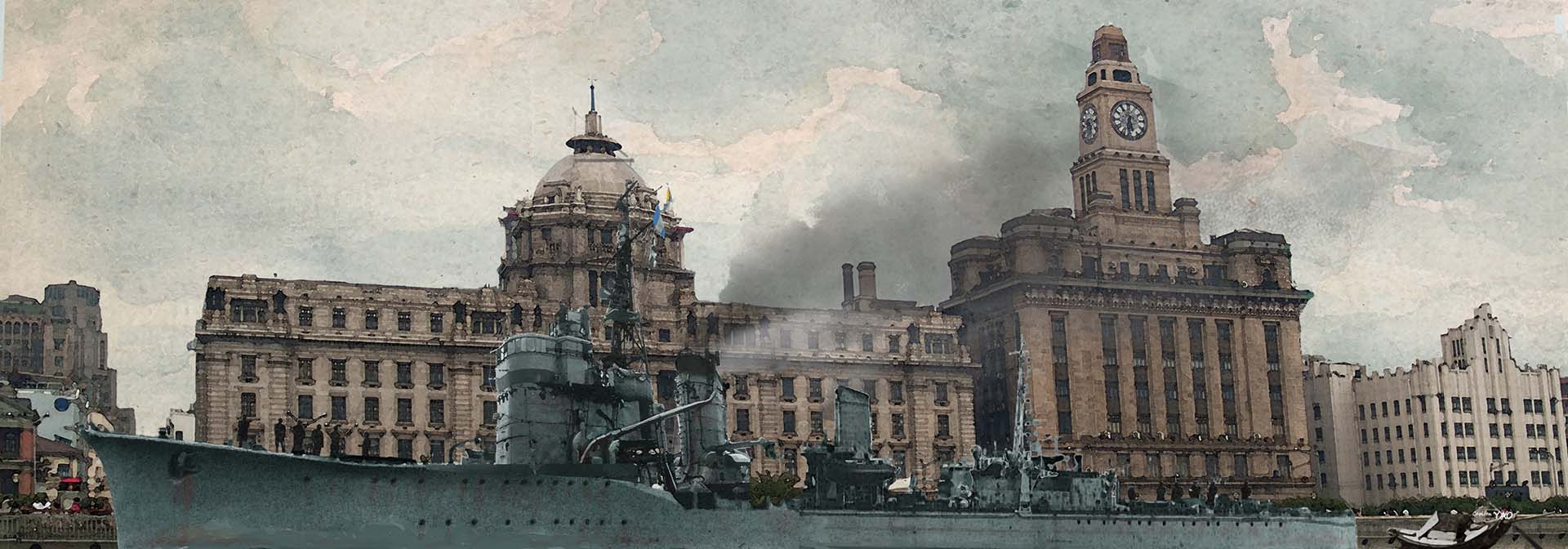
(Figure 6-3-7) The unarmed destroyer "Yukikaze" was brought to the Kiangnan Shipyard in Shanghai by Japanese crew members and is passing by the Bund.
My naive idea was immediately dashed by my superiors: "Kui Yungching? He can't even take care of a small boat, how could he possibly manage so many warships?"
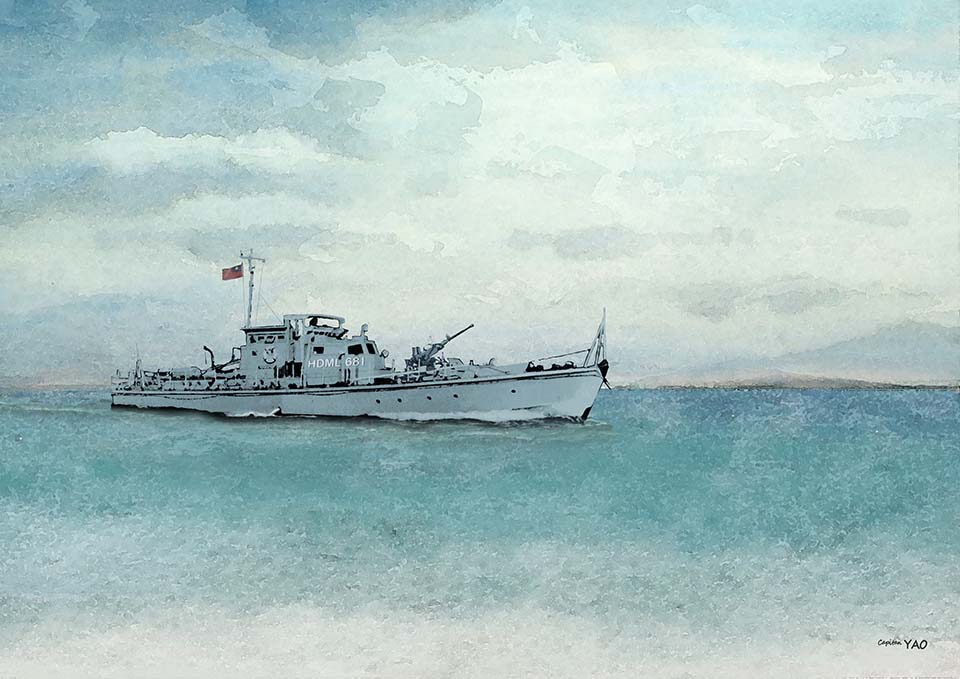
(Figure 6-3-8) The HDML harbor defense vessel donated by the United Kingdom to China.
It turned out that this was right after the "Fu Po" incident, when Rear Admiral Fang Ying was making accusations against the outside world, and London had already begun to lose trust in Kui Yungching. I thought that if the British were unwilling to even do this favor, the prospects for subsequent British ship donations would be even less optimistic, and this proved to be true in hindsight. The British originally planned to donate the 5,500-ton light cruiser "HMS Aurora", the 1,400-ton escort destroyer "HMS Mendip", two "T"-class submarines and eight HDML harbor defence boats. The HDMLs had already been transferred to Shanghai by cargo ship at the end of 1946, and the Chinese officers and men who received the other ships had already been training in Britain for two years. Therefore, when news came from London that the transfer of subsequent ships would be cancelled, it caused a great shock to the Chinese side. The two sides began diplomatic negotiations, and I was immediately pushed to the front line.
Since "HMS Aurora" was a decorated ship of the Royal Navy during World War II, London was very cautious and unwilling to give in easily. The Chinese side, on the other hand, pointed out that six Chinese customs patrol ships were anchored in Hong Kong before the outbreak of World War II and were requisitioned by the British military. If Britain broke its promise, it would demand the return of these six patrol boats.
I was aware of this matter. The six Chinese customs patrol ships fled to Hong Kong during the Shanghai Incident in August 1937. They were requisitioned by the Hong Kong government during the Battle of Hong Kong in late 1941. Some were sunk during the war, and others were captured by the Japanese and their whereabouts are unknown. It was impossible to demand their return to their rightful owners. After hearing my explanation, London had no choice but to agree to donate the light cruiser "HMS Aurora" free of charge as originally agreed, in exchange for China not claiming compensation for the loss of the six customs patrol boats. This was the later cruiser "Chungking".
The British were no longer willing to provide "HMS Mendip" as a grant, and instead opted for a lease, meaning they could terminate the lease and reclaim the ship at any time. This ship later became the escort destroyer "Lin Fu". As for the two "T" class submarines, the grant was cancelled altogether, and all trainees were sent home.
As for the 34 Japanese warships received by China as reparations, many were abandoned in ports or waterways due to a lack of repair technology and sufficient operators. They were not until 1949, when the Kuomintang retreated to Taiwan. To avoid giving them to the enemy, most of them were towed to Taiwan. Because the Kuomintang and the Communist Party were facing each other across the strait and needed a large number of ships, they managed to repair and put them back into service. However, due to a lack of materials and technology, their condition was not good. In addition, with the start of the Cold War, the United States resumed aid and provided American equipment. These Japanese warships were regarded as worthless by the Kuomintang Navy and were decommissioned very early.
Boxer's position at the Far Eastern Commission was recommended by George Sansom, who was also the British representative of the Commission. So I met him in Tokyo. After talking with him, I discovered that he and my father had come to Japan at the same time in 1904. My father was a staff member at the consulate in Yokohama, while he studied Japanese at the legation in Tokyo and later became one of the earliest Japanese experts in Britain. Boxer followed in his footsteps. Boxer said he was fascinated by Japanese culture from a young age. After graduating from military academy, he participated in a three-year exchange program with Japan, serving in the 38th Infantry Regiment in Nara and the Army Officer School in Toyohashi. In 1933, he obtained his official Japanese interpreter qualification. He was also fascinated by Japanese judo and kendo. While in Japan, he learned about the history of early contact with the Portuguese and Dutch, which sparked his interest, leading him to study and learn Portuguese. He frequently published academic papers on Portuguese trade in East Asia during the 16th century, gradually gaining renown in the field. He also collected many historical manuscripts and books, storing them in Hong Kong. This is precisely why Boxer was willing to work for the Far Eastern Committee in Tokyo, as his collection was looted by the Japanese during their occupation of Hong Kong in late 1941 and transferred to Japan, where it is now housed in the Tokyo Imperial Museum. Boxer came to Tokyo to take up his post to reclaim these collections, and ultimately, he succeeded in recovering most of them. It was then that I learned that his reluctance to escape with us on a torpedo boat was not only due to injury or Emily Hahn's recent childbirth, but also partly because he couldn't bear to part with these collections.
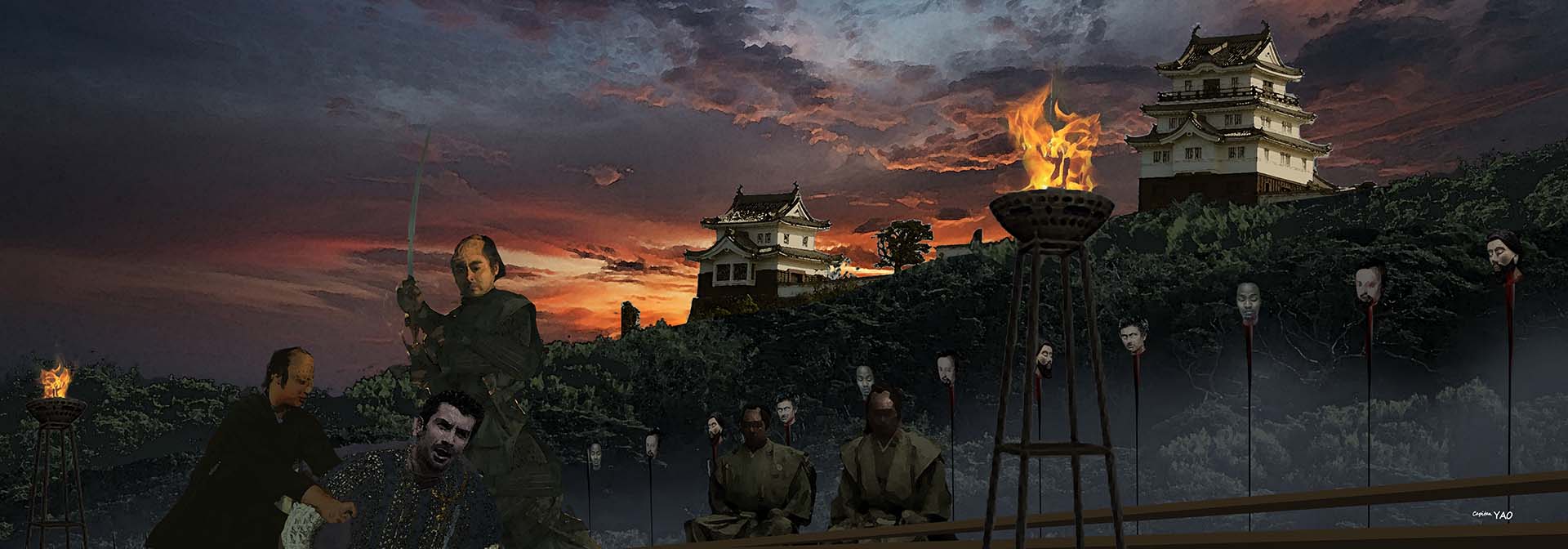
Boxer once told me that the reason he began studying Portuguese maritime history in Japan was because he first heard about a historical event there that he would never forget. In 1640, a ship from Macau arrived in Nagasaki on July 6th, carrying 61 Portuguese and 13 Lascar sailors. The main figures were four high-ranking representatives of the Macau municipal council, who carried official documents to the shogunate, intending to express the Portuguese's commitment to trade only and not missionary work. To the West, this was the rank of diplomatic envoys carrying official credentials on a formal visit. However, upon arrival, all were imprisoned by the shogunate and immediately ordered to be executed. The 61 Portuguese were beheaded one by one, their heads pierced every 6 feet with an iron spear and erected on a high platform, while their bodies were buried in a cave. All goods, clothing, and silver coins, along with the ship, were towed back to the point of initial entry, burned, and sunk to the bottom of the sea.
(Figure 6-3-9) In 1640, the Japanese shogunate beheaded 61 Portuguese from Macau, 4 of whom were senior representatives of the Macau Municipal Council. The heads of these Portuguese were pierced with iron spears and stood upright on a platform at 6 feet intervals. This reminded me of Vice Admiral Sakonju Naomasa, the man whose crew of the British merchant ship "Behar" was beheaded en masse. I discovered that he was now living in seclusion in Japan. So I reported to headquarters and obtained authorization to represent the British government in filing a complaint with the Allied prosecutor, requesting that he be extradited to Hong Kong for trial. He was indeed sentenced to death by a military court in October 1947 and hanged in January 1948.
(Figure 6-3-10) When Boxer resigned from his military post and left the Far Eastern Committee of the Allied Powers in Tokyo, Paul Draken came to help him move.
When I was in Tokyo, it was always Boxer who took me to places with good food and fun activities. His fluent Japanese made things much easier. Boxer is three years older than me, so I privately consider him an older brother, but in formal settings he has to be very respectful to me because he's only an army major, while I'm a navy captain—it's a requirement of the system, which makes me feel quite embarrassed. Back in Hong Kong, we were both majors, with him being slightly more senior than me. However, because he spent time in a POW camp during World War II, he couldn't be promoted, so he's still a major at forty-three years old and probably won't have any opportunities in the future, which is why he's considering retirement.
Just then, the Camões Professorship in Portuguese Studies at King's College London became vacant, and Boxer was invited to take the position. This was a rare opportunity for him, as Boxer didn't even have a university degree and was entirely self-taught. To seize this fleeting opportunity, he decided to leave his military post, but this would mean he could no longer work for the Far Eastern Commission. Boxer recommended me to succeed him, but this was opposed by headquarters in London, who believed I was more useful in China. I suspect this was probably Mr. M's doing behind the scenes again.
Boxer told me privately that he didn't actually want to return to England, but the opportunity was too good to pass up, so he reluctantly agreed. I asked him where he liked the place most, and he said Hong Kong. Indeed, Boxer spent his golden years in Hong Kong, where he met Emily Hahn, and his research is inextricably linked to Macau. Every middle-aged man has a place that haunts his dreams; for Boxer, it's Hong Kong, and for me, it's Shanghai.
When Boxer left Japan in mid-1947, I happened to be in Tokyo at the time and went to the airport to see him off, promising to visit him and Emily on my next trip back to England. In October of that year, Boxer officially became Professor Camões, beginning the second chapter of his life. Under Boxer's guidance, I later also began studying the history of the East during the Age of Exploration. Unlike Boxer's focus on Japan and Portugal, I focused more on Spain, the Netherlands, and Britain in Taiwan, because I developed closer ties with Taiwan after the 1950s. Historical research has had a great influence on my work because it has enabled me to see the macro background behind events.
|