I left London at the end of 1944, traveled through the Mediterranean, the Middle East, and India, and flew over the Hump back to China. This journey was much safer than when I returned to London at the end of 1943, but the busy military transport made the journey difficult. As a result of the frequent stops and starts, I did not arrive in Chengdu until the beginning of 1945.
The Kuomintang Air Force Staff School in Chengdu wanted me to come to the school as an assistant instructor and translator. At that time, there were already five Royal Air Force instructors teaching at the school, and there were no British officers in Chengdu who were pilots and understood Chinese. That was why they urgently needed me. Actually, I didn't have a formal training in air force command and staff, but I took the opportunity to learn from the instructors and improve my knowledge.However, I alone was not enough. In Chengdu, we also recruited a group of translators from local universities. I was the chief examiner. I remember that among those who were recruited was a student from the Journalism Department of Yenching University named Larry Wu-Tai Chin. He left us after the war to serve the Americans and eventually worked for the CIA. He had quite a bit of a connection with me.
My experience at the Air Force Staff School enabled me to maintain good relations with high-ranking officials in the Kuomintang Air Force. These officers who came for training were key talents cultivated by the government to become leaders in the Air Force. In China, the teacher-student relationship is second only to that of father and son. Even teaching assistants are "teachers." Since I became their teacher, they had to respect me, which made things much easier for them.
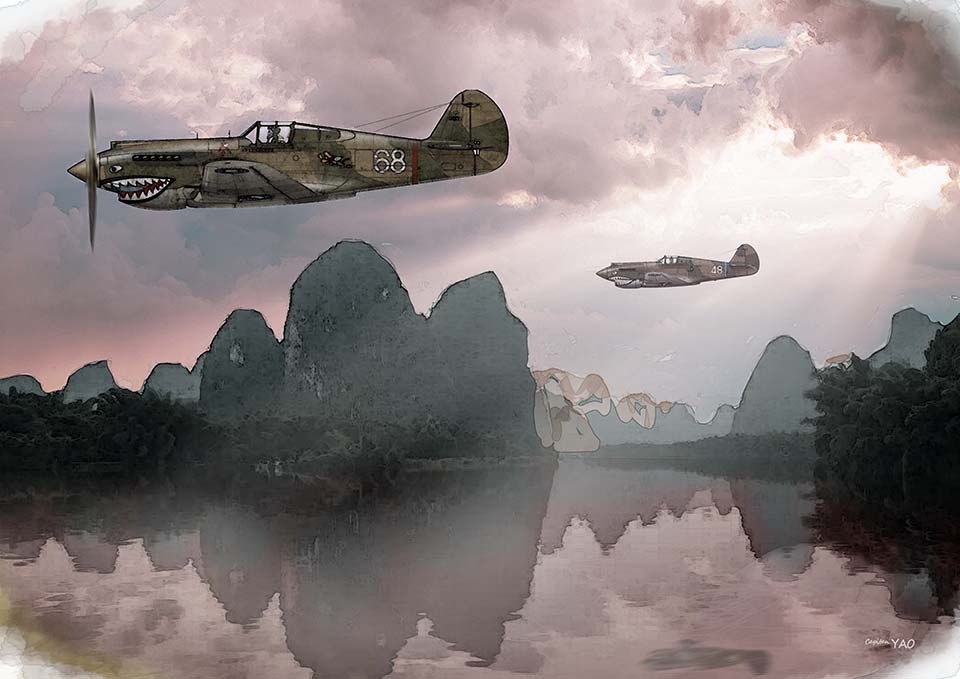
(Figure 5-9-1) The American Volunteer Group (AVG), along with the image of the "Flying Tigers," was incorporated into the 14th Air Force of the United States Army.
I was temporarily seconded to MI6 by the Royal Air Force. Since British intelligence wasn't doing much in China at the time, the higher-ups probably didn't care about letting me go. Although many of my classmates were serving in the Royal Air Force, this was my first time working in the air force, and I found them much more energetic than the outdated and conservative navy.
The establishment of the Air Staff School represented the limit of the British Royal Air Force's operations in China. The key to defeating the Japanese in the Chinese theater was the powerful American air force. From the moment the Japanese Zero fighter appeared on the Chinese battlefield, they completely dominated the air. However, in the later stages of the war, the deployment of American air power forced Japan to relinquish air superiority, putting the Japanese army and navy at a disadvantage. Coupled with the carpet bombing of Japanese cities by American heavy bombers, Japan's fate was sealed regardless of whether or not atomic bombs were dropped.
During World War II, the United States did not have an independent air force. All air power was divided among the Army and Navy air forces. In the China Theater, the primary force was the 14th Air Force, led by General Chennault. Established on March 5, 1943, in Kunming, China, it comprised the 68th Composite Wing, the 69th Composite Wing, the 312th Fighter Wing, and the Sino-American Composite Wing, among others. Its aircraft primarily consisted of P-40, P-38, and P-51 fighters, B-25 light bombers, and B-24 heavy bombers. The original volunteer force had been disbanded and rejoined after the US declared war. Besides the 14th Air Force, there was also the 10th Air Force, responsible for the Hump airlift, using C-47, C-46, and C-53 transport aircraft. Additionally, the 20th Air Force's B-29 heavy bombers initially also took off from Chinese bases to bomb Japan, but this was directly commanded by Washington and unrelated to the mission and command system in the China theater. They soon switched to taking off from the closer Mariana Islands.

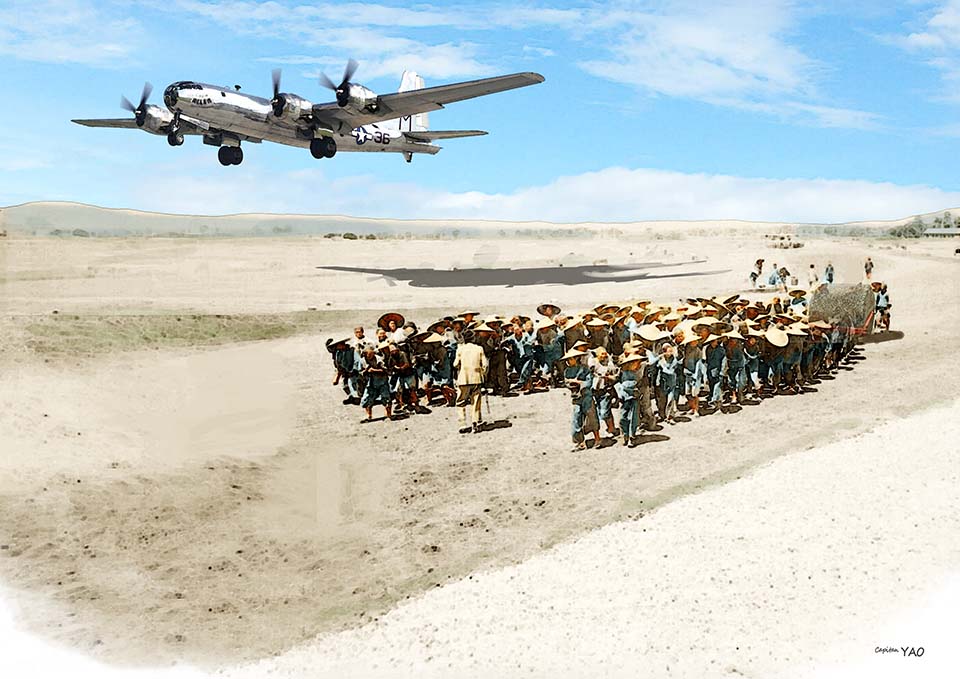
(Figure 5-9-2) Local laborers were recruited to build an airfield for B-29 heavy bombers to take off and land.
These airports, built with a great deal of manpower, became useless shortly after the US military captured the Mariana Islands, and all the B-29 fleets were moved to the islands.
One day, Kim Koo, the leader of the Korean government-in-exile who was living in Chungking with the Nationalist government, came to see me with his son, Kim Shin. Kim Koo was a leader of the Korean government-in-exile whom I had known in Shanghai. Hearing that I had returned to Chengdu from Europe and was teaching at the Chinese Air Force Staff School, he specially brought his son, who was studying at the Chinese Air Force Officer School, to pay me a visit.
Kim Koo thanked me for my assistance in Shanghai in 1932. At that time, the Hongkou Park bombing occurred, in which a Korean named Yoon Bong-gil assassinated several high-ranking Japanese military and political officials with a bomb. As a result, the Japanese pressured the French Concession to conduct a large-scale arrest of Koreans. Kim Koo came to ask me for help. Through my clever use of the media offensive, the French Concession had no choice but to release all the arrested Koreans.
Kim Koo's purpose in visiting me was because he realized that the Japanese would be defeated sooner or later, at which point he would have the opportunity to return to Korea and become its first president. Therefore, he needed to seek all possible international support. At the time, I didn't know much about the situation in Korea, and it was only after hearing Kim Koo's words that I learned that the Americans might support Syngman Rhee.
Kim Shin is about to go to India for flight training, and soon he may go to the United States for further training. Kim Koo knows about my connections in the Chinese Air Force and hopes to help me out. At that time, the Americans controlled everything, and I was thinking that if I could help him, perhaps when Kim Koo really became the president of South Korea, I could ask him for this favor and secure a place for the British Empire in postwar Korea.
Life at the Chengdu Air Force Staff School was pleasant, but with the end of the war I had to leave because my superiors had assigned me a more important task.
In May of the same year, Soviet troops entered Berlin, ending the war in Europe. Everyone believed that Japan, the only country still fighting a desperate battle, was about to surrender. The British government had begun making various preparations for its postwar interests in China. My responsibilities included two main points: first, Britain would continue to maintain its control over Hong Kong; and second, it would compete with the United States for dominance of the Chinese navy after the war. Of course, these were very high-level decisions, beyond the purview of someone of our class. My job was simply to provide sufficient intelligence to the decision-makers and to do my best to carry out the orders assigned by my superiors. In this situation, my superior suddenly remembered my special value: "Isn't this guy very familiar with Shanghai? Shouldn't we send him back to Shanghai to make arrangements before the Americans do?" This kind of mission wouldn't normally require my personal involvement, but looking around, it seemed no one knew Shanghai better than me. Plus, I'd been away for a while and wanted to "go home" for a visit, so I volunteered. Fortunately, the situation was very different from 1942. The entire trip was actually arranged in advance through channels with the Japanese naval intelligence agency, because the Japanese also wanted to find a respectable way to end the war. The fastest way to get there is to fly to the front-line airport, where the Japanese army will pick me up and I will transfer to a Japanese plane to fly directly to Shanghai. What we need to guard against is the American intelligence agency. We absolutely cannot leak the slightest clue. This is a real headache. The entire Chinese battlefield is filled with American planes. How can I find a plane to get to the front line from Chengdu without notifying the United States? And how can I ensure that the Japanese plane I take will not be misunderstood by the American planes, or even deliberately shot down like it was with Yamamoto Isoroku? After racking my brains and considering various options, none seemed feasible. The final conclusion was that I would pilot the plane to the front lines myself. However, there wasn't a single British aircraft in the Chinese theater. But this didn't stump MI6. Under the guise of a morale-boosting airshow, they acquired a Spitfire fighter from India. It had a distinguished reputation in the Battle of Britain, but most people in China hadn't seen it, so it had a selling point. The Americans were somewhat suspicious, but they figured one plane wouldn't amount to much, and agreed to provide logistical support. There was another important reason for choosing the Spitfire: I had previously flown its predecessor, the Supermarine S6 racing plane, so I didn't need to relearn how to fly it. This tactic probably wouldn't have worked with other aircraft.
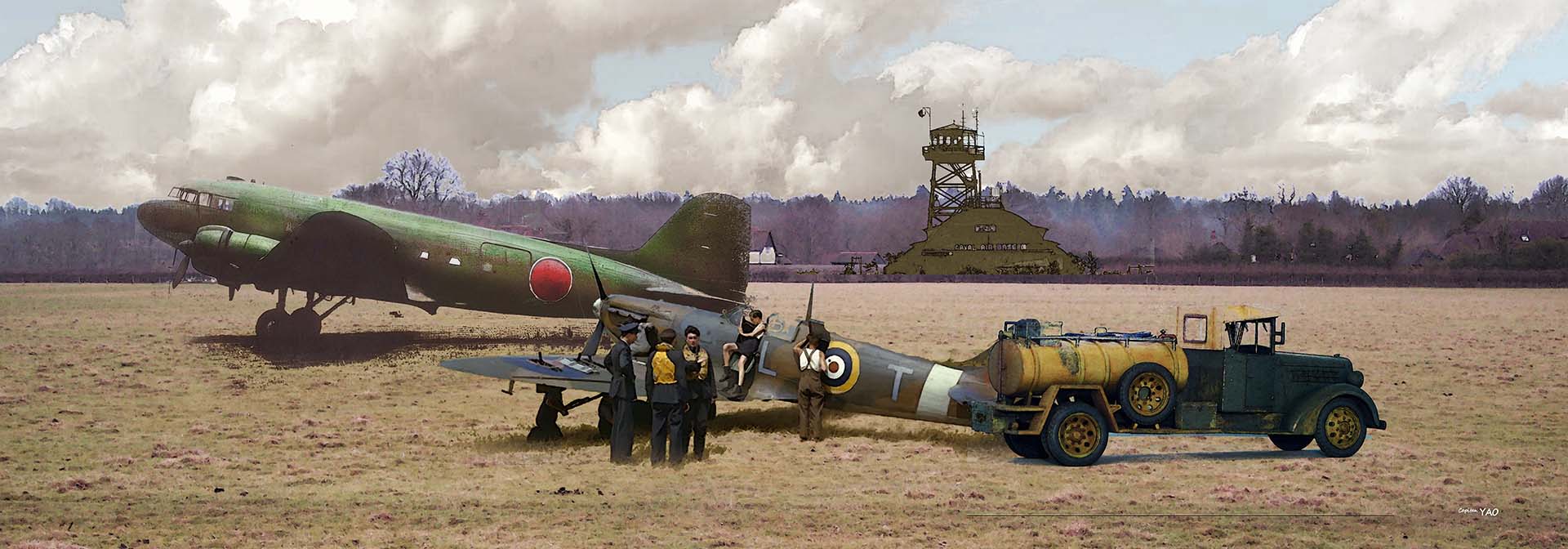
(Figure 5-9-3) Paul Draken arrives at the Japanese airfield in his Spitfire fighter plane, where a Japanese-made DC-3 transport plane (Tabby) is waiting. The Japanese officer bowed, saluted, and shook hands in a friendly manner, even offering me food. I glanced at the Tabby, then back at the Spitfire, and asked if he could help refuel the Spitfire, as I planned to continue flying it to Shanghai. Upon hearing this, the Japanese officer quickly shook his head and said, "No, no, if it flies in our controlled airspace, it might be shot down due to a misunderstanding." He said the exact opposite. In fact, given the air superiority at the time, the chances of me being shot down by American fighter planes while in the Tabby were probably greater than the chances of being shot down by the Japanese while piloting my own Spitfire. Because of my insistence, the Japanese officer had no choice but to compromise. After refueling, I took off with the Tabby and followed it closely all the way to Longhua Airport in Shanghai.
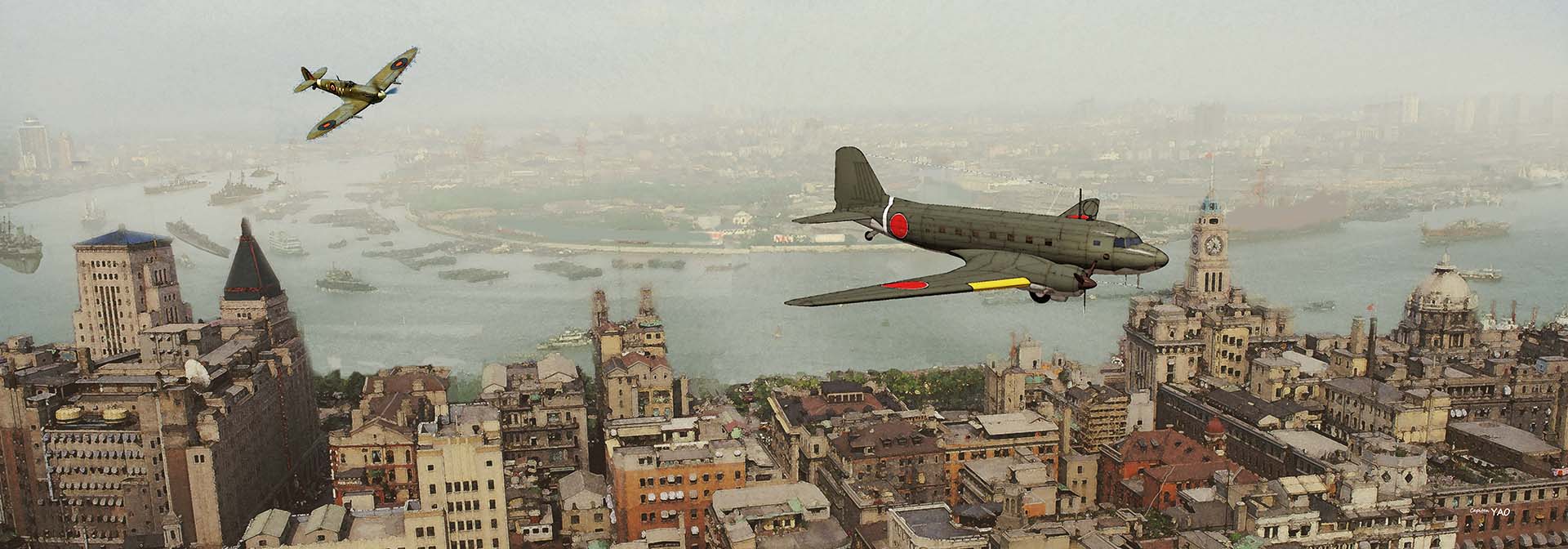
(Figure 5-9-4) Paul Draken pilots a Spitfire fighter, following a Japanese Tabby transport plane over the Bund in Shanghai. The sky was calm along the way, with no Japanese or Allied planes in sight. When we arrived at Longhua Airport on the banks of the Whampoo River, the Japanese planes signaled for me to land first. So, after circling the airport, I let the Spitfire gracefully and gently glide down onto the runway. As soon as I got off the plane, the Japanese covered it with a tarpaulin and pushed it into the hangar to hide it. I was picked up from Longhua Airport by a steamboat, passing the familiar Bund along the way. There wasn't a single large warship in sight on the Whampoo River. The steamboat arrived at a warship moored beside the naval dock at the mouth of the Soochow River. I recognized it as the flagship of the Japanese river gunboat fleet stationed in China, the "Uji". This was the place where the "Izumo" was moored, and also the place where I met Yamamoto Isoroku on the "Tatara" in 1942.
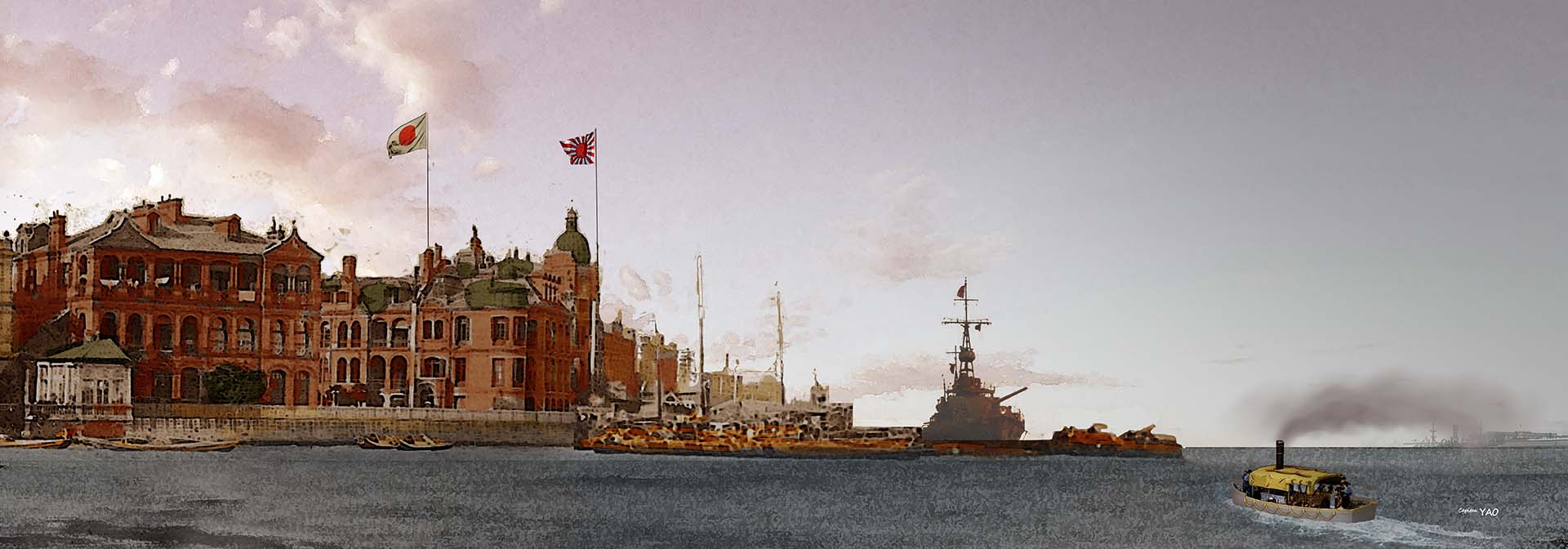
I was greeted by a naval captain on the "Uji". It turned out that he was Commander Usui Yoshiro , the staff officer I had consulted with Admiral Yamamoto Isoroku in Shanghai in August 1942. At that time, I had hoped to become the "Emperor's secret envoy," but the assassination attempt by the Americans ruined the opportunity. Because of this connection, the Japanese side specifically designated me to represent them this time. So that's how this mission came about.
"Welcome, Captain Draken, to Shanghai. It's been almost three years since we last met. I apologize for making you take a small boat, as traveling by water from Longhua Airport to this ship avoids land transportation, which is more confidential and safety."
Safety? Is Shanghai different now than it used to be?
On June 22, the day I arrived, the Battle of Okinawa had just ended. Japan had exhausted all its resistance forces, and only the hardliners in the army were still stubbornly resisting, wanting to destroy everything. The navy, with a view to the grand strategy of postwar reconstruction, hoped to avoid this situation. The so-called security concerns were to prevent the army fanatics from assassinating me en route.
The meeting was held aboard the ship "Uji," with Vice Admiral Sakonju Naomasa , Chief of Staff of the China Area Fleet, as the main Japanese negotiator. During the meeting, the Japanese side continued Yamamoto Isoroku's concept from years before, hoping to first make peace with Britain, and then have Britain relay a message to the Allies. I know this is part of the Japanese culture of seeking intermediaries in negotiations, and I also know that they had considered using the return of Sorge as leverage to get the Soviet Union to intervene, but Stalin gave them the cold shoulder, which led to Sorge's execution last November. Now the war situation is even more unfavorable for Japan, and in their desperation, they remembered that Yamamoto had discussed this issue with me years ago, which led to this meeting.
Although the Japanese lead negotiator at the meeting was Sakonju, it was because no higher-ranking naval officer could be found in Shanghai at the time. The one who truly understood the overall situation was Usui Yoshiro, who was currently the naval attaché at the Japanese Embassy in the Soviet Union and had flown to Shanghai specifically for this meeting. Sakonju rarely spoke during the meeting, and Usui led the discussion for the majority of the time.
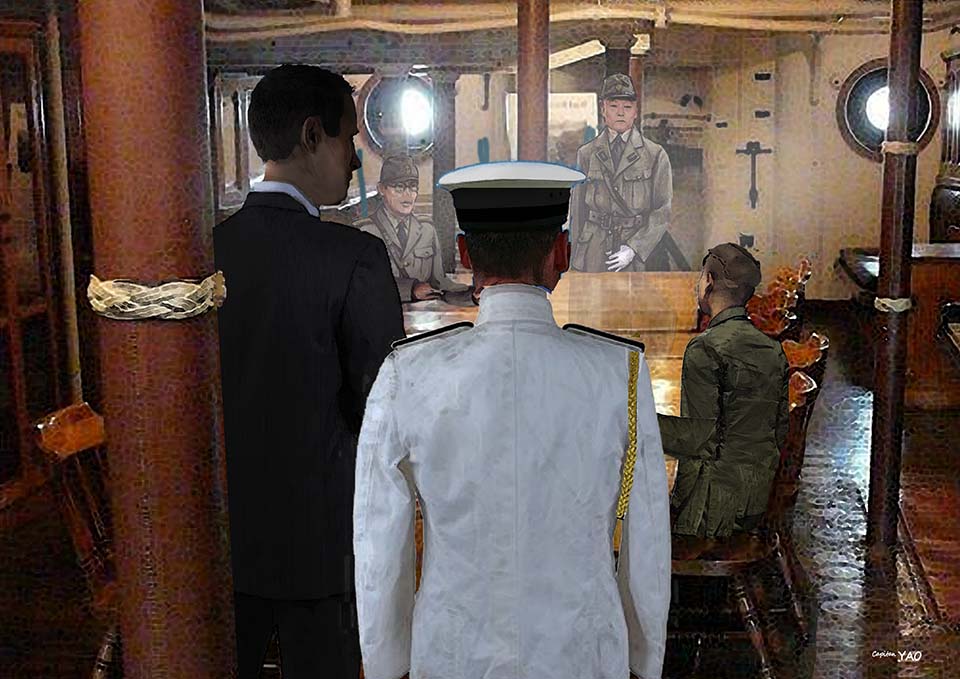
(Figure 5-9-6) Paul Draken meets with Japanese Navy representatives in the officer quarter of the "Uji" ship.
Usui began enthusiastically by reminiscing about the wonderful times he had spent talking with Admiral Yamamoto years ago. However, things were different then; Britain could no longer negotiate peace with Japan alone, detached from the Allies. Having participated in the Cairo and Tehran Conferences, I knew clearly the bottom line of the Allied camp: unconditional surrender. In truth, my purpose in coming to Shanghai was not to negotiate peace, but to control the situation during the surrender process, steering it in a direction favorable to Britain. Therefore, surrender was an unchangeable prerequisite for this conference. Although I knew the Japanese were very concerned with saving face and couldn't be too blunt, seeing that the two sides couldn't reach an agreement, I finally had to lay my cards on the table.
"Gentlemen, please stop harboring unrealistic illusions about peace negotiations; it's impossible because the Allies have already set the bottom line of unconditional surrender. What you should be thinking about now is how to find the minimum space for survival for yourselves under the premise of surrender. In this regard, Britain can help you more than the Americans."
Upon hearing "surrender", Sakonju slammed his fist on the table and stood up abruptly, shouting, "Surrender to you? Who do you British think you are? I killed countless British people in Southeast Asia back then." Usui quickly tried to smooth things over, butSakonju continued to rant, "Go ahead and check. Last March, I personally ordered the beheading of seventy people on that British merchant ship in Java."
The meeting ended unhappily, and Usui apologized to me repeatedly, saying that he would invite me to the Grand Theater that evening to see the "Night Fragrance Fantasy Concert" as an apology.
"Of course I know her. I'm very familiar with her. She's Japanese, Yamaguchi Yoshiko !" "You must be mistaken, she's Chinese, everyone knows that."
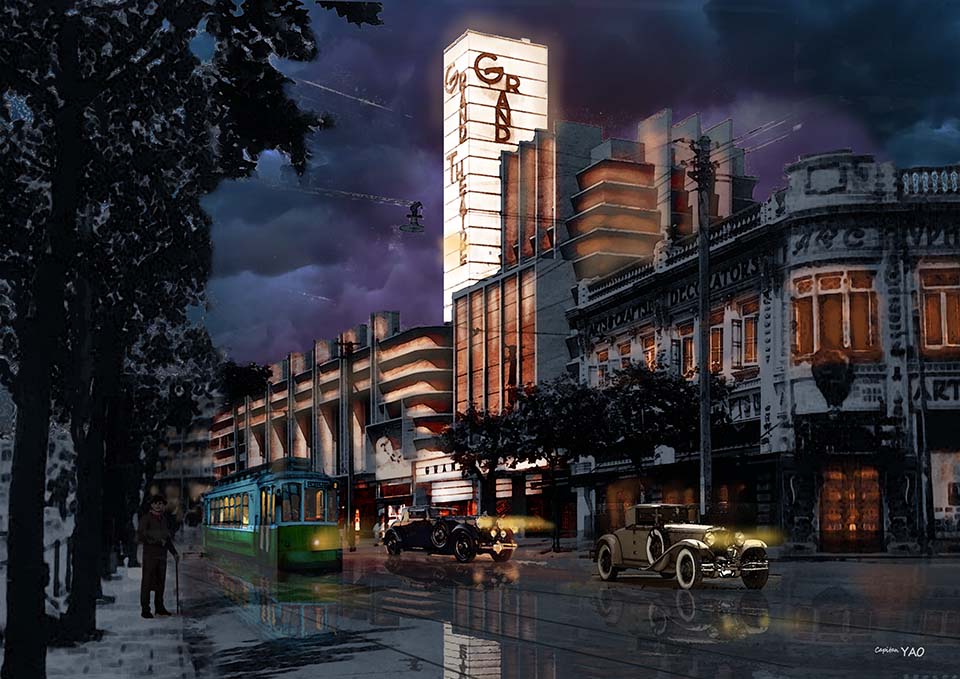
(Figure 5-9-7) The Shanghai Grand Theater, where the "Night Fragrance Fantasy Concert" was held.
It turns out even Usui thought Li Shianglan was Chinese; this was a perfectly timed deception. But I knew Li Shianglan from my time in Peiping through Kawashima Yoshiko , so I knew she was Japanese. Ironically, everyone thought Kawashima Yoshiko was Japanese when she was actually Chinese, and everyone thought Li Shianglan was Chinese when she was actually Japanese. But regardless, seeing her again in Shanghai was still a pleasant experience.
"Captain Draken, since you know Li Shianglan, could you please get my autograph?" Usui said somewhat shyly.
"You're a fan of hers too? No problem, as long as I can see her."
First, it's necessary to explain Li Shianglan's situation during the war. She originally worked at a film studio in Manchuria, but resigned in June 1945 and came to Shanghai to join the Great China Film Company. From the 23rd to the 25th, she held a solo concert of "Night Fragrance Fantasy" at the Shanghai Grand Theater. The former Shanghai Symphony Orchestra (formerly the Shanghai Municipal Council Symphony Orchestra of the former International Settlement, with many musicians being White Russians), known as the "First Orchestra of the Far East," provided accompaniment. Hattori Ryoichi personally arranged and orchestrated the music, with Chen Gexin and Hattori Ryoichi serving as conductors respectively. This made Li Shianglan's singing even more magnificent and elegant, reaching the highest level of popular art.
Li Shianglan is known for singing famous songs such as "When Will You Return?" (composed by Lü Jinguang), "Night Fragrance" (composed by Liu Xue'an), "Suzhou Nocturne" (composed by Hattori Ryoichi), and "Night Shanghai" (composed by Chen Gexin). She also starred in many films praising Sino-Japanese friendship. Many people expressed dissatisfaction with her for making pro-Japanese films despite being Chinese, unaware that she was actually Japanese. Because Li Shianglan's image as Chinese was beneficial to the propaganda of Manchuria Film Studio and the Japanese military, the truth was deliberately not clarified. Caught in a dilemma, Li Shianglan eventually chose to leave Manchuria Film Studio and develop her career in Shanghai. Manchuria Film Studio was controlled by Japanese spy Masahiko Amakasu , who was the shadow puppet behind Emperor Puyi. Leaving Manchuria Film Studio meant escaping the control of the spy, which was not a simple matter.
We attended the rehearsal the day before the concert. The film company arranged for some political and business connections to be cultivated, providing free hospitality. The official performances were from the 23rd to the 25th. Although it was late in the war, Shanghai's upper class and Westerners still flocked to the theater. Tickets were priced at 4,000, 5,000, and 6,000 yuan. The concerts were held for three consecutive days, totaling six shows, and have since become a legendary memory for old Shanghainese and a historical and cultural treasure of the Grand Theater.
The Grand Theater was a place I often went to see movies before the war. Holding such a concert in this special time and space gave people a sense of impending doom. At that time, all the "traitors" in Shanghai and Nanking were in danger. Those who had a way begged the Japanese to help them fly to Japan in hopes of escaping the trial of war criminals. Many more chose to numb themselves, living for the moment, which ironically led to Shanghai's entertainment venues being packed with people, waiting for the last day to arrive.
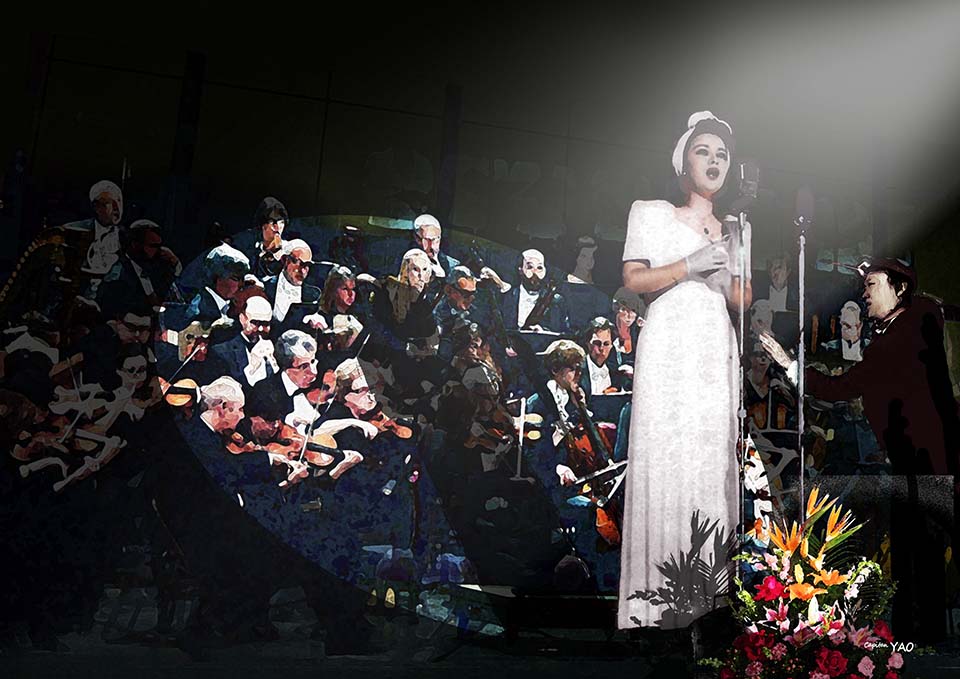
(Figure 5-9-8) Li Shianglan's "Night Fragrance Fantasy Concert", accompanied by the former Shanghai Municipal Council Symphony Orchestra.
I met LiShianglan backstage. She was still beautiful, but more mature. Because of our special relationship, we were very close. The only problem was the language. I spoke Chinese with Li Shianglan, while she spoke Japanese with Usui. We had to trouble her to translate, which was too much trouble. In the end, we all communicated in English.
Usui was overjoyed to receive Li Shianglan's autographed photo, thanking me repeatedly. Then we drove together towards Longhua Airport. I thought Usui was going to see me off, but on the way he said he was flying to Moscow that night because Stalin was holding a Victory Parade in Red Square the day after tomorrow, which military attachés were required to attend according to diplomatic protocol. It was over 6,000 kilometers to Moscow, a full day's flight, and he didn't want to miss Li Shianglan's concert, so he was heading straight to the airport as soon as it ended, hoping I would understand.
"Wait, wait, you said a victory parade, what victory? Defeat the Axis powers?"
"yes!"
"Aren't you the Axis powers? What are you celebrating?"
"But the Soviet Union and Japan still have diplomatic relations today! So even though I know it's very awkward, I, as the naval attaché at the embassy, still have to attend," Usui said with a hint of helplessness.
As the car pulled into Longhua Airport, a Tabby plane was parked in front of the hangar, its propeller already warming up. My mind started racing again. This was a once-in-a-lifetime opportunity; perhaps I could go along and take a look? I made my request to Usui, who, probably feeling awkward refusing because he had Li Shianglan's autographed photo, reluctantly agreed. Actually, besides the pilot and crew, he was the only passenger on the plane, and flying all day was rather boring.
Just like the Cairo Conference, such long-haul flights during wartime require multiple consultations between the two countries to establish communication signals, and refueling, resupply, and escort all need to be arranged in advance—something I have extensive experience with. The Tabby is a copy of the American Douglas DC-3, a type of aircraft I've flown many times over the Hump. I estimated that it would take about 24 hours to reach Moscow and require two refuelings. Fortunately, there is a seven-hour time difference between Moscow and Shanghai, allowing us to arrive in the early morning local time, change clothes, and head to Red Square.
Before leaving, I needed to make arrangements for the Spitfire fighters I had brought. I told them through Usui not to do anything and to wait until I returned from Moscow, and then we took off with a rumble in the dark.
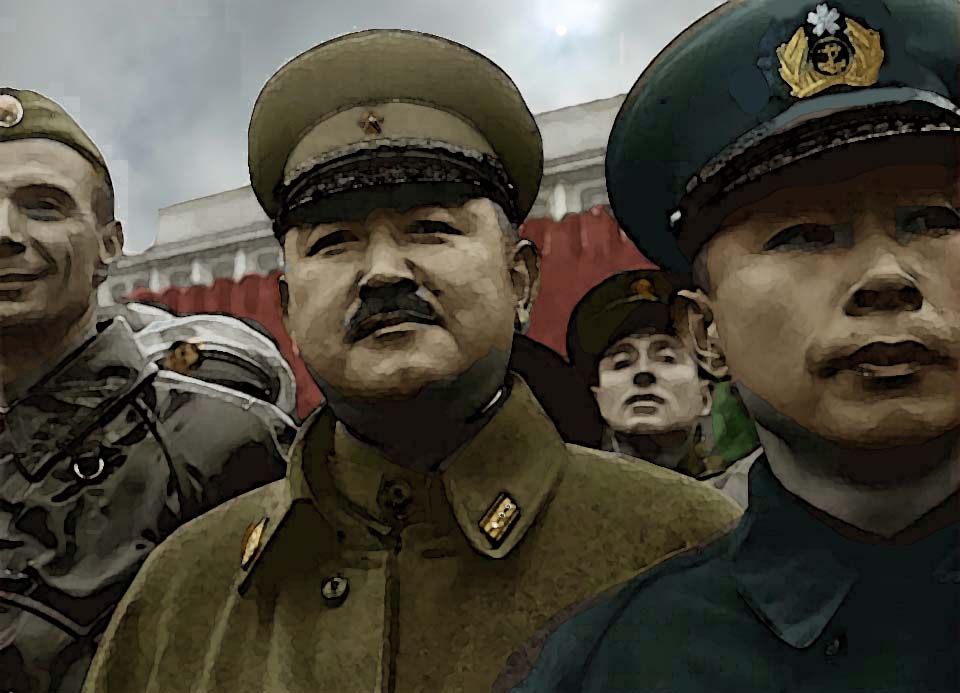
(Figure 5-9-9) Colonel Yabe Tadahiro , Japanese Army Attaché, and Captain Usui Yoshiro , Japanese Navy Attaché, at the victory parade in Red Square, Moscow, marking the triumph over the Nazis.
At 10:00 a.m. on June 24, 1945, the bells of the Red Square Cathedral rang for the last time, and the Victory Parade, personally presided over by Stalin, officially began in Red Square. As one of the five Allied powers, China's delegation was led by Lieutenant General Deng Wenyi, Director of the Government Military Committee., who sat high in the center of the rostrum. The Japanese military attaché sat on the far side, watching with a mournful expression as the flag of their former ally, Nazi Germany, was dragged across the ground and abandoned by the Red Army.
This army attaché, Colonel Yabe Chuta , also came from an intelligence background. We had met once before. He looked embarrassed, so I just patted him on the shoulder, and everything was understood without words. At that time, I didn't know that the Soviet Union was preparing to invade Manchuria, nor did I know that the local Japanese would suffer such a tragic fate.
Usui was to stay in Moscow, while I flew back to Chungking on an American plane with the Chinese delegation. The Spitfire fighter left at Longhua Airport in Shanghai had to be declared a crash and scrapped. However, after the war, the American forces found the plane in a warehouse at Longhua Airport during the takeover of Shanghai and were quite alarmed, assuming it had been captured by the Japanese in Burma. Fortunately, I was in Shanghai at the time and managed to suppress the matter through some means.
Regarding Lieutenant Admiral Sakonju Naomasa, who lost his temper at the meeting, I immediately checked through internal channels after returning to Chungking and found that in March 1944, a British merchant ship with a displacement of 6,100 tons, the "Behar," was indeed sunk by the Japanese Navy heavy cruiser "Tone" while en route from Melbourne to India. The 104 surviving crew members were captured and taken back to Java, of whom 69, including British and Indian crew members, were beheaded by the Japanese army. The order to do so was given by the commander of the 16th Squadron, Sakon Naomasa.
The British only knew that the "Behar" had been sunk by Japanese warships, but were unaware of the murder of its crew. After the war, I cooperated with the military tribunal in investigating the crimes committed by the Japanese army during World War II and proactively reported the case. The military prosecutor arrested Sakonju, who had already retired to Japan, and took him to Hong Kong. The trial began in 1947. I happened to be in Hong Kong at the time and appeared in court as a witness. When Sakonju saw me, his expression changed instantly, and he confessed on the spot. Finally, he was hanged in January 1948.
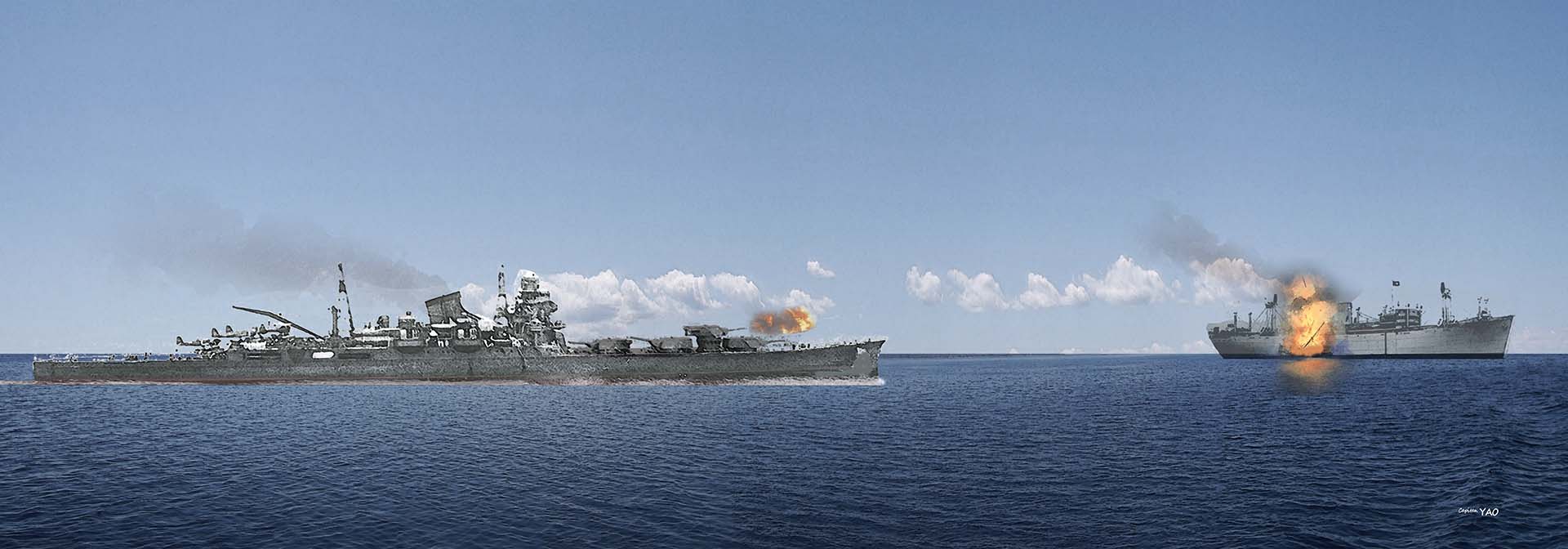
(Figures 5-9-10) The Japanese heavy cruiser "Tone" attacked the British merchant ship "Behar" in the Indian Ocean and then killed 69 captured crew members. |