7. The Sian Incident
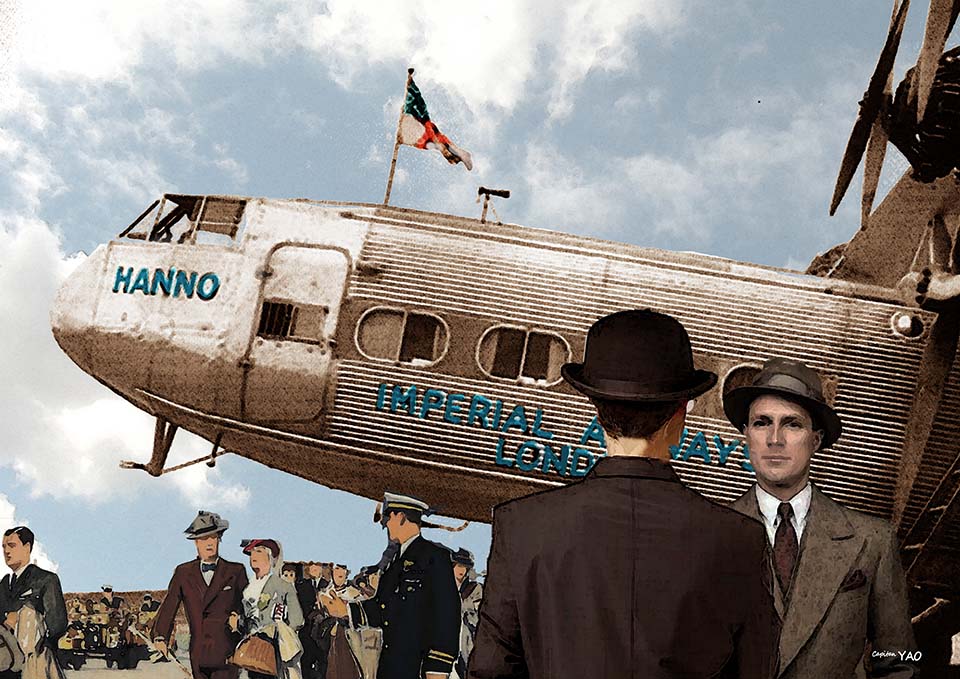
(Figure 4-7-1) Just as the Imperial Airway plane arrived in Hong Kong, Paul Draken's colleagues came to ask him to rush to Shanghai immediately.
On December 12, 1936, I arrived in Hong Kong on an Imperial Airway transoceanic flight. This was the inaugural flight, and although there were many stops along the way, it only took a few days to get from London to Hong Kong, which was much faster than taking a ship. Because I had flown this route before Imperial Airway, piloting the "China Pearl", I was invited to participate in the maiden voyage and to share some of my experience with the captain along the way.
Imperial Airway was negotiating air rights with China's Ministry of Transport at the time, wanting to extend its route from Hong Kong to Shanghai. They hired me as their representative in China because I had experience with transoceanic flights and had early connections to China's civil aviation development. I had always hoped to launch my own aviation business in China, so I accepted. Unfortunately, Imperial Airway didn't do well later on, suffering frequent accidents. After the outbreak of World War II, civil aviation was placed under military control, and Imperial Airway was merged into British Overseas Airways (BOAC). My position disappeared along with it.
As soon as the plane landed at Kai Tak Airport in Hong Kong, my colleagues from the Hong Kong intelligence group came to greet me on the tarmac. They immediately announced that a momentous event had occurred in China: Chang Hsueh-Liang had kidnapped Chiang Kai-shek in Sian, and I needed to immediately transfer to Shanghai to await orders; they had already arranged a flight. I had originally planned to stay in Hong Kong for a few days, but I didn't even enter the country before boarding another plane, arriving at Shanghai Longhua Airport in the evening.
At the time, Chiang Kai-shek was planning a final offensive against the Red Army, which was fleeing northwest. Chiang Kai-shek's Central Army and Chang Hsueh-Liang 's Northeast Army were concentrated in the Henan and Shaanxi areas, including air force aircraft, heavy artillery, and hundreds of thousands of troops. The Red Army, which had fled from the southwest to northern Shaanxi after the fifth encirclement campaign, had only a few thousand men left. The two sides were vastly different in strength, and Chiang Kai-shek felt that victory was in his grasp. He led a group of generals to inspect Chang Hsueh-Liang 's forward command post in Sian, preparing to enjoy the fruits of the final victory. However, Chang Hsueh-Liang suddenly launched a mutiny.
This event, known in China as the "Sian Incident," differed from typical military rebellions in that Chang Hsueh-Liang insisted it was a "military remonstrance" rather than a "mutiny," meaning he used drastic measures to force Chiang Kai-shek to stop his campaign against the Communists and unite against Japan, rather than for personal power and status. When I first heard this news, I was shocked but not at all surprised. Who else but Chang Hsueh-Liang would do something so reckless?
The detailed events of the Sian Incident have been extensively documented in publications, so I won't repeat them here. I will only address a few matters relevant to me. Upon arrival, I immediately went to the intelligence group. After understanding the general situation, our first task was to assess the impact on British interests, the potential future developments, and the British government's attitude. At the time, almost all senior Western intelligence officials considered it a typical warlord rebellion, but I held a different view due to my familiarity with Chang Hsueh-Liang . I also reminded them to pay attention to the possible roles played by the Chinese Communist Party and the Soviet Union in this event.
I also discovered that Chiang Bin, whom I used to fly planes with in the Northeast Navy, is now a Major General and Director of Transportation under Chang Hsueh-Liang in Sian, in charge of communications and telegraph operations. He had already maintained good relations with us regarding telecommunications intelligence during the Fookian Rebellion. I carefully examined and compared the telegrams intercepted by our telegraph monitoring personnel from Sian, and I felt that Chiang Bin might be someone who held different ideas from Chang Hsueh-Liang , because some telegrams that should have been sent were not sent, while others were directed towards the Central Army. I tried calling using the code name we had previously agreed upon, and soon I was able to make contact. Chiang Bin's intelligence poured in continuously, and we now knew more about the situation in Sian than we did in Nanking.
Chiang Bin was originally from the navy, but later developed his career in the army and radio. He was the most knowledgeable person in the Northeast Army when it came to telecommunications. We had known each other since we flew planes together in Tsingtao in our early years. Later, we also had a lot of business dealings with him in the telegraph office in the north. After the Manchurian Incident, Chang Hsueh-Liang stepped down and went abroad for inspection. Chiang Bin returned to his hometown in Fookian and still often contacted me by radio. During the Fookian Incident, he provided me with a lot of useful first-hand intelligence. That's how our intelligence system was established.
I want to emphasize that Chiang Bin is absolutely not a British spy. He was targeting me personally, not the British intelligence agency. We have never paid him a single penny. The reason he provided me with intelligence was because he believed that I could maximize the value of the intelligence and that I would not use the intelligence he gave me to do anything that would harm China's interests.
This is my problem. As my father often reminded me, I may really have a "Johnston complex," which means I'm too immersed in Chinese society and have forgotten that I'm a British intelligence officer, and I still think I'm Chinese! Chiang Bin was my most important source of intelligence during the Sian Incident. He obviously disagreed with Chang Hsueh-Liang 's kidnapping of his superior and was willing to provide me with intelligence. He may have been considered a traitor by lower-ranking officers in the Northeast Army for this reason. He was killed by the mutinous troops during the "February 2nd Incident" the year after the Sian incident. Several other high-ranking Northeast Army officers I knew were also killed on the same day.
That said, I have Chiang Bin as my trump card, but my superiors want me to follow the same approach I took in 1928 when I went to Mukden to persuade the Young Marshal to switch sides, and go to Sian to persuade Chang Hsueh-Liang . I feel really unlucky. I came back here hoping to have a nice Christmas in Shanghai, but I didn't expect to encounter this major event as soon as I got off the plane, and now they want me to jump into a fire pit?
Having been away from Shanghai for two and a half years and had grown accustomed to life in England, stepping back into this bustling metropolis brought back a flood of vivid memories: Annie, Willie, Korniloff, Mr. M… and so on. Mr. M? I suddenly remembered Mr. M, far away in Moscow. If we could strike at the root of the problem from Stalin, perhaps there was a way to resolve the Sian Incident. I immediately sent a secret telegram to Moscow to inquire about his opinion.
I told Mr. M that, in my judgment, Chang Hsueh-Liang's decision was absolutely impulsive, so Moscow probably hadn't made a decision yet. If there was a way to persuade Stalin, it might be possible to turn the tide.
Mr. M's telegram to me contained only four words: "Wishful thinking!"
However, things began to subtly change. The official Moscow news agency began reporting that the Central Committee of the Communist Party of the Soviet Union denied any connection to the Sian Incident. Then, Stalin sent a telegram through Soong Ching-ling in Shanghai to Mao Tsetung in Yan'an, defining the Sian Incident as a conspiracy by the Japanese in alliance with Wang Kingwei and Chang Hsueh-Liang. Stalin asserted that Chiang Kai-shek was the only qualified leader to lead China in the resistance against Japan, and that the Chinese Communist Party should urge a peaceful resolution to the incident and the release of Chiang Kai-shek. He further claimed that if Chiang Kai-shek died, the anti-Japanese national united front would collapse, and Japan would be the biggest beneficiary. He further stated that if Yan'an did not comply immediately, the Communist Party of the Soviet Union would announce to the world that it was severing ties with the CCP, regarding it as bandits… and so on.
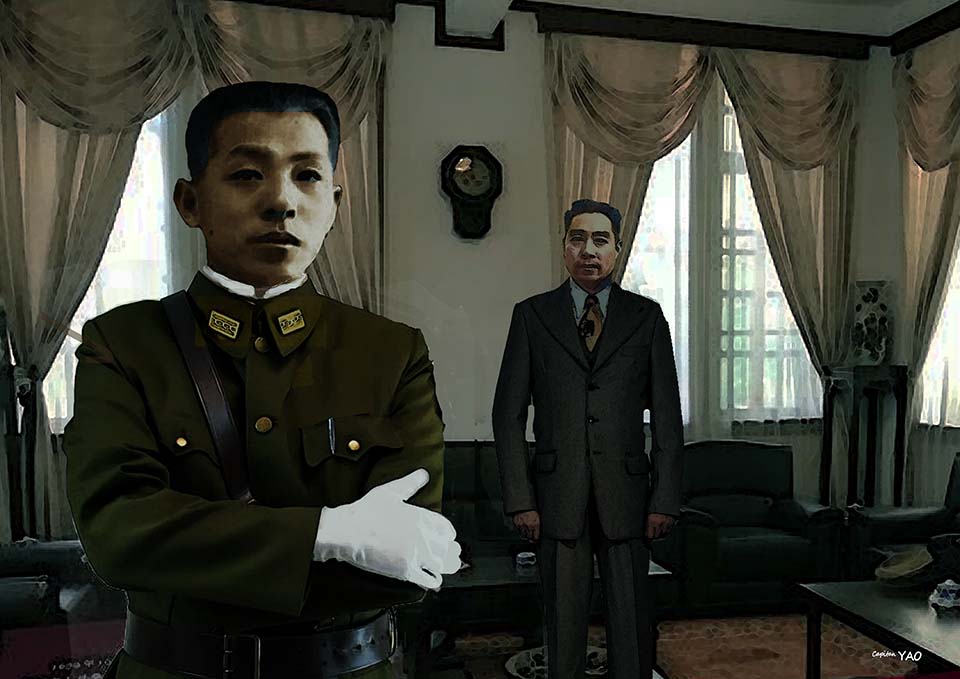
(Figure 4-7-2) Chou Enlai brought Stalin's telegram, and Chang Hsueh-Liang looked at it with despair.
Our telegraph monitors intercepted the telegram and immediately reported it to the intelligence group. I then knew that a decisive change had occurred. At the same time, Mao Tsetung in Yan'an also received the telegram. He was furious at Stalin's sabotage, but dared not disobey the Central Committee of the Communist Party of the Soviet Union. He immediately dispatched Chou Enlai to Sian. When Chou Enlai told Chang Hsueh-Liang the news, he saw that Chang was ashen-faced. Chang realized that everyone had been using him. Chang Hsueh-Liang decided that rather than let others use Chiang Kai-shek, whom he controlled, he should play the role of the one who untangles the knot. This is why Chang Hsueh-Liang later insisted on personally escorting Chiang Kai-shek back to Nanking. However, this heroic act resulted in half a century of house arrest for him.
On the 22nd, Soong Mei-ling and T.V. Soong flew to Sian. Three days later, Chang Hsueh-Liang, Soong Mei-ling, and others escorted Chiang Kai-shek back to Nanking. Most people believe that Soong Mei-ling risked her life to go to Sian to secure Chiang Kai-shek's release. However, the most crucial factor was Stalin. It was Stalin's stance that emboldened Soong Mei-ling to venture into danger to rescue her husband. Yet, Chinese history deliberately ignores this part.
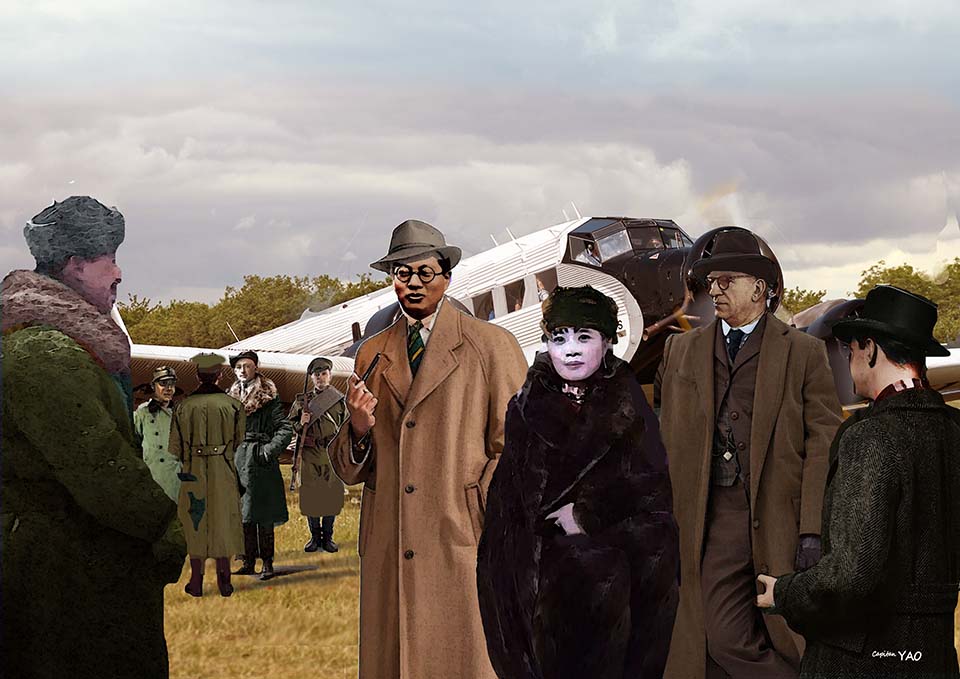
(Figure 4-7-3) Soong Mei-ling, T.V. Soong, The consultant William Henry Donald, and others flew to Sian, and Tai Li, who accompanied them, had his pistol confiscated.
On the day Soong Mei-ling went to Sian, Tai Li and I were also there. Tai Li was the spy formerly known as Tai Chunfeng, who was now in charge of his own affairs. He was accompanying her to make arrangements for protecting Chiang Kai-shek and his wife. As for me, I was waiting for the situation to calm down before making the trip to Sian to fulfill my superiors' requirements. Tai Li and I sat with Soong Mei-ling's maid in the tail section of the plane. I think in Chiang Kai-shek's eyes, the intelligence chief and the bodyguard and maid probably had the same status.
The atmosphere was still very tense when we arrived at Sian Airport. As soon as we got off the plane, Soong Mei-ling and her siblings walked ahead, while Tai Li and I were stopped, searched, and disarmed. Tai Li turned pale with anger after a pistol was taken from him, while I voluntarily handed over the Mauser pistol engraved with "Presented by Hanching". The Northeast Army officers present immediately reported this and returned the gun to me. Soon after, my adjutant Tan Hai came to see me and said that Young Marshal was busy receiving Madame Chiang Kai-shek and had no time to meet me. I smiled and said that I was in Sian for sightseeing and that the Young Marshal did not need to bother!
When Tai Li saw me again later, he still found it unbelievable. Why did I, a foreigner, not have to disarm, while he, the person in charge of the leader's security, had to suffer such humiliation? I laughed and said, "It's because you are the head of the secret service that I deliberately want to embarrass you!"
After the Sian Incident, various political parties and warlords in China demonstrated a high degree of unity, and all civil wars ceased. The Japanese began to feel uneasy and intensified their invasion of China. The full-scale war between China and Japan broke out the following summer, two years earlier than the war in Europe and four years earlier than World War II.

I brought a bouquet of flowers to Anne's memorial at Christmas. A cold wind blew across the Huangpu River. Four years have passed, but Anne's image remains vividly in my mind.
I stood by the riverbank, lost in thought, and seemed to hear the engine roar of the "China Pearl" from the misty river. Then, the blue dragon emblazoned on the bow led the bright yellow fuselage out of the fog. I saw Annie lean out of the cockpit sunroof, waving at me, and pulling down her flight cap to let her blonde hair flutter in the wind. I thought I heard her shouting to me, "Paul, I love you..."
The plane accelerated across the Hwampoo River, preparing for takeoff, when suddenly its wing tilted to the left, the wingtip touching the water's surface. In an instant, the right wing bounced up, causing the entire plane to tumble several times on the water, transforming into a fireball...
"Whoosh! Bang! Bang!"
I heard flashes of light and the sound of explosions from the river. I snapped back to reality to find that someone was setting off fireworks. It was Christmas Eve, and the streets of the Shanghai concessions were as ornately decorated and brightly lit as ever. Tonight, my single colleagues from the intelligence group were hosting a Christmas party at the French Club, and I don't know where they found a group of Chinese socialites.
I have so many memories of the grand ballroom of the French Club in Shanghai. Besides Annie, there's Kim Bihui, Kenji Doihara, Lu Xiaoman, Weng Ruiwu, the Sheng sisters, and Shao Sinmay... Oh, right! Speaking of Shao Sinmay, who wore a long robe into the ballroom, I met him here again tonight, and he even brought Emily Hahm with him. Emily Hahn is Annie's friend, an American writer who writes for The New Yorker. She's very beautiful and charming. When we met in New York before, she promised to come to China to see me after two years in East Africa. However, when she came to Shanghai in 1935, I had just returned to England, so I entrusted Shao Sinmay to take care of her. Tonight, I finally saw the results of his care.
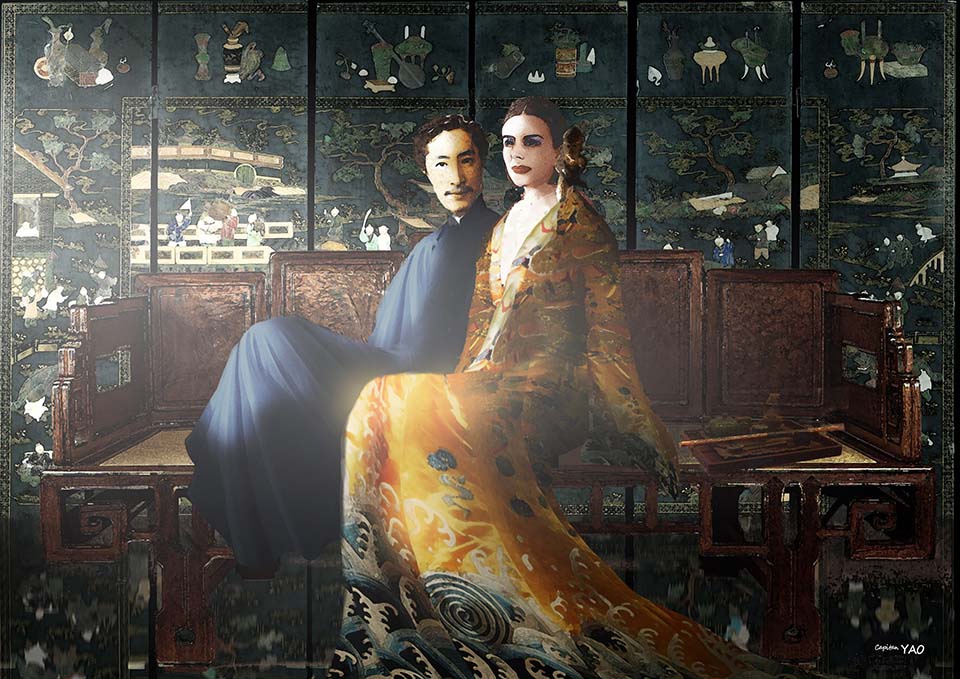
(Figure 4-7-4) Shao Sinmay and Emily Hahn smoking opium on an opium couch.
Although it was supposed to be a party for single colleagues in the intelligence group, I spent most of my time chatting with Shao Sinmay and Emily Hahn. Through this, I learned about their relationship and how it aroused great jealousy among wealthy Western businessmen in Shanghai. How could such a beautiful Western woman be with an Asian?
The relationship between Emily Hahn and Shao Sinmay was quite peculiar. Shao was a married man, and his wife was Sheng Peiyu, the granddaughter of Sheng Shuanhuai, one of China's richest men. However, Sheng's attitude towards Shao wasn't one of complaining about his infidelity, but rather that Emily Hahn, who was always seen with Shao, couldn't be without a proper status. Therefore, she arranged for Shao Sinmay to take Emily Hahn as a concubine, and Emily Hahn, enjoying the thrill of this exotic experience, readily agreed. Sheng Peiyu called Emily Hahn "Mickey," and the two women shared one husband, their relationship relatively harmonious. Emily Hahn forgot about her status as a concubine after breaking up with Shao, but it later had a significant impact on both of them.
During my conversation with Hahn and Shao, I mentioned that I had met an Air Force captain, Claire Lee Chennaul, in New York last time. I had introduced him to Soong Mei-ling, the First Lady of China and the person in charge of the Air Force's development. He was scheduled to retire from the U.S. military and report to China within a few months. Upon hearing this, Emily Hahn's eyes widened, and she exclaimed, "You know Madame Chiang Kai-shek?"
"Yes!" I said, "I not only know Chiang Kai-shek's wife, Soong Mei-ling, but I also know Sun Yat-sen's wife, Soong Ching-ling!"
I'm not exaggerating at all. In 1923, Soong Ching-ling and I flew together in the same plane over Kuangchow several times! But I'm quite curious why Emily Hahn is so interested in Soong Mei-ling. "I originally planned to only write a biography of Soong Mei-ling, but now it seems I could write a book that includes all three sisters... let's call it 'The Soong Sisters'!" Emily Hahn said. "Paul, could you introduce me?"
"Me?" I began to regret saying too much.
However, I actually succeeded. To thank me for helping her gather international pilots and mercenaries, Soong Mei-ling invited her second sister, Soong Ching-ling (wife of Sun Yat-sen), and eldest sister, Soong Ai-ling (wife of H.H. Kung), to be interviewed by Emily Hahn as a reporter for The New Yorker. This interview was later published as a book titled "The Soong Sisters," which became an instant bestseller, and Emily Hahn also made a name for herself in the literary world because of this book. To this day, "The Soong Sisters" remains one of the most important books for Western society to understand the most powerful Soong family in China at that time, and it can still be found in bookstores.
Many things happened between Emily Hahn and me after that, but I'll stop here for now.
(Figure 4-7-5) After the party at the French Club of Paul Draken, he strolled alone past the nearby Lyceum Theatre.
After the party, I walked back to my lodgings alone. Thinking of the happy times of the past, I felt especially lonely tonight. It has been almost ten years since I came to China in early 1927. Time really flies. According to the Chinese way of counting, I am already thirty years old.
As I passed a theater across the street, I noticed posters and photos displayed in the window. The photos showed heavily made-up women with their heads down, winking at me in a style reminiscent of Hollywood. However, their charm was tinged with confidence and arrogance. I couldn't help but stop and take a closer look. Suddenly, I felt that they looked somewhat familiar.
"Li Yunhe?"
That's right! She is Li Yunhe, my girlfriend who lived with me twice in Tsingtao. After leaving Tsingtao, she came to Shanghai to develop her career in the film industry, taking the stage name "Lan Ping". She became a notorious sex symbol due to her promiscuous private life and messy relationships. However, I only found out about her later because I had been away from China for a while and did not know that she had also come to Shanghai and was living not far from where I lived.
|