3. The Empress's Lover
1933 was drawing to a close amidst the Fookian Uprising and the entanglement with Yoshiko Kawashima. On Christmas Eve, I placed a bouquet of flowers at the small stone monument by the river in memory of Annie. That was the place where Annie set fly on the "China Pearl" the previous year. After Annie disappeared, I erected a small stone monument there, and every year since, whenever I am in Shanghai, I will come here to pay my respects on Christmas Eve.
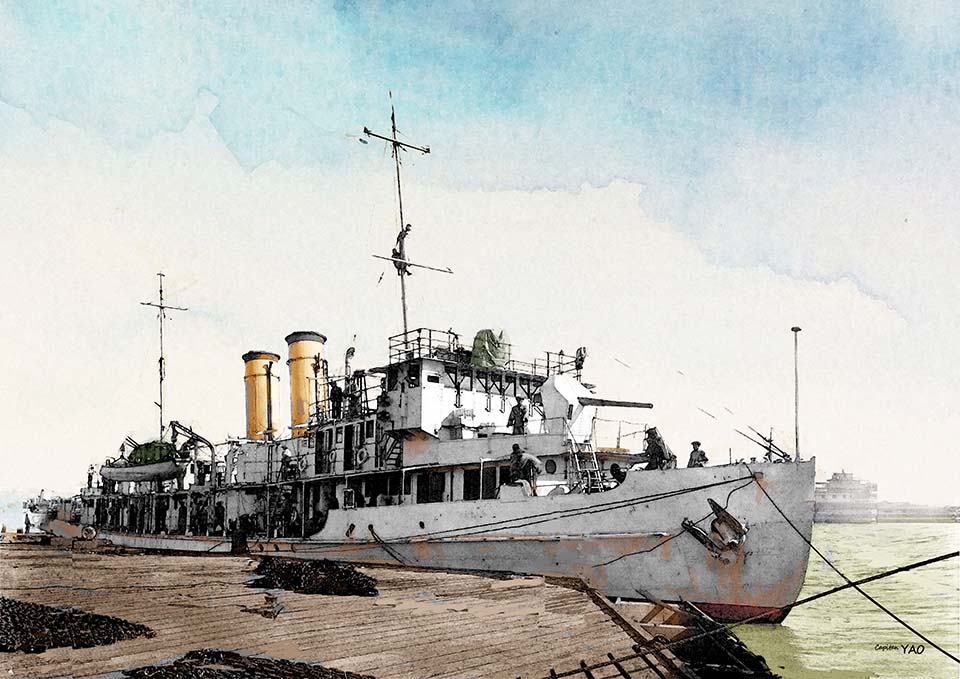
Last Christmas I spent on Willie's gunboat "HMS Peterel". This summer, during the dry season, the "HMS Peterel" ran aground on the upper reaches of the Yangtze River and will not be able to get out of trouble until the water rises the following spring. As the deputy commander, Willie had no choice but to stay on the ship.
According to experienced sailors, it is very easy to run aground on the Yangtze River when traveling to Chongking during the dry season. At the same time, a Japanese gunboat named "Futami" also ran aground on a reef on the riverbank in Wanhsian. It is said that the Japanese captain committed seppuku!
When the ship ran aground, Willie was the watch officer, and he was undoubtedly responsible for bringing the ship to the reef. However, according to tradition, the captain should have personally taken command on the bridge when navigating such dangerous waters, but the captain was fast asleep in his cabin at the time! Although the captain had many friends in the Far East Fleet, Willie was an outsider transferred from the intelligence department. In addition, he had always given his superiors a carefree and irresponsible impression, and after the incident, he was condemned by everyone and was eventually dismissed and transferred back to Britain.
Willie might not have been a very diligent officer, but he was a very helpful friend. When I saw Willie off from Shanghai, he introduced me to the new deputy commander, Lieutenant Steve Polkinghorn, a New Zealander serving in the Royal Navy. Willie knew full well that having a shallow-draft gunboat capable of penetrating deep inland would be of great help to my intelligence work.
Speaking of shallow-draft gunboats, they are also called river gunboats, a name derived from China's "inland waterway navigation rights." Due to underdeveloped infrastructure, China relies heavily on water transport for inland transportation, resulting in poor security along the routes and rampant banditry. River gunboats play a role similar to traffic police.
Although river gunboats only had a displacement of one or two hundred tons, their captains held high ranks, at least lieutenant commander, because they were involved in diplomatic affairs. Furthermore, about half of the crew members on river gunboats from various countries in China were naval personnel, while the other half were locally hired laborers responsible for non-combat tasks such as boilers, cooks, servants, and shoemakers.
Britain and Japan had the most river gunboats deployed to China, followed by the United States and France. Italy had only two, and Germany originally had some, but they disappeared after being acquired by China during World War I. These river gunboats were difficult to sail directly from their home countries; most were dismantled, transported by merchant ships, and then reassembled. Later, they were built in Hong Kong or Shanghai. For example, in 1927, the US Navy ordered six river gunboats from the Kiangnan Shipyard, which became the basis for the later design and construction of warships by the Chinese Navy.
River gunboats were characterized by their shallow draft, typically less than one meter, sometimes even only half a meter, yet they were required to navigate the Yangtze River upstream through the Three Gorges to Chongking, making their design far from simple. Due to the relatively calm waters of inland rivers, the freeboard was low, allowing for two to three stacked superstructures and ample usable space. River gunboats rarely carried naval guns, instead using field howitzer or mortars from the army, as the probability of ship-to-ship naval battles was low; most engagements were land-based. Because the river level was the lowest point, the main guns and lookout towers had to be positioned high to suppress the land on both banks. Most river gunboats were equipped with traditional reciprocating steam engines, but the "HMS Peterel" was unusually equipped with steam turbines.
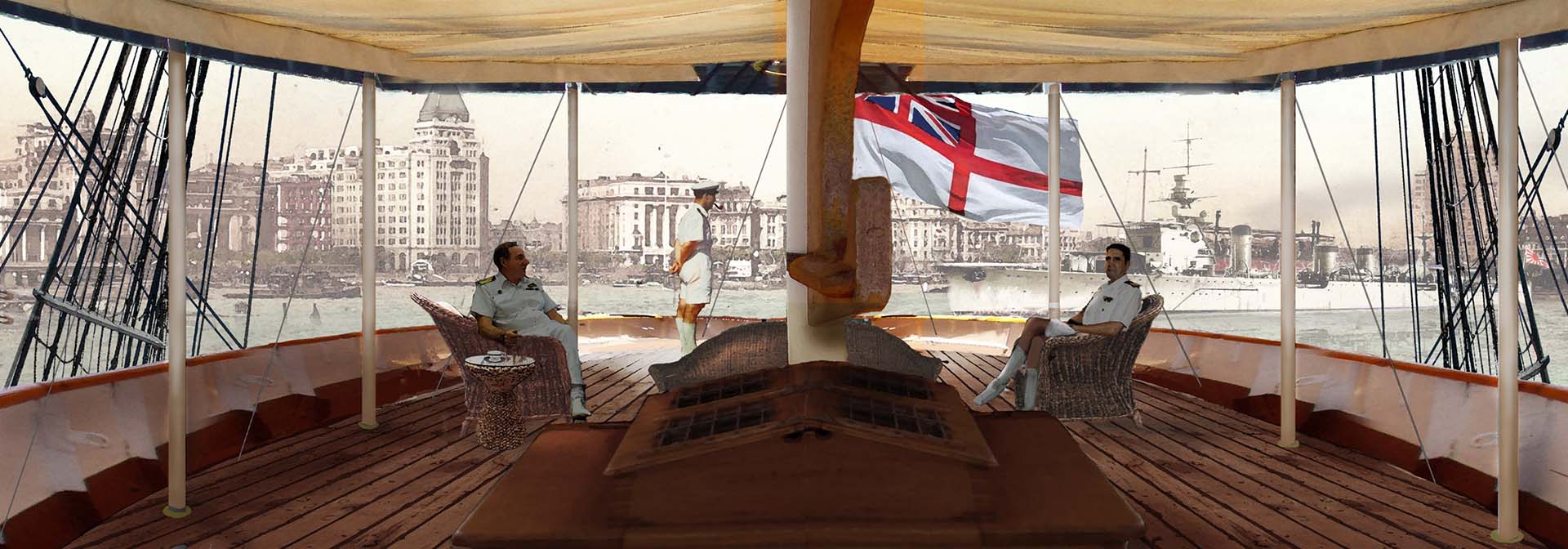
(Figure 4-3-2) Paul Draken was invited by the commander of the Yangtze River Flotilla to have tea on the aft deck of the gunboat.
The Royal Navy deployed several of these river gunboats on the inland waterways of China, under the command of the Yangtze Flotilla, headquartered in Shanghai. I often visited them for business. In peacetime, these river gunboats were painted white, with spacious, stable, and comfortable cabins. A canvas canopy was hung on the aft deck, where one could lie in a wicker chair, drink tea, chat, and watch the boats come and go on the river. In summer, a cool breeze would blow, giving the feeling of a yacht vacation – an atmosphere unavailable on regular naval vessels. Although I was only a lieutenant, each visit represented the intelligence group, so the flotilla commander would invite me to have tea on the aft deck and learn about outside news, which was crucial for their frequent missions deep upstream and into the Chinese interior. Actually, I had a purpose in visiting the flotilla commander. It was really unsafe to keep the radio cipher communication base on land. River gunboats were a good platform. The surrounding waters could isolate us from outsiders, and there were armed guards on guard 24 hours a day. The generators on board ensured a continuous power supply, and there were also towering mast antennas. So I wanted to persuade the commander to move our equipment to a gunboat. The only problem was that gunboats often had to go out on patrol and could not be stationed in Shanghai. So the commander could not spare one for me to use. It was not until the outbreak of the Sino-Japanese War in 1937 that warships from various countries withdrew from China one after another, leaving only one gunboat to symbolically stay in Shanghai. That one happened to be the "HMS Peterel". Since the outside world was occupied by Japan and there was nowhere else to go, I had the opportunity to move the cipher team to the ship.

In March 1934, I accepted an invitation and secretly arrived in Changchun (then called Sinking) to attend the coronation ceremony of Puyi, the emperor of Manchukuo. Although the Lytton Commission sent by the League of Nations did not acknowledge Japan's invasion of Manchuria, the Western powers secretly hoped for international co-governance of Manchuria. Japan, of course, was unwilling, and thus withdrew from the League of Nations a year earlier. My superiors agreed to let me attend Puyi's coronation ceremony, but in reality, they wanted to observe the relationship between Japan and Puyi and find a suitable opportunity to place British interests in Manchuria. For the sake of the face of the Nanking Nationalist Government, I had to go secretly.
Because I was more familiar with and attuned to Eastern societies than the average Briton, my work in China went relatively smoothly. I even began to participate in naval intelligence operations against Japan. I felt that my superiors valued me and couldn't help but become somewhat smug. My father in London was very familiar with my every move. In a letter he sent me, he advised me: "Being close to the Chinese is certainly helpful for your work, but I must also remind you that the Foreign Office in London traditionally suspects that overseas staff who get too close to foreigners may have forgotten that they are officials of the British Empire. Once trust is compromised, it will be difficult to have a future in the Foreign Office. Johnston is a good example."
The Sir Reginald Fleming Johnston my father mentioned was his Oxford classmate and colleague at the Foreign Office. Both of them developed their careers in the East, and he was considered an uncle who had watched me grow up. He later became famous for becoming Puyi's English tutor and was once awarded a Imperial yellow jacket, and horse to ride in the Forbidden City. In China, the status of an "Imperial Tutor" was higher than that of any other official, so Johnston was very proud and forgot that he was also an official of the British Foreign Office.
After Puyi was lured out of the country by the Japanese, he had no choice but to leave Puyi and return to Scotland to become a professor. Incredibly, he erected a flagpole at his doorstep and hung a yellow dragon flag, and kept saying that he wanted to go to Manchukuo to serve the emperor. His unusual words and actions aroused the suspicion of the Ministry of Foreign Affairs, which issued a curfew order forbidding him from returning to the East.
When I arrived in Sinking and met with Puyi, I mentioned Professor Johnston to him. After hearing this, Puyi said, "Poor Professor Johnston is still so loyal to me. It seems I should send him an invitation so that your Ministry of Foreign Affairs won't make things difficult for him."
Puyi did indeed write an invitation letter and asked me to take it back to London. In 1935, Johnston rushed to Puyi's side, but by then his emperor was completely under the control of the Japanese, and Johnston was also nearing the end of his life.
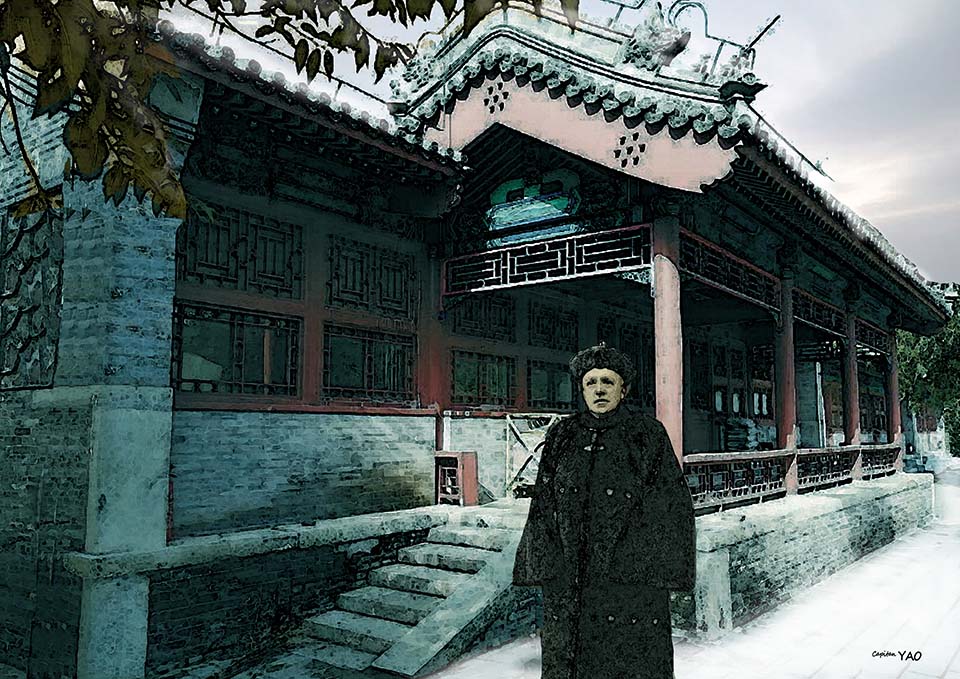
Puyi's coronation ceremony was a combination of Eastern and Western styles. The Japanese had only allowed him to wear Western-style military uniforms, but he went to great lengths to find and wear a Ch'ing Dynasty dragon robe. He also insisted on building a Temple of Heaven in the suburbs to offer sacrifices to Heaven. I witnessed this interesting ceremony while standing at the Temple of Heaven.
I also met Puyi's empress, Wanrong, a pale but pitiful woman. Kawashima Yoshiko followed closely by her side as she walked.
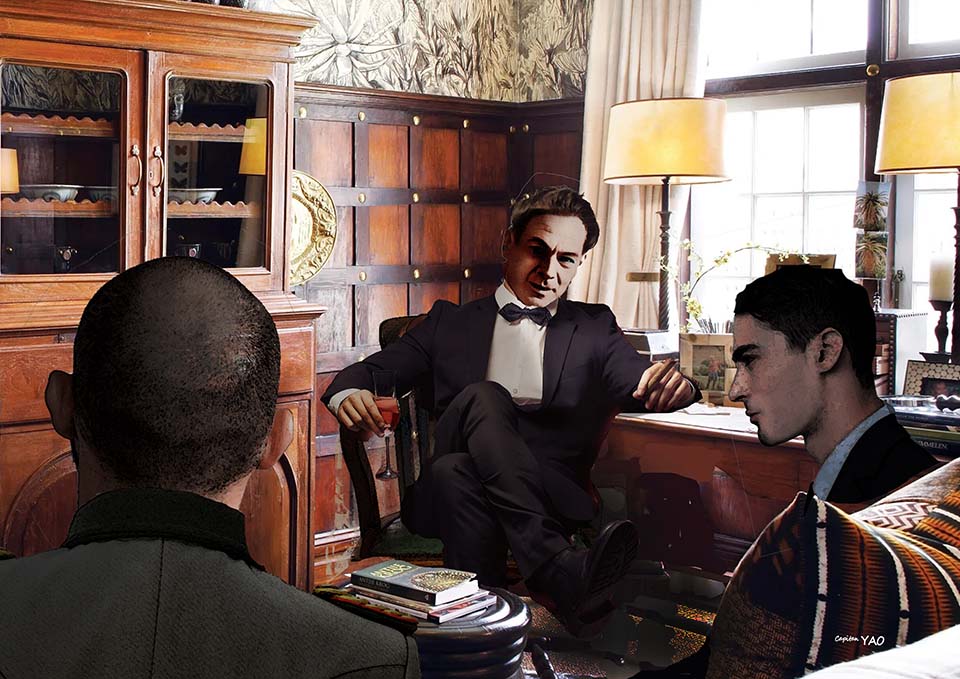
One evening, a coronation ball was held in the palace. The second-floor gallery was equipped with many bright arc lights, making the ball look like a scene from a movie. Curious, I went up to the gallery and saw Masahiko Amakasu directing the camera. This time, I couldn't pretend not to know him, so I took the initiative to strike up a conversation: "Oh! Mr. Amakasu, you're directing?"
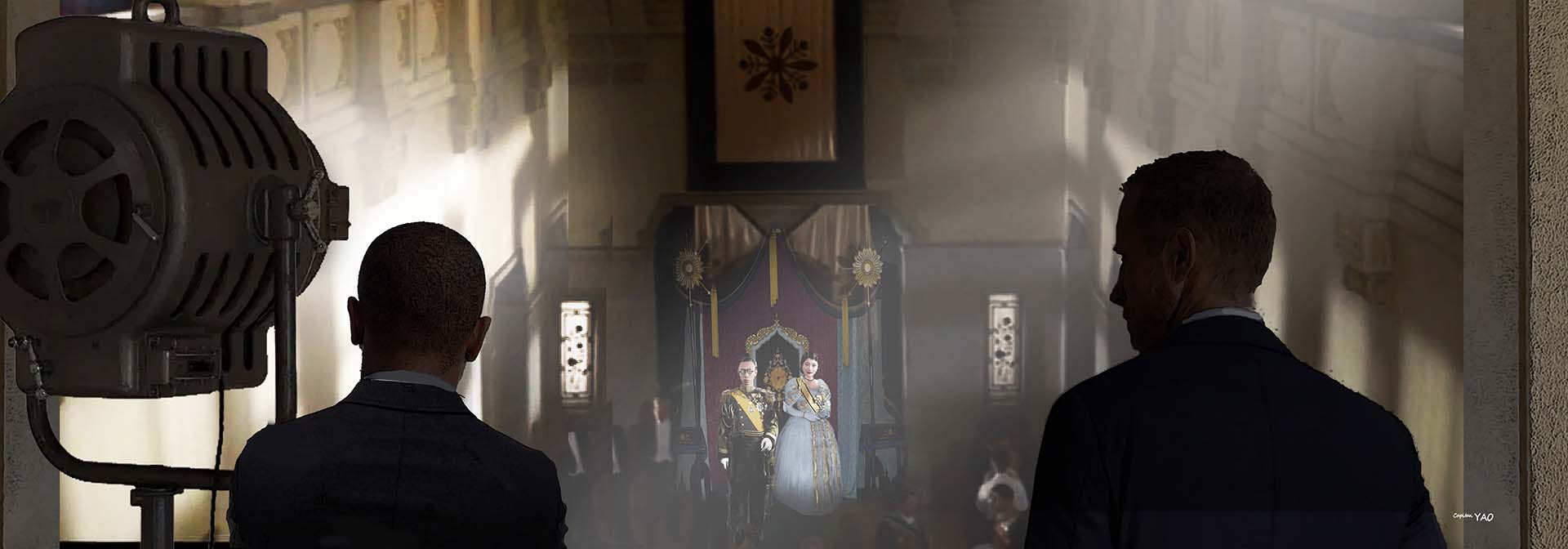
(Figure 4-3-4) Paul Draken and Amakasu Masahiko exchange greetings at the ball celebrating the coronation of the Emperor of Manchukuo.
After exchanging brief pleasantries with Masahiko Amakasu, I continued to look down at the ball from the corridor, watching Wanrong leave Puyi alone. Soon after, Yoshiko Kawashima approached me and said, "This isn't fun; let's go do something exciting!" I said, "Are you out of your mind? This is the palace!" "So what if it's the palace? I can come and go as I please. Come on, follow me!" Kawashima pulled me away from the corridor and led me to the depths of another long corridor. She turned the doorknob of one of the rooms, and when the door opened, I saw Empress Wanrong lying on the sofa. I thought I had gone to the wrong place and quickly apologized and tried to back out, but Kawashima pulled me into the room and locked the door. "I've brought you a man, a real man, your highness!" Kawashima said to Wanrong. "I can prove it!" "You?" I stared at Kawashima, speechless. Before I could even react, Kawashima had already grabbed me from behind and was groping me. Wanrong, who had been lying on the sofa, got up and slowly walked over, resting her head next to Kawashima. I could smell the strong scent of her perfume. Kawashima took Wanrong's hand and stroked it. She was a little shy at first, but when Kawashima started to put his hand inside her clothes, Wanrong trembled all over, her face turned red, and she collapsed into my arms. I pushed Kawashima away and carried Wanrong to the sofa. Kawashima stood to the side, watching us with admiration... The feeling was indescribable. She was no longer a noble empress; she was just a young woman craving sex. Once it started, her wantonness was completely different from her previous reserve. I don't know how Kawashima trained her, but I could see many of Kawashima's traits in her reactions.

(Figure 4-3-5) Yoshiko Kawashima uses a spy camera to photograph Wanrong and Paul lying on the sofa and laughs wildly.
"What are you doing?" "A spy camera just imported from Germany, what do you think? Pretty compact, right?" Kawashima laughed wildly as he walked out of the room. I could guess Kawashima's intentions; these photos could be used to blackmail Wanrong and Puyi, and even, if necessary, Britain—all because of my connections. But I didn't have time to think about that now; my priority was to escape. Afterwards, I leaned down and kissed Wanrong, helping her put on her clothes. Wanrong said softly, "Can you come often in the future?" "Do you think that's possible? You should go back to the Emperor's side." Wanrong sighed and said, "He's more interested in Professor Johnston than in me..." I'm not sure what she meant by that. There are indeed many rumors circulating about Puyi's sexual orientation, but I can't ask too many questions. Did Puyi not notice that his empress was missing all night, or did he simply not care? On my way back to Shanghai, I suddenly remembered what Master Chiu had said before: "Both the princess and the queen will not have a good end. The queen disappeared in the chaos of war, and the princess died a violent death..." Wanrong was the Empress! Could it be that she...?
In late May 1934, my father's old friend, Admiral Togo Heihachiro, passed away. He was a hero who led the Japanese Combined Fleet to victory over the Russian fleet in the Tsushima Strait during the Russo-Japanese War in 1905. After the war, he was promoted to Admiral and enjoyed a god-like status. In fact, he was able to detect the Russian Baltic Fleet's approach from afar thanks to intelligence provided by my father. I had met this old Admiral during my visit to Japan in 1923. My father was unable to come due to illness and entrusted me to represent him at the state funeral.
In the past, it was customary for countries to send special ships to attend the funerals of important naval figures. Although Britain sent a delegation led by Admiral Frederick Dreyer, commander of the Royal Navy's China Fleet, to Japan aboard the cruiser "HMS Suffolk", I was not on board as I was representing my father's personal affairs and not as a member of the official delegation. I chose to travel on the Chinese Navy's cruiser "Ninghai". This was arranged with the help of my Chinese classmates at the Royal Naval College. Time was very tight, and I had to rush to Weihai overnight to board the ship.
The "Ninghai" was a light cruiser built in Japan in 1932. It was equipped with three 5.5-inch main guns and a seaplane hangar at the stern, which was considered advanced for its time. It was also the flagship of the Chinese Navy. The "Ninghai" was led by Rear Admiral Wang Shouting, commander of the Chinese Navy's training fleet, and departed from Weihai on the morning of June 2 to attend the state funeral of Admiral Togo. It also took the opportunity to return to the Harima Shipyard for repairs.
Admiral Wang treated me with great courtesy, arranging a nice cabin for me. I was also invited to the bridge to watch them maneuver the ship and conduct exercises, which was exactly why I wanted to board the "Ninghai". She is the flagship of the Chinese Navy and the newest light cruiser built by Japan, but she still uses coal as fuel, so thick black smoke billows from the smokestack every time it is turned on, trailing a long distance behind the stern and not dissipating for a long time.
I've sailed on many ships belonging to the Northeast Navy, but this was my first time aboard a ship belonging to the Fookian-based Central Navy. The officers and sailors all spoke Foochow dialect, which I didn't understand a word of, so I had to speak English with them. Fortunately, the officers, graduates of the Mawei Naval Academy, were all highly trained, trained entirely under the British naval system, so communication was easy. However, I remembered Admiral Shen Honglie's criticism of officers from Mawei: "They're well-educated, but not soldiers!"
Observing from the sidelines, it does seem to make some sense.
At midnight on the 3rd, the "Ninghai" ship arrived at Moji Port in Japan. Admiral Wang and his entourage, along with the honor guard, disembarked and took an express train to Tokyo in time for the funeral on the morning of the 5th. I originally hoped to go with them, but I was not allowed to because I was not a member of the Chinese naval delegation. So I had to continue sailing with the "Ninghai" to Yokohama, arriving on the 7th, which was two days after the funeral. I did not actually make it, but I still conveyed my father's condolences to Admiral Togo's family.
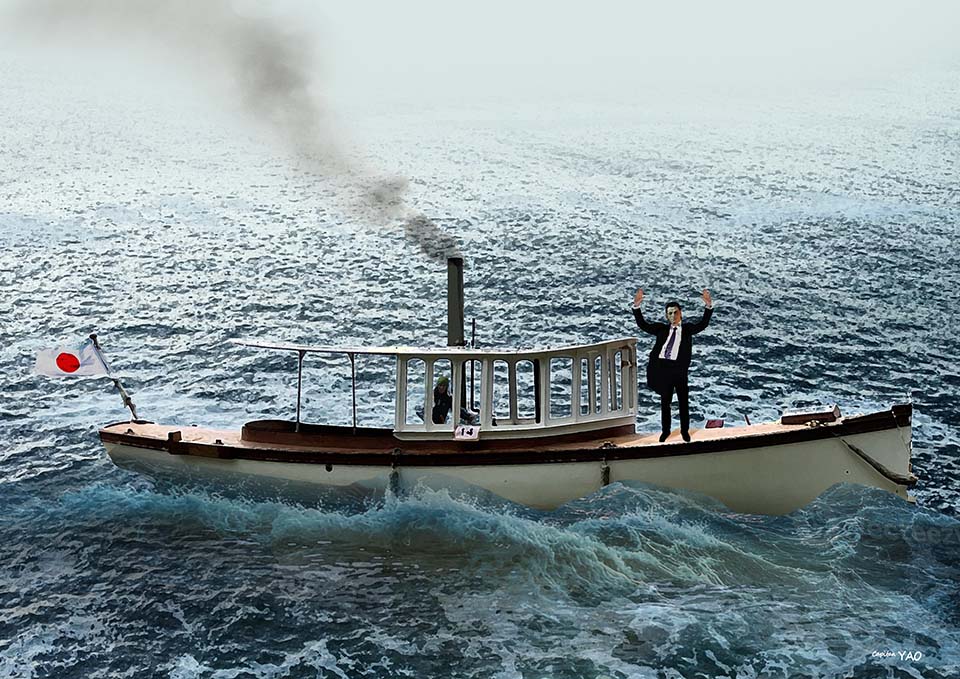
On the 7th, when the cruiser "Ninghai" approached the waters off Yokohama, I also went up to the bridge to watch them deploy and enter the port. I saw small boats coming from afar. At this time, I noticed that the railings on both sides of the ship were covered with sheets drying in the sun. I quickly reported to Captain Kao, but the captain's reply seemed to think that I was making a fuss.
"Drying bedsheets out to dry is the ship's rule; things will be clean when it's open to visitors in a couple of days!" Captain Kao pointed into the distance and said, "You mean that? That's the pilotship!"
I feel like I'm an outsider who doesn't understand the rules and likes to meddle in other people's business, so I don't want to say anything more.
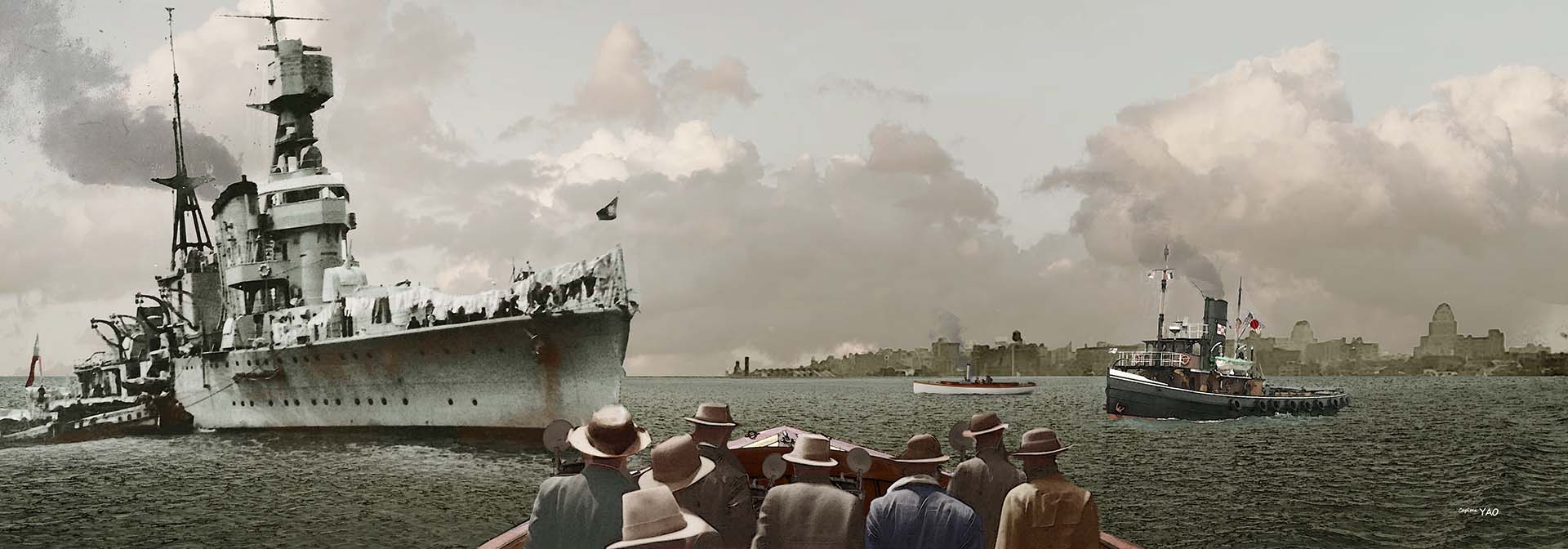
(Figure 4-3-6) Japanese media chartered a boat to take photos of the "Ninghai" entering Yokohama Port to hang clothes to dry.
My father once told me the story of how the Chinese Beiyang Fleet's ironclad warships, the "Tingyuan" and "Chenyuan," were drying their trousers on the cannons during a visit to Japan more than forty years ago. At the time, these two German-made ironclads were the heaviest, most heavily armored, and largest-caliber warships in the Far East, shocking the Japanese, who had no comparable vessels to counter them. However, Captain Togo Heihachiro, then the port commander, saw the Chinese navy's weakness: "Drying trousers on sacred cannons? This is the greatest insult to weapons! A fleet with such discipline will be utterly vulnerable in wartime!" Togo's prediction came true. The Chinese Beiyang Fleet was completely annihilated in the war with Japan from 1894 to 1895. The "Tingyuan" sank, and the "Chenyuan" was captured by the Japanese. My father had even seen her serving in the Japanese Navy when he was serving in Japan. Did these Japanese media outlets who came today still want to find what Admiral Togo had foreseen? Sure enough, the next day, major Japanese newspapers published news of the Ningha" , "drying clothes on its guns!" even comparing it to the history of the "Tingyuan" and "Chenyuan"'s visits to Japan more than forty years ago. Although Captain Kao was right to say that drying clothes on the deck and ropes of warships was a tradition shared by navies of all countries, and I had seen Japanese warships do this same, this time the Japanese media were clearly prepared, so we had to be on guard. Unfortunately, the careless Captain Kao allowed their cunning to succeed.
I saw a tall Western man on one of the small boats circling around me; it was Dr. Sorge! He waved frantically: "Remember to look for me when you get to Tokyo. Phone? No need, you can find me at the German Embassy..."
As I mentioned earlier, Richard Sorge's American colleague and girlfriend during his time working in China, Agnes Smedley, was a good friend of Annie's. We met and attended several parties together. Later, during the Shanghai Incident, we encountered him at the Chinese army's positions, where he was there to conduct an interview. Remarkably, disregarding his status as a journalist, he was actually helping the Chinese troops fighting the Japanese distribute hand grenades. Sorge left China last autumn to work in Japan.
After I arrived in Tokyo, I actually went to the German Embassy to find Sorge one afternoon. I thought the embassy would have to go to great lengths to help me find a fellow citizen, but to my surprise, Sorge was already inside the embassy. He told me why he was there: he was now not only a reporter for several German media outlets in Japan, but also an advisor to the German Embassy in Japan.
Sorge was having a wonderful time in Japan. The exotic charm of the East and the gentleness of Japanese women made him completely forget about Smedley. What surprised me even more was that he had now become a pro-Nazi, a complete 180-degree turn from his previous words and deeds in China when he joined forces with Smedley to fight against fascism!
"If Smedley likes it, I'll join in the cheering!" Sorge said. "But I'm German after all, and our country is gradually recovering under Chancellor Hitler's leadership. If I don't support him, who should I support?"
Sorge had told me before that his father was German but his mother was Russian. He was born in Russia and his family moved back to Germany when he was young, which is why he speaks fluent German and Russian. During the European war, Sorge served in a German army infantry regiment and was awarded the Iron Cross Second Class and promoted to sergeant for his military achievements and two wounds. This record left no room for doubt about his loyalty to Germany, a record so similar to that of Adolf Hitler.
So when he arrived in Japan, everyone at the German embassy treated him differently. He was very proactive and soon gained the trust of the ambassador and military attaché. He even got a personal office in the embassy later on.
At that time, Hitler's Nazi Party had only recently come to power, and the German community in Japan, far from the central government, still retained the liberal ideas of the postwar era. The Nazi Party's influence was not yet very obvious. However, Sorge was more enthusiastic than the average party official upon his arrival, and was therefore particularly welcomed by the young officers in the military attaché's office at the embassy.
Due to my professional instincts, I believed that Sorge was a German spy. At that time, the German threat was not very obvious, and our superiors had never asked us to do this kind of work. So I just put my judgment of Sorge in my diary. I never expected that this information would play such a big role later, but the result was far beyond our expectations. I will continue to mention Sorge's story later.
As for Agnes Smedley, she was deeply devoted to the Communist Party and later went to Yan'an to follow Mao Tsetung, becoming the most important channel for the Chinese Communist Party to communicate with Western society. Another interesting anecdote is that she reportedly got these conservative CCP leaders to start dancing Western capitalist social dances in the cave dwellings of Yan'an.
Sorge told me about the current political situation in Germany and Hitler's ideals, which gave me a deeper understanding of the current situation in Europe, even though Sorge's words sounded a bit like Nazi propaganda.
However, Sorge was Sorge after all, and soon he revealed his true nature as a playboy.
“Talking about politics is too boring, let’s talk about Japanese geisha,” Sorge said. He felt that Japan was a paradise for Westerners, and later it really did become the place where he went to heaven.
|