9. The Shanghai Incident
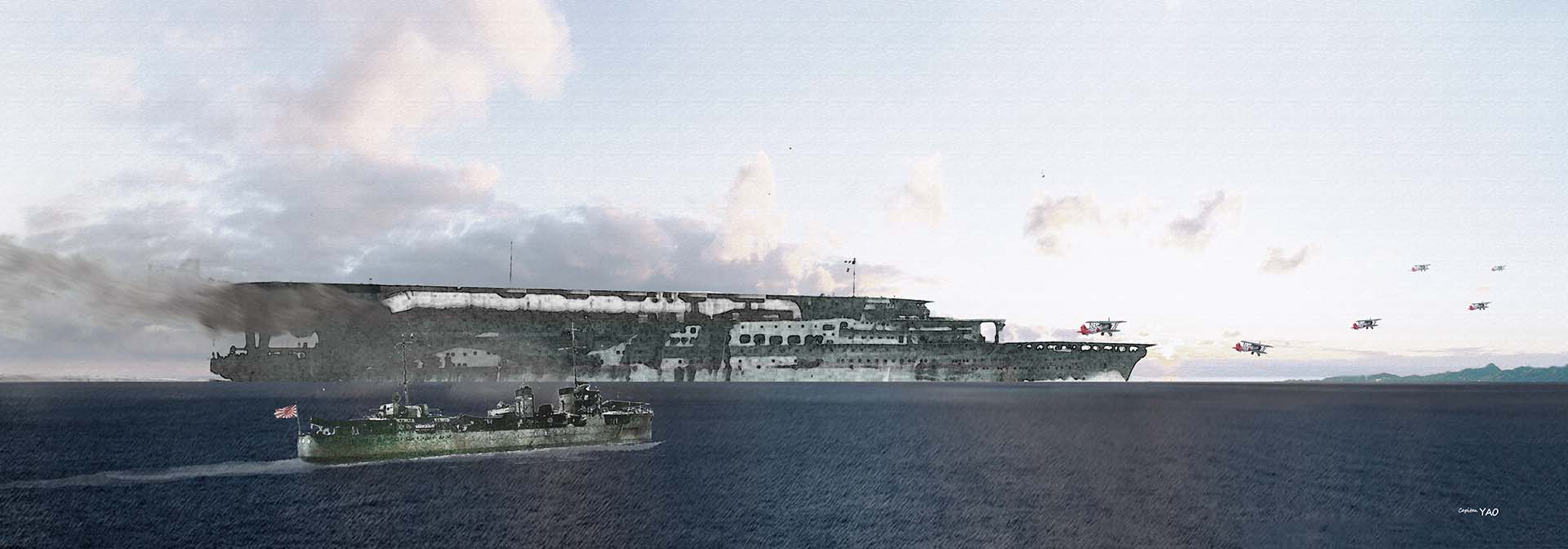
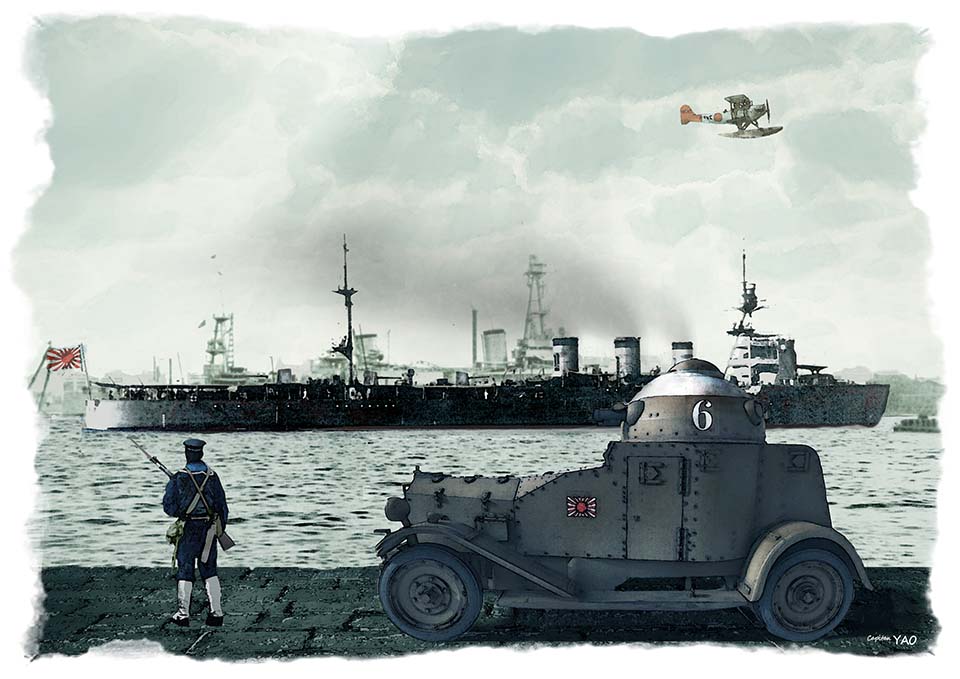
(Figure 3-9-1) The Japanese Navy aircraft carrier "Kaga" participated in the "First Battle of Shanghai" and took off from the open sea with Type 90 carrier-based fighters. At that time, "Kaga" had not yet been refitted and was still in the era of three decks.
Before I knew it, Christmas 1931 had arrived. Unlike when I first came to China, I felt time was flying by. Perhaps this meant I had gotten used to this place and was gradually integrating into the local society. Annie and I had both been busy with our own things this year, and we seemed to be drifting apart. I decided to make it up to her on Christmas Eve. I bought her a necklace with a diamond, without telling her that it was the exact same style I had given to Lomui for Christmas 1927.
Kim Bihui wasn't seen on Christmas Eve this year, but according to our group's intelligence, she should be coming to Shanghai frequently recently. I wonder what she's planning? Sure enough, as soon as 1932 arrived, the continuous conflicts between Chinese and Japanese civilians reached their peak on the 28th. That night, the Japanese Marines and the Chinese 19th Route Army engaged in fierce fighting in Zhabei. Japanese aircraft carriers sailed to the open sea, and planes took off to bomb the Chinese-controlled areas of Shanghai. The Japanese Marines also dispatched numerous armored vehicles to attack the Chinese troops—a spectacle never before seen in Shanghai.
The fighting in Shanghai was perhaps even more tense for the Western powers than the Manchurian Incident of the previous September, because the foreign concessions and the Chinese-controlled areas were so close and intertwined that misfired shells or mistakenly dropped bombs could land on the streets of the concessions. For the British, maintaining stability was in their best interest, so they were trying their best to get a ceasefire. Our intelligence group had to provide our superiors with accurate information for their assessment.
I needed to figure out where the Japanese bottom line was, something I couldn't get from my Chinese informants. I needed intelligence sources from the Japanese side, but how easy was that at this crucial moment? I thought of Yoshiko Kawashima. But with the war raging, where could I find her? Just as I was racking my brains trying to figure it out, she unexpectedly came to me first!
Yoshiko Kawashima called me and asked to meet at a secret location. After consulting with my superiors, I went alone. When I saw Kim Bihui, she was dressed in men's clothing and was swinging a cane around, acting rather strangely.
"Aren't you busy fighting a war right now? How come you have time to meet me and catch up?" I said to her deliberately when we met.
"You absolutely have to help with this!" Yoshiko Kawashima said, as usual, plopping down on my lap.
"Help you?" I asked, curious.
She held a walking stick in both hands, wrapped it around the back of my neck, and pulled me forward. Her bright red lips pressed against mine, and after a passionate kiss, she told me why she had come to see me.
It turns out that the Shanghai Incident was not part of the original plan of the Japanese military. Their focus at this stage should have been on North China. The Shanghai Incident was purely an accident caused by a clash between Chinese and Japanese civilians instigated by their intelligence organization. Now that the battle with the Chinese 19th Route Army is at a stalemate, finding a way to save face as soon as possible is the best strategy. Since this accident was caused by Jin Bihui and her group, she must be responsible for finding a solution. The first person Kim Bihui thought of was me!
"Could you ask the British minister to intervene?" Yoshiko Kawashima asked.
"This?...Shall I give it a try?"
While I said this, I was secretly thinking that this was incredibly easy money; it turned out to be exactly what Britain wanted to do but didn't know how to start. However, for the mediation to be effective, the Chinese side needed to cooperate, so I asked Yoshiko Kawashima, "But what about the Chinese army?"
"Don't worry, I know the Chinese army's trump card perfectly well," Yoshiko Kawashima said confidently. Then she revealed a shocking secret: "That old lecher Sun Ke told me everything."
Sun Ke was Sun Yat-sen's son and was then the Premier of the Executive Yuan in Nanking. I had heard that Yoshiko Kawashima had taken the initiative to approach him, but I didn't expect her to win him over so quickly. The 19th Route Army was fighting bloody battles on the front lines, but the rear had already revealed its hand to the enemy, which profoundly affected the attitude of the 19th Route Army generals later on.
Yoshiko Kawashima deliberately revealed Sun Ke's affair as leverage to persuade me to invite Britain to mediate. This made me the biggest winner, giving me control over both Japan and China's cards and providing Britain with significant room for maneuver. When I returned and reported the information to my superiors, those conservative career diplomats were utterly shocked. The arrogant Japanese would actually seek peace? They couldn't believe a mere youth could handle such a major matter so easily.
"How could this kind of thing be relayed through you? Is the information accurate?"
Diplomacy in the new era is no longer the same as in the 19th century, and the importance of intelligence officers is increasing day by day.
As expected, in May, Britain, along with France and the United States, mediated and declared Shanghai a demilitarized zone. The Chinese government transferred the 19th Route Army from Shanghai to Fookian to suppress the Communists. The army's commanders were resentful, feeling betrayed by the government, and later joined forces with local Communist forces to declare independence—an event later known as the "Fookian Rebellion," which triggered another crisis of civil war in China. The Central Army subsequently quelled the unrest in Fookian and disbanded the 19th Route Army.
This incident is known in China as the "January 28 Incident" because it occurred on January 28th, while internationally it is commonly referred to as the "First Shanghai Incident" to distinguish it from the "Second Shanghai Incident" of August 13, 1937. These two incidents were related. Because the "First Shanghai Incident" created a sense of crisis in the foreign concessions, Western mediation focused on the withdrawal of troops from Shanghai by both China and Japan. China could only deploy police, while Japan deployed lightly equipped marines.
However, both sides had their own agendas. Following the incident, Japan began constructing a massive bunker-like headquarters for the Shanghai Special Marine Corps on North Sichuan Road, equipped with artillery and armored vehicles. China, in turn, secretly deployed its regular troops disguised as police officers. Upon learning of this, the Japanese marines sent personnel to inspect the site, leading to a clash that resulted in casualties and ultimately escalated into a full-scale war between China and Japan, known as the "Second Shanghai Incident."
The First Shanghai Incident was a peculiar war. While the two sides were locked in fierce fighting in Shanghai, the Chinese and Japanese navies were simultaneously engaging in mutual visits and celebrations. China's order for cruisers from Japan remained completely unaffected, with delivery proceeding normally and on schedule. This incident seemed to be solely a war fought by the 19th Route Army, unrelated to other units. Furthermore, the internal conflicts between the Japanese army and navy were clearly revealed in this incident. Yoshiko Kawashima was an army member, and the navy didn't clean up her mess; she had to find her own way to resolve the trouble she had caused.

After the Shanghai Incident, I remembered my business dealings with General Ouyang Ge. In 1931, I had arranged for him to visit shipyards in England. However, General Kui Yungching, who had studied in Germany, controlled the entire trip and made him focus on Germany. So when Ouyang Ge returned from his inspection tour of Europe after the Shanghai Incident, he showed great interest in the large torpedo boats made in Germany. "Bigger is better! It won't rock when we're out at sea, and the torpedoes will be able to hit the target more accurately!" Ouyang Ge said. "The Chinese navy may not have the opportunity to engage in a decisive naval battle with Japanese fleet in the future!" I said. "If it were to take place on rivers, it would be more like a land battle. Our British CMB torpedo boats are light, shallow-draft, and highly maneuverable, making them more suitable for future operations against Japan than the cumbersome German boats!" What I'm talking about is my firsthand experience from the Sino-Soviet Three Rivers Estuary Campaign two years ago. However, the traditional mindset of relying on large warships and heavy artillery has firmly bound most naval officers who came from surface ship backgrounds. Ouyang Ge shook his head and said, "The purpose of our naval academy is to train naval personnel who can truly operate across the ocean. If they can only run around in rivers, wouldn't they become water police?" Shortly after Ouyang Ge returned to China in 1932, Chiang Kai-shek ordered him to establish the "School of Mining Command" (S. M. C.) He chose Cheniang as the school site and scheduled the opening for January of the following year. He also used his personal connections to obtain a gunboat, the "Haitsing," from the Chekiang Coast Guard for student training. The contract to order three large torpedo boats from Germany was signed in 1935.
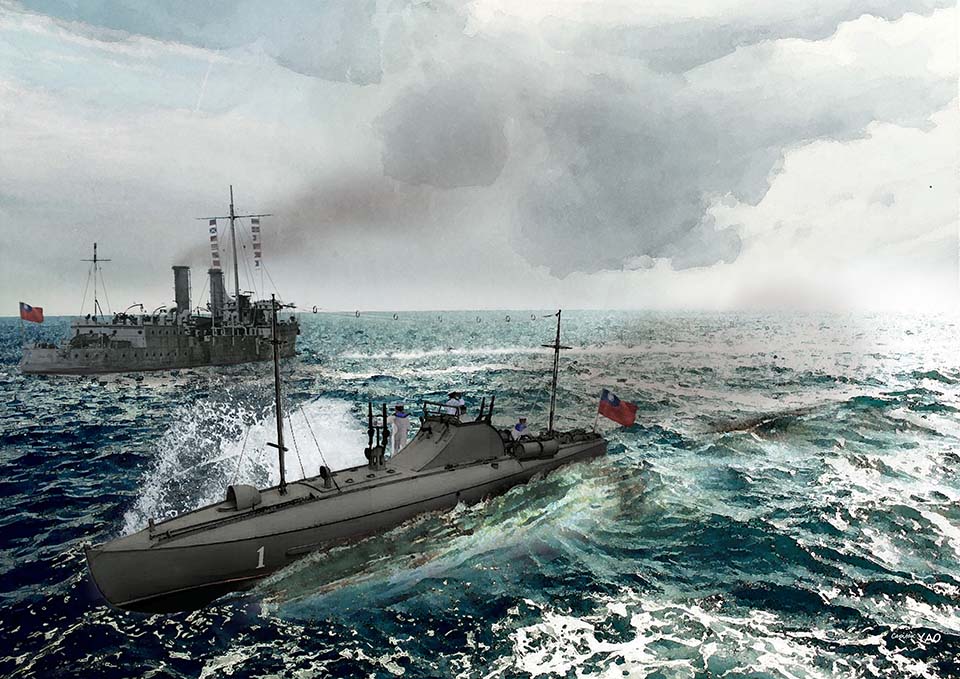 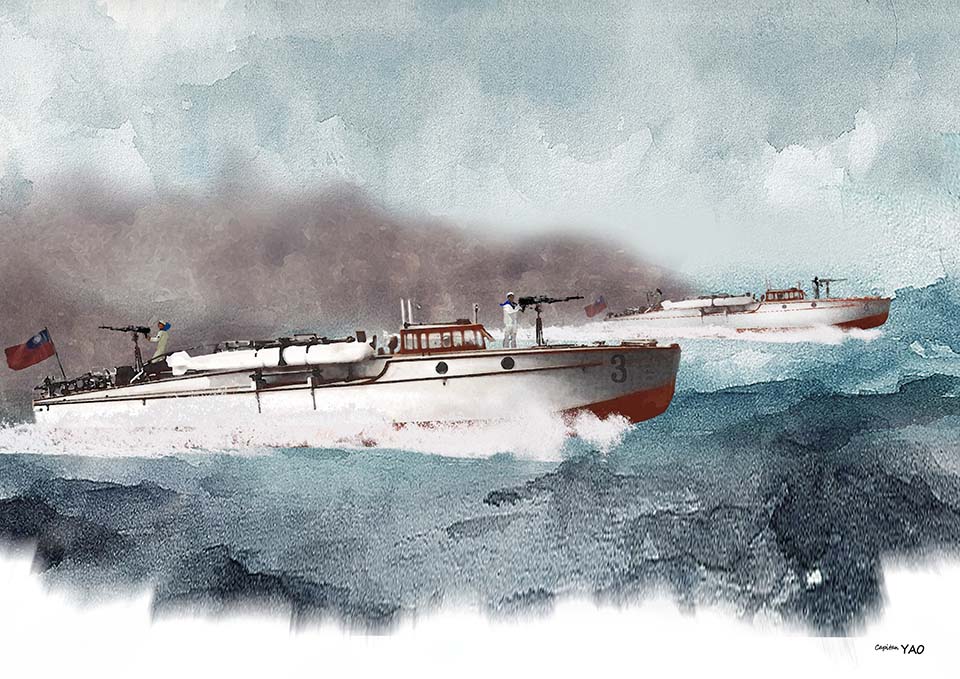
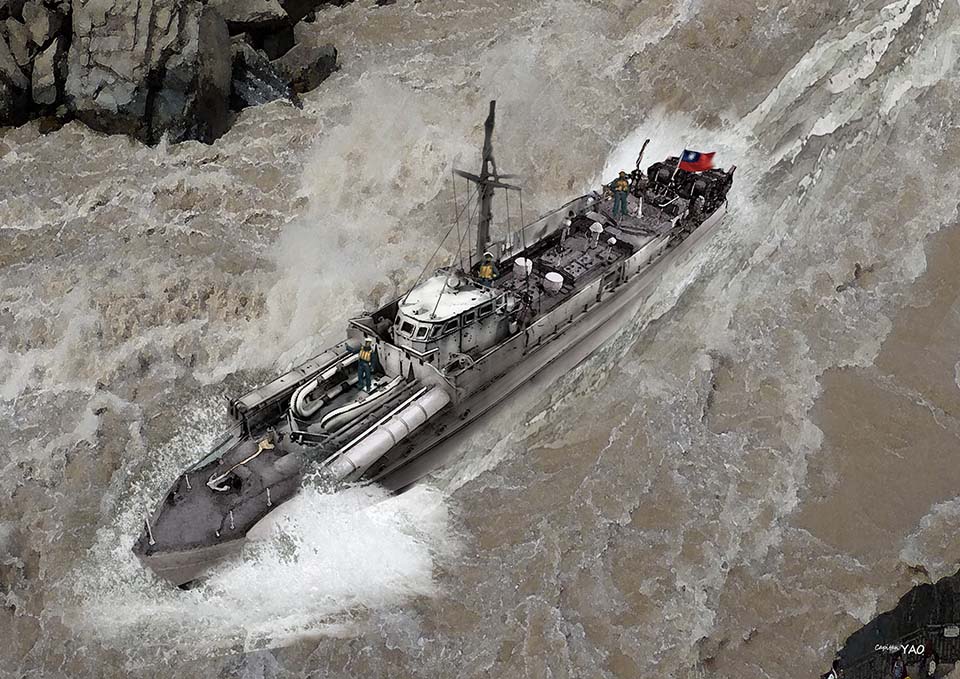
(Figure 3-9-4) The Canton Navy's British-made CMB torpedo boat "No. 1 Torpedo Boat" and "Chongshan" gunboat conduct joint exercises. (Figure 3-9-5) The Canton Navy's Italian MAS torpedo boats "No. 3 Torpedo Boat" and "No. 4 Torpedo Boat".
Ouyang Ge was intrigued by the Canton Navy's actions. After learning about it through his connections, he found my reasoning to be sound and finally placed an order for 12 CMB torpedo boats with Thorncraft Company in 1936.
"An order for 12 torpedo boats!" This was truly hard-won. I went to the gunboat on the Hwampoo River to tell Willie the good news, but it turned out he had already gotten used to life on the ship and didn't want to be transferred back to the intelligence group.
I once visited the German-made S-7 torpedo boat at the S.M.C. It was much larger than the British-made CMB torpedo boat, with a 92-foot-long steel hull and a displacement of 54 tons; our British-made torpedo boat was only 55 feet long with a wooden hull and a displacement of 14 tons, just one-third of that.
German-made torpedo boats featured two 21-inch torpedo tubes mounted on either side of the bow deck. This was the design of the first generation of German torpedo boats; later versions integrated the torpedo tubes below deck. The tubes used high-pressure gas to propel the torpedoes, making the system far more complex than that of the British CMB boats, and naturally, much larger and heavier as well.
British-made CMB lacked launch tubes; instead, two 18-inch torpedoes were locked onto a rail at the stern. To launch an attack, the boat would first speed towards the target, then release the torpedo clamps, allowing the torpedoes to slide into the water from the stern and hurtle towards the target. The boat would then accelerate ahead of the torpedoes and turn away. This unusual torpedo attack method raises serious doubts about its hit rate. However, the British CMB were specifically designed to attack anchored warships.
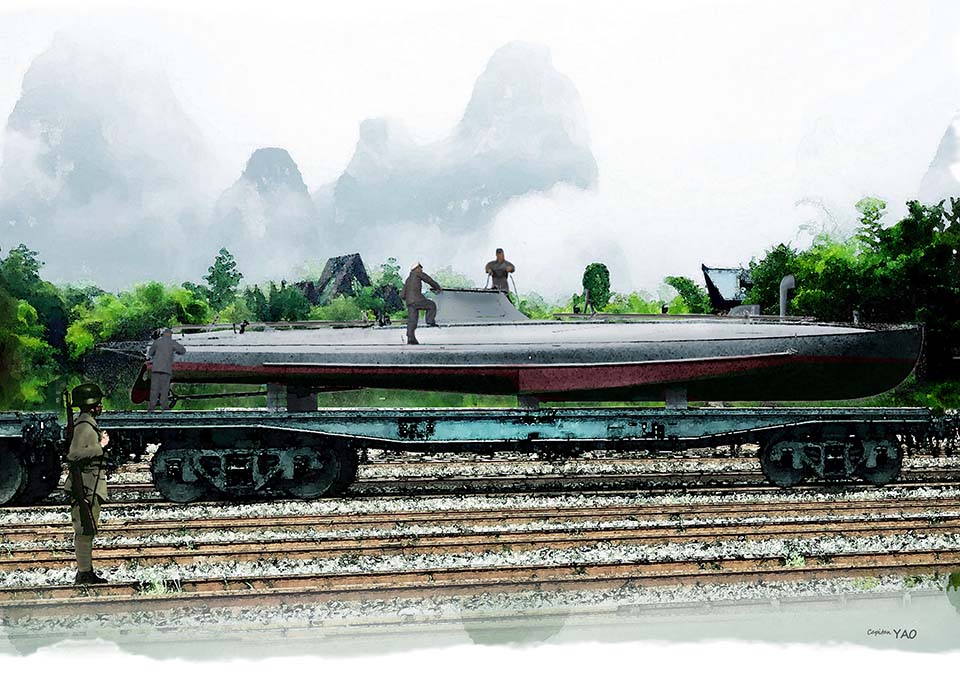
Simplifying equipment reduces costs and size, facilitating large-scale deployment and mobility—something German torpedo boats could not achieve. This is because British CMBs could be transported by train, which was crucial for China, whose coastline might be completely blockaded at the outbreak of war. This allowed the Chinese army to utilize the railway system to move its fleet inland for attacks, achieving a surprise victory.
It can be said that Germany's S-series torpedo boats were scaled-down versions of regular warships, while Britain's CMB-type torpedo boats were true special attack weapons, especially in China's inland waterways. Moreover, the CMB was relatively inexpensive and suitable for mass deployment, but for impoverished China at the time, even the CMB was an expensive luxury, and only a few could be purchased. More importantly, the Chinese military leadership lacked sufficient understanding of the operational characteristics of torpedo boats, resulting in these CMBs not playing a significant role during the war.
However, for the S. M. C., buying torpedo boats was just the beginning; their real goal was submarines. I really hoped to get their order, but at this time, China and Germany were getting closer and closer, and London often did things that displeased the Chinese government. So, the order for five submarines was snatched by Germany, but after the outbreak of World War II, they were all requisitioned, and none of them were delivered.
Back then, the Chinese government's procurement of foreign arms was handled entirely through Chiang Kai-shek's brother-in-law, H.H. Kung. Ouyang Ge's direct approach to me to purchase torpedo boats from Britain was tantamount to blocking his path to wealth. This not only had a negative impact on the British arms market in China, but worse still, these boats performed poorly after the outbreak of the Sino-Japanese War. The expensive equipment failed to perform effectively, and H.H. Kung took the opportunity to slander Ouyang, accusing him of embezzlement. This may have been one of the reasons why Ouyang Ge was later executed by Chiang Kai-shek.
Due to official business, I frequently travel between Hong Kong and Shanghai, which gives me many opportunities to meet with Canton military personnel in Hong Kong and obtain a great deal of intelligence. The Canton military is heavily reliant on Hong Kong; many weapon and equipment parts must be imported through Hong Kong trading companies, and the annual maintenance of larger naval vessels is also carried out at the Whampoa Dockyard in Hong Kong. Therefore, it is common for their military personnel to come to Hong Kong. You may remember Song Feihu, who fled from the north with me to Hong Kong in 1927 to start an airline. We were later confiscated by the Canton government, along with our aircraft. He is now a figure in the Canton Air Force. When I met him in Hong Kong at the end of April 1932, he revealed that the Canton military had recently launched a purge. The former Air Force Commander Chang Huichang had been dismissed by Chen Jitang, a military leader in Canton, and Huang Guangrui had taken over. Huang Guangrui was the pilot who took me flying in the "Rosamond" in 1924. Chen Tsitang's purge made Chan Chak, the commander-in-chief of the Canton Navy, feel that his own safety was also in danger, so he concentrated his ships at Huangpu to counterattack. On May 3, Chan Chak led eight warships, including the "Chongshan" and marines, to Hainan Island to declare his secession from the Canton government. When he set sail from Humen, he also had a fierce battle with the forts. Subsequently, throughout May and June, the two sides had many naval and air battles in Hong Kong, Macau and Hainan Island, which aroused great tension in the Hong Kong British government.
Chan Chak's military tactics were superb, reminiscent of my teacher Shen Honglie. Chen Tsitang planned to send troops to land on Hainan Island, but the motorized sailing ships carrying the troops were discovered by Chan Chak's warships and crushed by artillery fire and ramming, drowning many officers and soldiers. On June 15, Chan Chak sent the ships "Chongshan" and "Hairui" to land on Chen Tsitang's hometown of Peihai, robbing them of opium and bank cash. Then, on the 21st, he sent the "Chongshan" gunboat to rob Chen Tsitang's arms ship "Shuitong" in the Lingdingyang, seizing thousands of guns and ammunition.
Chen Tsitang, having reached his limit of tolerance, ordered the Canton Air Force to bomb Chan Chak's fleet. At this time, Britain was outwardly neutral, but secretly had decided to help the Canton government quell the unrest as soon as possible to avoid affecting the stability of Hong Kong. As the only one with naval aviation combat experience, I became the only choice, and the Hong Kong British government made a request to the Naval Intelligence Group.
I secretly arrived in Canton at the end of June. To ensure success, I insisted that Song Feihu lead the attack, with Ding Jixu, the captain of the third squadron, leading three planes for cover. Due to the lack of aerial torpedoes and sights, the mission was quite difficult. Based on my experience in Shanghai, I compiled some formulas and made some simple aiming tools, which turned out to be quite effective.
For reasons of secrecy, the Hong Kong British government wanted me to stay as short as possible. After a few days of on-site training and verification, I secretly returned to Shanghai via the inland. Ding Jixu led the air force to Leizhou and soon discovered that the "Feiying" ship was anchored in Haikou. The air force immediately launched an attack, but there were no results.
July 7, 1932, is a significant day in the history of naval aviation worldwide. The day before, under the cover of the Third Air Squadron, Song Feihu, near the port of Hainan Island, fired a 150-pound bomb that penetrated the deck of the "Feiying" destroyer, causing it to leak. The crew was thrown into chaos, failing to organize any rescue efforts. This 850-ton destroyer, built in Germany in the last century and featuring four funnels, gradually took on water and sank completely on the morning of the 7th, becoming the first Chinese warship to be sunk by aircraft. Song Feihu was my prized student; after my personal training, he indeed surpassed his teacher.
After the sinking of the "Feiyang," Nanking intervened to mediate, but in reality, everyone had their own ulterior motives. Because many defector ships fled to Hong Kong for refuge during the war, the Hong Kong British government had the power to decide whether to release these ships. At that time, the Fookian-affiliated Central Navy in Nanking was eager to take over these Canton ships, but the Hong Kong British government objected for fear of damaging relations with Canton. In the end, only the "Chongshan" was taken over by the Central Navy, and the rest of the ships returned to Kuangchow.
After the incident, Chan Chak went to Europe and America for inspection. After returning to China, he joined Chiang Kai-shek in Nanking and served as the director of the Naval Command of the Military Commission. He was not giving up. Three years later, he planned another bigger drama of the departure of Canton ships, determined to bring down Chen Tsitang!
On March 1, 1932, the Manchukuo Empire was established, with the deposed Ch'ing emperor Puyi as regent. Subsequently, the League of Nations sent Sir John Lytton to China in April to investigate the Manchurian Incident. Unexpectedly, at this time, Wang Yachao, a member of the Hong Gang, attempted to assassinate Sir John Lytton. However, his men were arrested for robbing a bank, and the plot was exposed. Both China and Japan were afraid that this would have an adverse impact on their own side, so they mobilized various intelligence forces to investigate. At that time, there was a great deal of tension.
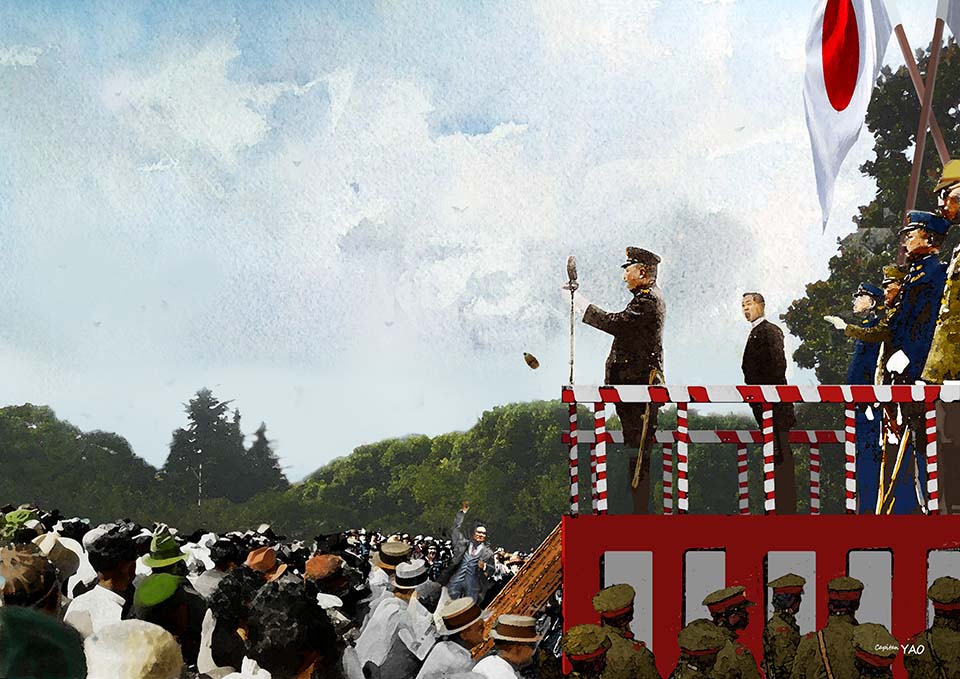
Then Wang Yachiao orchestrated the bombing at Hongkou Park in Shanghai on April 29. Through his arrangement, Yoon Bong-gil, a Korean exiled in Shanghai, infiltrated the site of the Japanese celebration of the Emperor's birthday, "Tencho-setsu," and used a bomb to kill General Yoshinori Shirakawa, the highest-ranking Japanese military officer stationed in Shanghai, and Teiji Kawabata, the head of the residents' administrative committee. The bomb also injured several high-ranking officials, including the Japanese Minister to China, Mamoru Shigemitsu, as well as army and navy generals.
The British Consul General in Shanghai also attended the celebration that day, but left early to avoid the subsequent celebrations of Japan's victory in launching the Shanghai Incident. No sooner had he left than a tremendous explosion occurred. The Consul General, still shaken, immediately summoned me through my superior. This wasn't originally within the scope of the Naval Intelligence Service, but because he had heard that I was most familiar with Chinese society, he insisted that I be in charge of the investigation.
Because Yoon Bong-gil did not flee after the incident and publicly announced his identity and purpose, the cause of the incident was quickly identified. In fact, we had already guessed that the mastermind behind it was the Korean exile group in Shanghai, the so-called "Provisional Government of the Republic of Korea." One of their leaders, Kim Koo, had previously secretly contacted us, hoping to obtain assistance from the British. I was the person who contacted him on behalf of others, so we had met several times. Unexpectedly, more than ten years later, I helped his son, who was serving in the Chinese Air Force, return to Korea to establish the Republic of Korea Air Force—but that's another story.
Most of the Korean exile groups were hiding in the French Concession of Shanghai. Due to Japanese oppression, the concession authorities were forced to arrest Korean residents en masse, causing great panic. Kim Koo then came to me again, hoping I could help persuade the concession authorities to release these innocent Koreans. But the French Concession and our International Settlement were two separate administrative systems; how could I overstep my bounds and interfere in the affairs of the French Concession?
I thought of Annie's godfather, Huang Jinrong, the former head of the Chinese detectives in the French Concession police station. Huang Jinrong had already retired by then and built a vast garden called "Huang Family Garden," so large that it even had a private fire station. One afternoon, Annie and I went there to find him.
When Huang Jinrong saw us, before I could even say anything, he immediately asked Annie, "You promised to invite your godfather to the wedding, why haven't you told me yet?"
"I still have one wish to fulfill," Annie said, blushing.
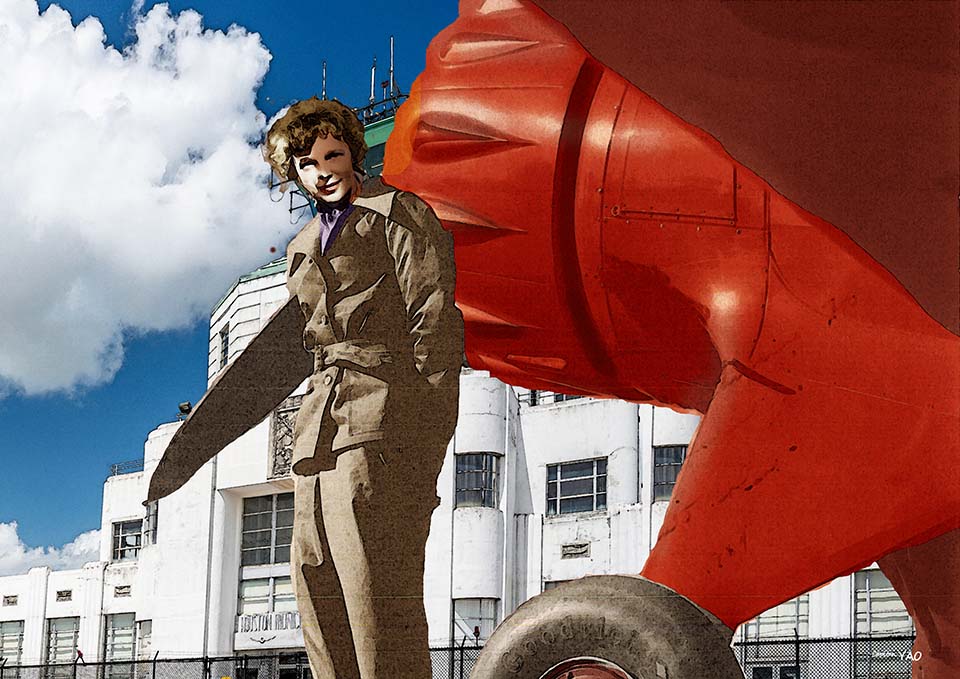
On May 21st of that year, American Amelia Earhart became the first woman to fly solo across the Atlantic Ocean, and she even claimed she would be aiming for the record of becoming the first woman to circumnavigate the globe. Annie felt a little resentful upon seeing this news; in fact, Annie was the first woman to circumnavigate the globe, but because she didn't fly solo, most people assumed she was a passenger rather than the pilot.
"Don't be angry! I know you can drive!" I comforted her when I saw her pouting.
"No one will believe me if I don't fly solo!" Annie said. "I'm determined to fly solo around the world before her!"
"You're not kidding, are you? Your father will definitely not agree!" I remembered Annie's father's instructions to me.
At that time, Elhart was already internationally famous. In fact, Annie was more qualified to be considered an idol, at least she was younger and prettier (although Elhart is quite charming in photos, but that was an image created by sophisticated public relations).
Because Elhart was based in the United States, he had easier access to the media, which led him to become a Hollywood star, and later even have licensed merchandise. As for Annie, flying planes was just one of the fashionable and expensive hobbies of a wealthy heiress.
Annie is a very serious woman. She keeps her word and really started preparing in secret. She also kept an eye out for information about Elhart, which I only found out later. At the time, I was too busy with work to notice.
When Kim Gu asked for his help, Huang Jinrong used his retirement as an excuse to avoid interfering. In reality, I knew that although Huang was retired, his protégés and followers still controlled the French Concession police station. His excuse of "inconvenient intervention" likely stemmed from his belief that the Korean exile groups were unprofitable and not worth offending the Japanese for. However, this seasoned veteran still pointed out a possible path: "Use the newspapers!"
Since most of the newspapers in Shanghai were anti-Japanese, I hinted to Kim Koo to leak the news to the newspapers, which immediately sparked a barrage of criticism from the entire Shanghai news media. Then the international media followed suit. Under pressure from public opinion, the Japanese and the French Concession had no choice but to release all those arrested. However, the "Provisional Government of the Republic of Korea" could no longer stand in the French Concession and had to move to Hangchow.
In May, I was secretly summoned by my superiors. They said the Japanese had designated me to go to Manchuria as a liaison between Britain and Japan. I wondered if this was another of Kim Bihui's schemes. At that time, Japan had already occupied Manchuria and installed Puyi as the founder of the Manchukuo government. Contact between the British and Japanese envoys would be a very sensitive matter. My superiors were very cautious about this matter, fearing the reaction of the Chinese government, and demanded that my trip be kept secret. Therefore, I could not go there openly as before, aboard the "China Pearl." Moreover, my team leader had warned me that Annie was too conspicuous in Shanghai and that being with her would be detrimental to intelligence work. So I didn't see her for a while. My superiors only required secrecy, but did not provide any specific arrangements or assistance. Given the large number of people coming and going at the Shanghai docks, no one could guarantee that the trip would be kept secret. Coincidentally, in June, the "Chenhai" training ship of the Northeast Chinese Navy was carrying students from the Tsingtao Naval Academy on a long-distance training voyage. Through Admiral Shen Honglie's connections with the Japanese Navy, they arranged a visit to Taiwan. When the ship stopped in Shanghai, the captain invited me to board and tour the ship.
The Chenhai was seaplane carrier when I bombed Shanghai in 1927. It felt very familiar to board the ship again, as many of the people on board were people I knew in the past. Unlike the last time when I was kidnapped, this time I became a VIP on the ship.
"Would you like to travel to Taiwan on this ship?" the captain asked me.
"Taiwan?" I had caused a huge uproar there just over a year ago. Wouldn't going there now be like walking into a trap? But curiosity prevailed, and I immediately accepted the captain's invitation. However, this impromptu trip triggered a series of events.
The next morning, as agreed, I arrived at the dock and boarded the small boat sent by the "Chenhai". The captain immediately ordered the ship to weigh anchor. On the bridge, I watched the "Chenhai" ship sail out of the Yangtze River estuary and turn towards Taiwan. The sea breeze was refreshing, and all the pressure of the past few days was left behind. I was in a completely pleasant mood, like I was on vacation. The problem is that I didn't report this trip to my superiors. Coincidentally, Annie contacted me for several days in a row, but I ignored her. In her anxiety, she used her godfather Huang Jinrong's network of informants and quickly found out that I had gone to Taiwan. "Go to Taiwan? Isn't that like walking into a trap?" Annie shouted, while calling my office. The colleague who answered was baffled, because Annie kept emphasizing that I might have been kidnapped to Taiwan. This was unacceptable! So my unit secretly contacted the Japanese intelligence agency in Shanghai, and the Japanese were also completely baffled. The news quickly reached Kenji Doihara. "You bunch of good-for-nothings! This is the brilliance of the British!" Doihara said. "They publicly claimed he was detained because of the theft at a Taiwanese shrine, but secretly they wanted us to send him to Manchuria to complete a secret mission. It was a brilliant tactic, done without anyone knowing!" Kenji Doihara immediately made various arrangements and personally went to Taiwan to deploy them.
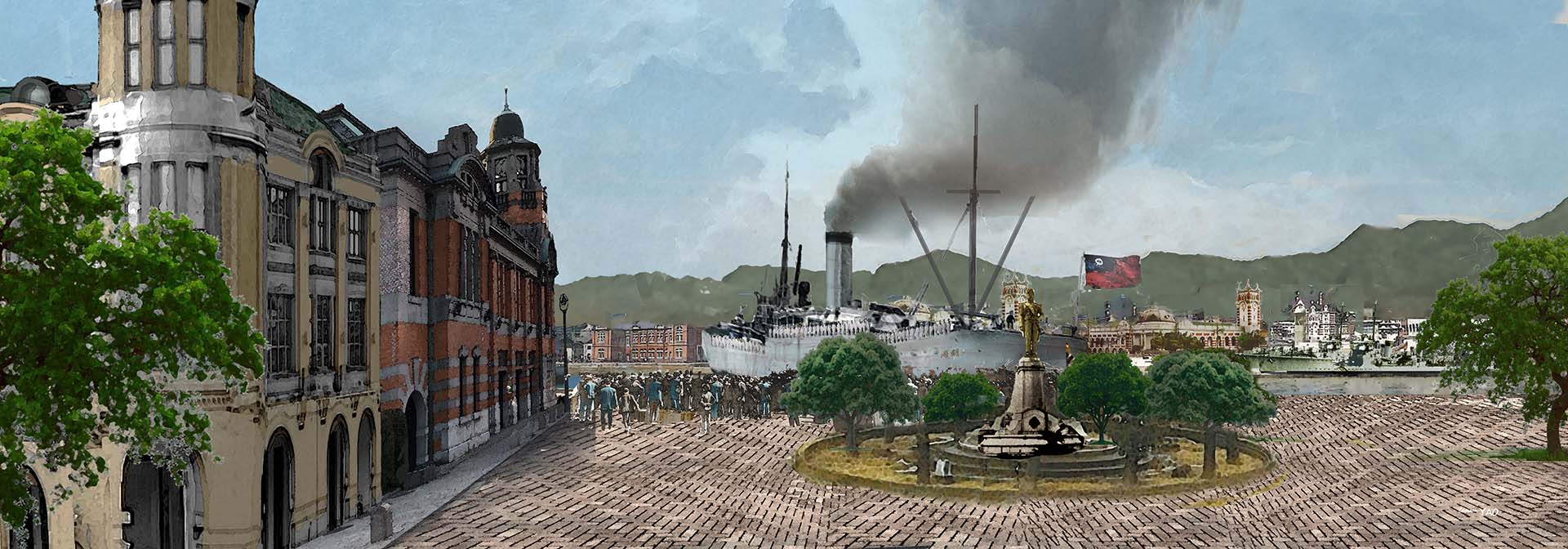
(Figure 3-9-12) The Republic of China Northeast Navy training ship "Chenhai" was transferred from Tamsui to Keelung and docked in front of the customs pier.
As is customary during naval port visits, there are many visits and tours. I accompanied the captain and officers on board to the flagship of the local mine warfare squadron for an official visit. It was a light cruiser with three funnels, and the flag raised on the mainmast indicated that a rear admiral squadron commander was stationed on board. Japanese warships are very cramped. We could only move forward in a single line in the aisles. My professional instincts as an intelligence officer made me always walk at the back during the tour so that I could easily observe the surroundings. Just as I turned a corner, a handkerchief covered in chloroform came straight at me, and I fainted on the spot.
I don't know how much time passed before I woke up to find myself lying in the cabin. The swaying deck indicated that the ship was sailing at sea, and I thought I was on the "Chenhai" ship. At that moment, the cabin door opened and a sailor brought in food. I saw that he was wearing a Japanese Navy uniform and cursed inwardly, "How unlucky I am, I've been kidnapped again."
Then a man in plain clothes followed me in, and I recognized him as Kenji Doihara.
"Such a brilliant move is truly admirable, Lieutenant Draken!" Doihara said with a smile, "We are now on our way to Manchuria."
"Manchuria?..." As soon as the words left my mouth, I realized it was inappropriate, so I immediately suppressed my surprise and pretended to be relaxed, saying, "That saves me the cost of a boat ticket."
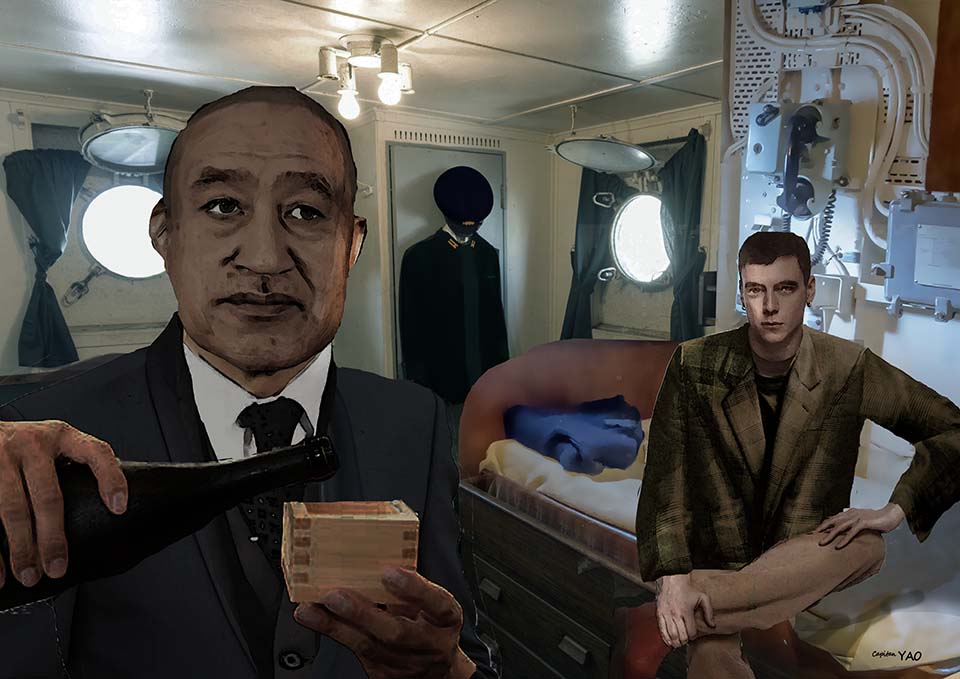
Doihara pulled up a chair and sat down, picked up the sake from the plate, poured two "masu", and handed one to me, saying, "Yes! It's brilliant that you made the Chinese government think you were detained in Taiwan because of the shrine theft, while you secretly went to Manchuria on a clandestine mission! Here, let me toast you!"
"So that's how it is. It was quite a lucky accident." Doihara finished speaking, downed his drink in one gulp, and continued, "However, I have a question for you, sir: was that luminous pearl in Loulan real or fake?"
|