10. The Manchurian Emperor
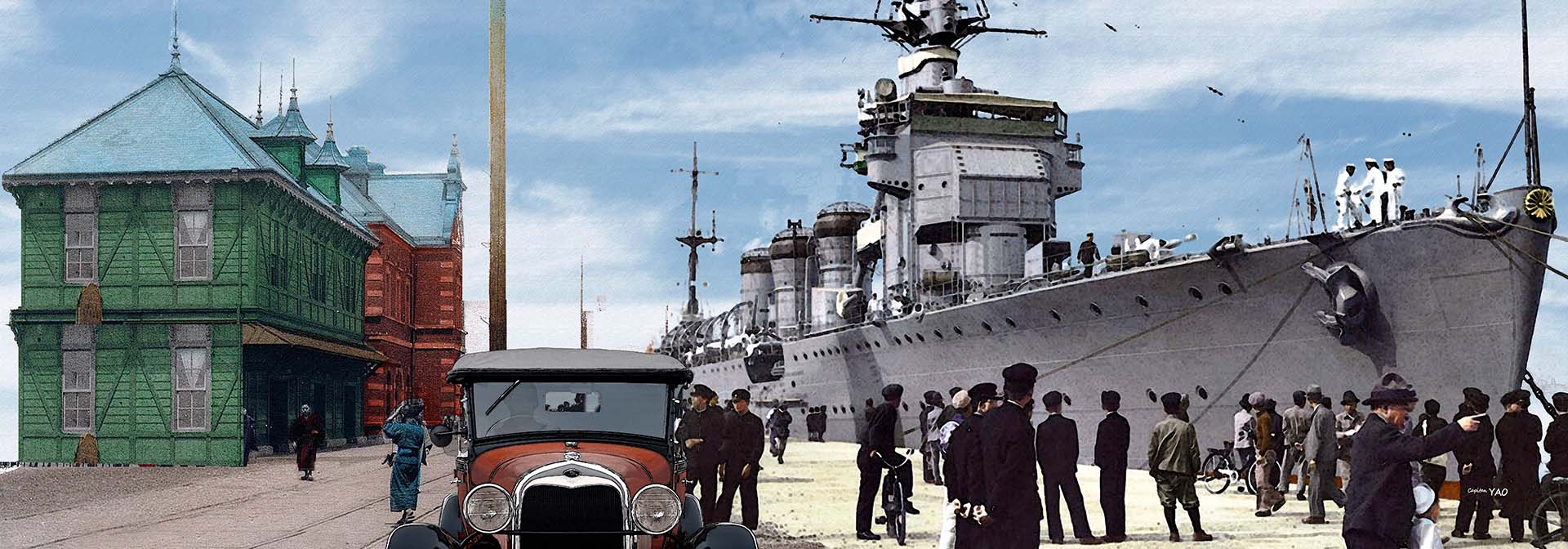
(Figure 3-10-1) Yoshiko Kawashima personally drove to Lushun Wharf to pick up Paul and Kenji Doihara.
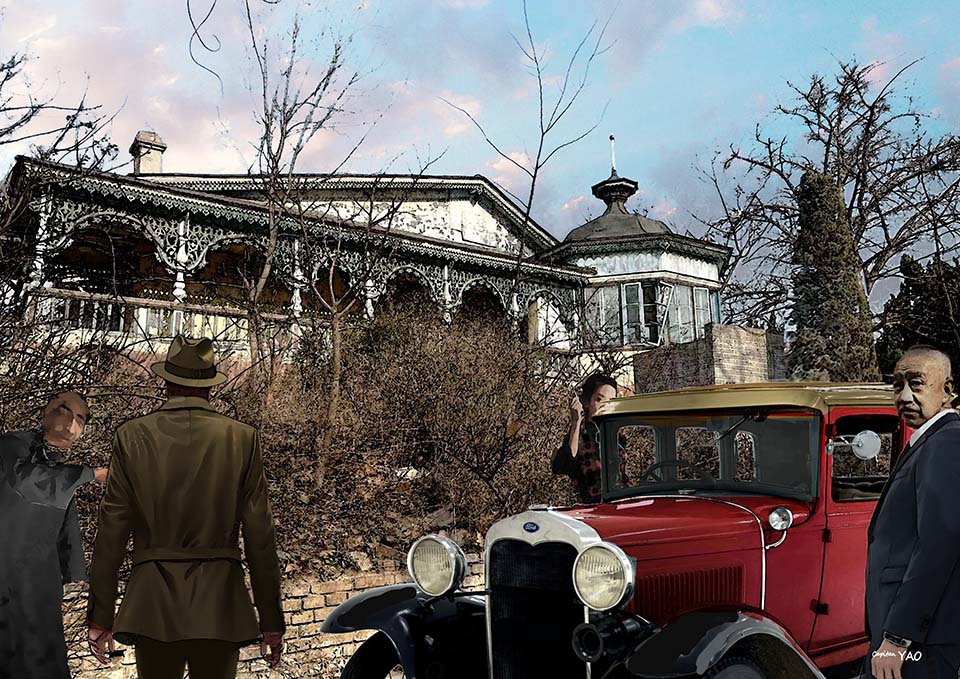
My intuition tells me that Kim Bihui borrowed the luminous pearl from the Japanese, but the Loulan mission failed. Unable to explain herself, she insisted the pearl was fake and shifted the blame to Captain Ma. Interestingly, the pearl stolen from the shrine was originally fake, but neither she nor the Japanese knew it; while the one in Loulan is real because I switched it at the last minute. "It's fake!" I said firmly, though I could still see a hint of disbelief on Doihara's face. "Then what about that missile on the Poseidon submarine..." Doihara asked. "It's fake too!" I replied. "So which one is real?" Doihara was clearly confused. "The one belonging to Chiang Kai-shek's wife!" "No, no, no!" Doihara shook his head and said, "As far as I know, the one Sun Dianying presented was probably fake!" "Hahaha! That's just something they said on purpose to mislead outsiders," I said. "If the one on Loulan was real, how could Kawashima's mission have failed? If the one on the Poseidon was real, wouldn't the British have gone to salvage it? Let me tell you, only Soong Mei-ling's one is real. Look how lucky Chiang Kai-shek has been these past few years. He only stepped down last December and became the Chairman of the Military Commission this January, with even more power!" Kenji Doihara was skeptical, but the impression that Chiang Kai-shek's wife, Soong Mei-ling, possessed a genuine luminous pearl was deeply ingrained in his mind, which had a decisive influence on his later policies towards China. However, Yoshiko Kawashima believed that the luminous pearl from Loulan was the real one, which is why she later instigated the Kanton Army to launch the Nomonhan Incident. "Aren't you going to ask me about the theft of treasure from the shrine?" I asked him tentatively. "Since that luminous pearl is fake, why even mention it?" Doihara said calmly, "I understood immediately. The treasures offered in such a grand ceremony at Taiwan's highest-ranking official shrine were fake? No Japanese person could bear such a loss of face, so everyone chose to keep quiet about it. I'm sure no one wants to pursue this matter now, because if it gets out, many Japanese people will probably have to commit seppuku." The warship docked at Lushun Port. Looking back after disembarking, I saw it was indeed the light cruiser I had visited in Keelung. Doihara pointed to a car by the dock, and as I walked over, I discovered that the driver was none other than Yoshiko Kawashima.
After we got in the car, she said, "Come on! I'll take you to see an old friend!"
"An old friend? Who is it?" Yoshiko Kawashima smiled but did not answer. Soon the car drove into a heavily guarded villa on the hillside.
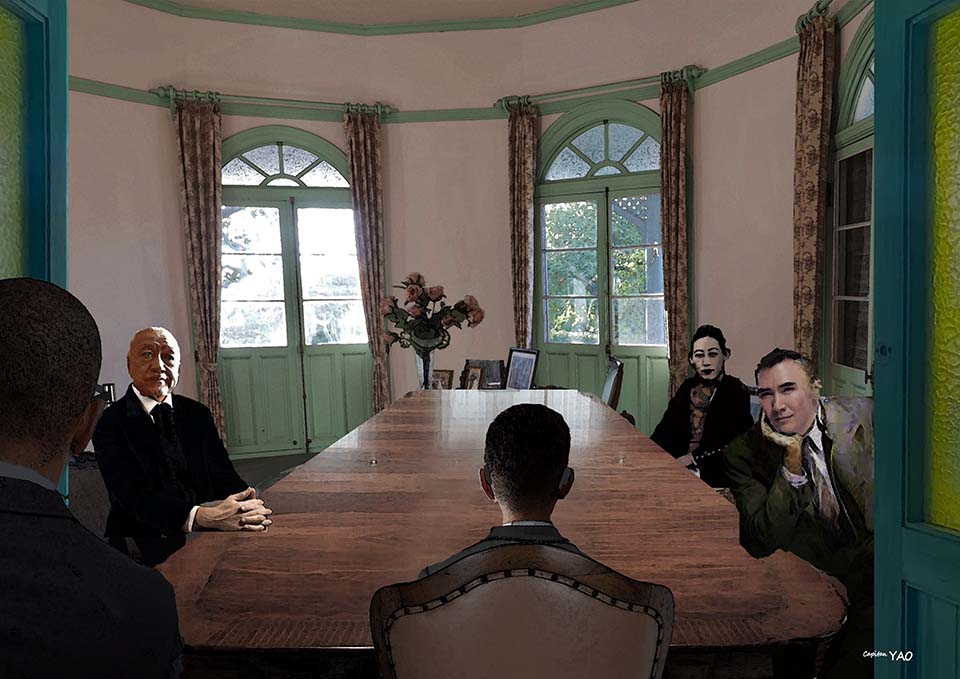
A servant led us to a large table in the hall, whereupon a thin young man wearing round glasses emerged from the room. Everyone immediately stood and bowed in greeting. Seeing my lack of reaction, Yoshiko Kawashima tugged at my sleeve and said, "You've forgotten? This is your cousin Henry, His Majesty the Emperor!"
"Cousin Henry? His Majesty the Emperor?" I tried hard to recall, but it was difficult to connect my impression of the young emperor in the Forbidden City with the young man in a suit who was about my age.
"Hello Paul!" He spoke first, in English.
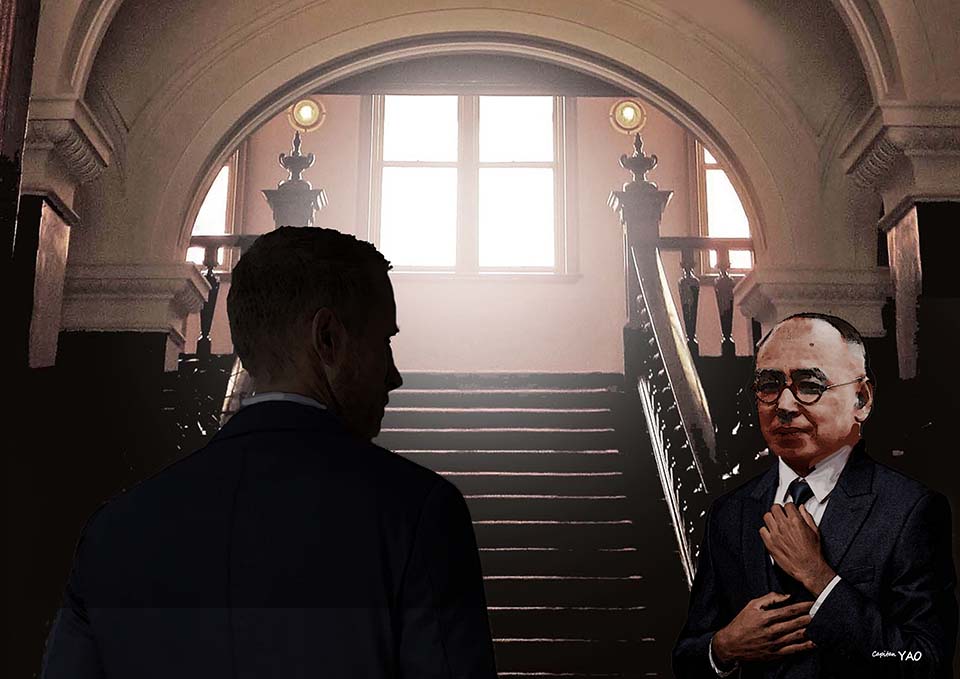
Then I saw a man standing behind a pillar by the hall, looking at Puyi. Strange? I felt like I'd seen him there before.

"Hmm!" Puyi simply nodded in response. "The Manchurian Empire hoped to establish normal relations with Britain," Doihara said, "and also hoped that Britain could assist in ensuring that the League of Nations investigation team could reach a conclusion that was consistent with the facts." At the time, the Lytton Commission, sent by the League of Nations to investigate the Manchurian Incident, had just left China. Japan hoped that Britain could exert its influence to ensure that the investigation report aligned with Japan's interests, namely, acknowledging Japan's occupation of Manchuria. My role was to deliver this message. They chose me because the case of the Shanghai Incident led them to believe that I was well-versed in the British diplomatic system.
Japanese people often express themselves indirectly because it is considered impolite to be straightforward in Japanese society. Finding a suitable intermediary to relay messages and probe the bottom line of both parties is necessary to protect face, but this often leads to mistakes or gives others an opportunity to take advantage of the situation.
At the end of World War II, Japan's willingness to surrender to the Allied forces through the Soviet Union allowed the Soviets to gain a huge advantage, while the Japanese people suffered two atomic bombs for nothing!
"Please go back and convey to the British Foreign Office that His Excellency's establishment of the Manchurian Empire is completely legal. Manchuria was originally their territory, and the Chinese government has no right to interfere. Our Japanese Empire is merely helping to achieve their wishes. We hope that the British Empire will also join in this great undertaking," Doihara said.
After listening to Doihara's high-sounding words, I turned back to stare at Puyi with great interest, hoping to get his reaction, but Puyi seemed indifferent, simply nodding and saying, "Understood!"
On the way out, I asked Yoshiko Kawashima who the person who had been eavesdropping by the door was. Kawashima replied, "He's Amakasu, the advisor sent by his superiors to the Emperor. Do you know him?"
Just then, the car passed by the entrance of the Japanese military police headquarters in Lushun, and I suddenly slapped my thigh: "I remember now!"
That's right! That person is Masahiko Amakasu! He's the arrogant military police captain who threatened to expel my father and me from the Imperial Hotel during the Great East Japan Earthquake in 1923; what is this murderer of Sakae Osugi and Noe Ito doing in Manchuria now?
During their stay in Lushun, Yoshiko Kawashima told me about their plans. Puyi was currently the nominal ruler of Manchukuo, but he would officially ascend the throne as emperor next March, with the capital set in Changchun, which would be renamed "Hsinking" (New Capital). Before that, they hoped to gain recognition from more countries, especially Britain, which had a symbolic role and was their primary target. As for Japan, the government planned to establish diplomatic relations with Manchukuo within three months.
"It's a play directed by the Japanese themselves, so of course they have to be the first to take the stage," I said to Yoshiko Kawashima. "I really don't understand, do you represent the interests of the Japanese or the Manchus?"
Yoshiko Kawashima said, "The Japanese helped us Manchus restore our country, so the interests of the Japanese are the interests of us Manchus!"
However, the establishment of diplomatic relations between Britain and Manchuria never materialized. At that time, Britain had begun to be wary of Japan, and in order to maintain its interests in the Chinese concessions, it still had to consider the position of the Chinese government and had no reason to recognize a Japanese puppet regime. However, due to this contact, I became a secret messenger between Puyi and the British government, and we continued to communicate secretly until the outbreak of World War II.
While I was talking to Puyi, Masahiko Amakasu was still watching from behind a pillar. I deliberately waved to him, but he pretended not to see me and turned away. I thought he probably didn't remember me, but when I said goodbye to Puyi and left, Amakasu stopped me at the door: "Lieutenant Draken, it's been almost ten years since we last met at the Imperial Hotel in Tokyo, hasn't it?" I was startled and could only feign confusion: "Have we met before?" It seemed the Japanese had figured me out completely, and I didn't want to get entangled with Amakasu, so I left quickly. In Lushun, I was constantly being followed and monitored by the Japanese, and I couldn't really escape there anyway. I just didn't like the weird and eccentric feeling that Amakasu Masahiko had, but the thought of Puyi having to see him every day must have been very difficult for him. During my stay in Lushun, I met with Doihara and Kawashima Yoshiko several times. They tried to extract information about British intelligence operations from me under the pretext of discussing the possibility of Anglo-Japanese intelligence cooperation. I knew their intentions, so I played along and deliberately asked Doihara, "How can we be sure that the intelligence we hand over to you in London will not be leaked on its way back to Japan?" "This...we have imported the latest cipher machine (Enigma) from Germany and installed it in important overseas embassies. This system is highly efficient and difficult to crack, so please rest assured." This is top secret. Is Doihara, that old fox, serious or just kidding me? I saw a cipher machine when I was training in London two years ago. At the time, the intelligence department considered it top secret. In fact, it was just a simple commercial model, far from the military version. Later, Germany improved the military version, adding more functions to make the code harder to crack. The day before I left Lushun, a farewell banquet was held by Puyi, arranged by the Japanese. It was unusual; it was a purely Japanese banquet held at a hot spring inn, with geisha serving drinks. Masahiko Amakasu represented General Shigeru Honjo, commander of the Kanton Army. Doihara and several senior staff officers from the Kanton Army headquarters accompanied him. Yoshiko Kawashima also attended, dressed in men's clothing, and brought a beautiful woman named Chong Ruolan. Kawashima introduced her as Puyi's cousin. I was skeptical, but Puyi, who was present, didn't deny it, so perhaps it was true. Amakasu frequently raised his glass, citing the friendly relations between Britain, Japan, and Manchukuo, and the other Japanese immediately followed suit. I, too, had to feign compliance. My alcohol tolerance has always been poor; a few cups were all it took for me to become a heavy drinker! "Mr. Draken must be tired. Let me give you a massage!" Chong Ruolan came over and pulled me up with her hand. In a daze, I only heard cheers and applause all around me, and I followed her out of the banquet area. We walked through several winding corridors to a large bathhouse filled with mist. She took off both of our clothes, poured hot water over me with a ladle, and then slid her body back and forth on my back. My smell of alcohol gradually dissipated, but my sexual desire gradually rose.
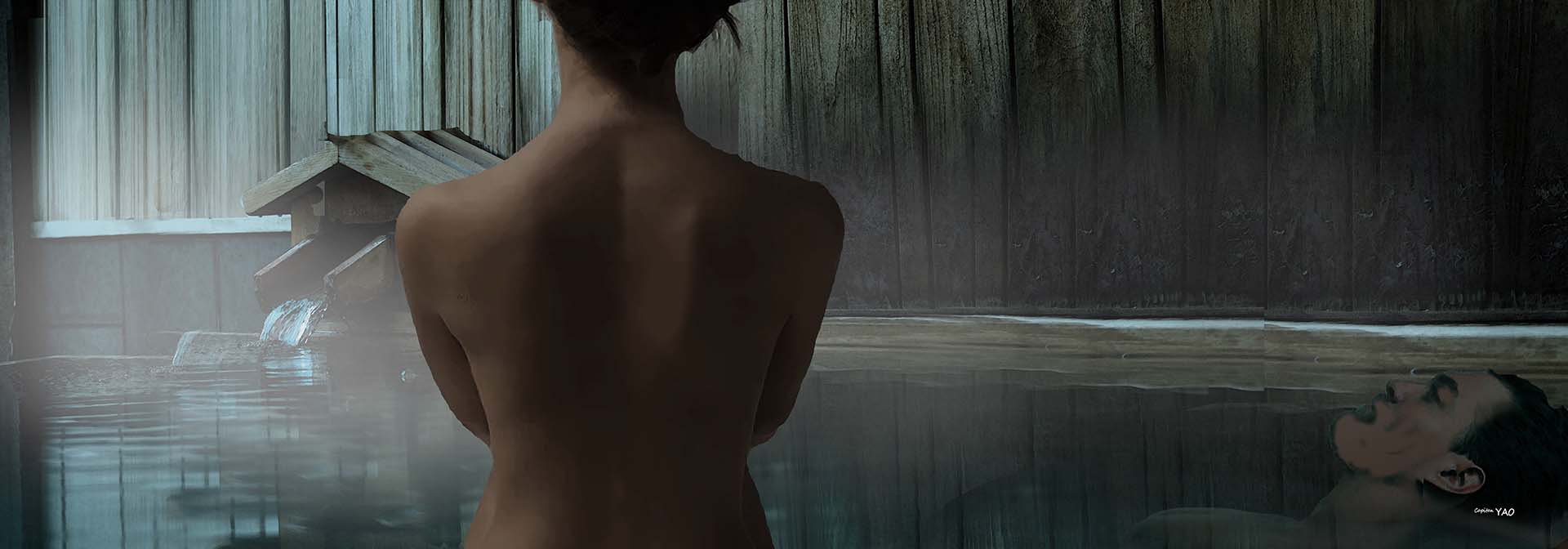
(Figure 3-10-5) Pual Draken enjoys mixed-gender bathing at a hot spring. Afterwards, we went to a Japanese-style room and made love several more times on the uniquely decorated tatami mats before finally falling asleep in each other's arms. Around midnight, the paper door was opened, and a slightly drunk Yoshiko Kawashima entered. The three of us then engaged in another night of passion. Compared to Yoshiko Kawashima, Chong Ruolan was even more alluring with her beauty, gentleness, and romance. But I never imagined she was a graduate of a Japanese spy academy; that night was her graduation exam!
|