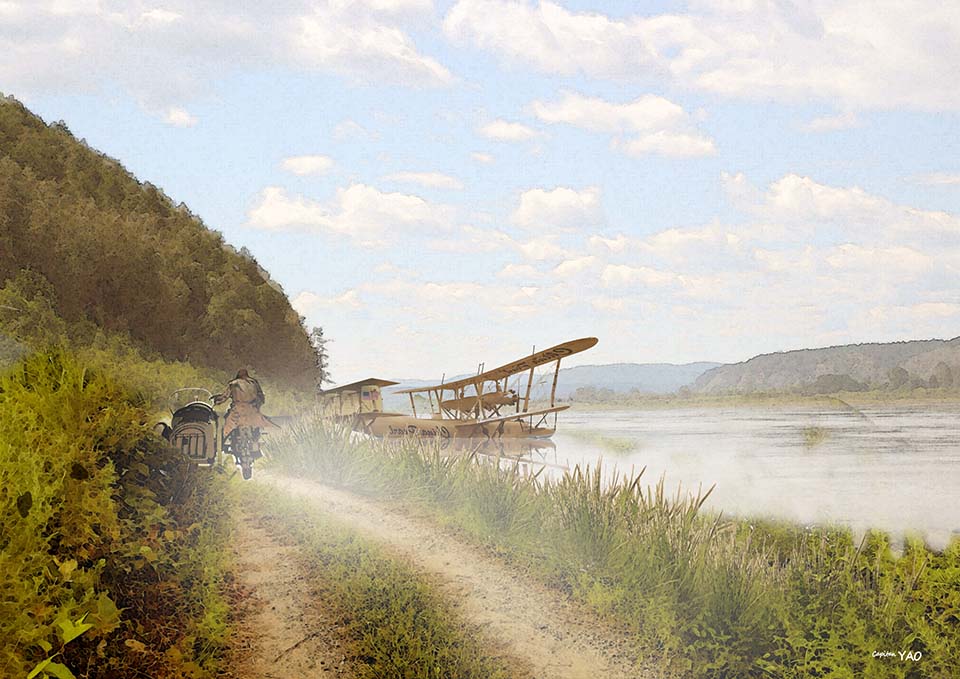
2. The Sino-Soviet Naval War
I finally received a notification from the Royal Naval College that a special course for short-term advanced studies for officers stationed overseas would be held early next year. My father managed to get my name on the list, so after nearly three years away from England, I could finally go home.
"Great! Let's take this opportunity to go on a round-the-world trip aboard the China Pearl!" Annie exclaimed excitedly. "We can fly west, passing through Hong Kong and Saigon to Singapore to see my daddy, then via India, Ceylon, the Arabian Peninsula, Cairo, the Mediterranean, France, and England. We'll stay in England for six months until you graduate, then fly across the Atlantic to New York, stay at my house for a while, cross the United States, and then fly across the Pacific to Japan before returning to Shanghai!"
This seemed like a good idea, and we planned to set off in October. Annie couldn't wait to start making preparations.
I was very busy with official business, so I left all the preparations to Annie. Annie is a capable girl, and she arranged everything in an orderly manner, from flight route planning and airspace entry applications to landing points and resupply. She even drew up the designs herself and found a factory to make two external fuel tanks to increase the flight range.
She also had a strategist to consult, namely her flight instructor Lin Bai, who was the first person to fly solo across the Atlantic. This was very important because at that time, very few people had experience with transatlantic flights.
Just as we were looking forward to this romantic round-the-world trip, Chang Hsueh-Liang in Northeast China clashed with the Soviet Union over the issue of regaining control of the Chinese Eastern Railway. The two armies were facing off across the river and war was imminent. Intelligence quickly reached our office.
"Hanching, Hanching! Can't you just be patient? Nanking, Japan, the West, you have enough to deal with, why do you have to provoke those old Russians?" I sighed as I looked at the telegram, and couldn't help but think of the prophecy that the old man Chiu Taochi told me in Peking last year.
"Someone invited you to Manchuria!" Willie shouted as he walked in, holding a telegram in his hand.
"To Manchuria?" Actually, I had a premonition that whenever something happened on Chang Hsueh-Liang 's side, I would be involved. "The Young Marshal invited me?"
"No!" Willie glanced at the telegram and said, "This time, it's Admiral Shen Honglie who invited you!"
"Admiral Shen Honglie?" Admiral Shen is the deputy commander of the Northeast Fleet who kidnapped me in Peking in 1927 to help them bomb Shanghai. Do they want me to go back and be their mercenary?
"What does Admiral Shen want me to do?"
"He proposed it through our fleet commander stationed in Tsingtao, and the higher-ups agreed!" Willie said. "The higher-ups said that helping others fight the Red Army was in our Western interests!"
I called Annie to tell her I might have to go to Manchuria on business, but Annie suggested, "We can go together on the China Pearl! You really plan to take the train to such a far place? Aren't you tired?"
"That's true, but that's the front line! How can you go?" I said.
"Why can't I go?" Annie said. "It's settled then, we'll leave the day after tomorrow morning!"
Fortunately, we had prepared sufficient supplies for our round-the-world voyage, and I even loaded my motorcycle onto the "China Pearl".
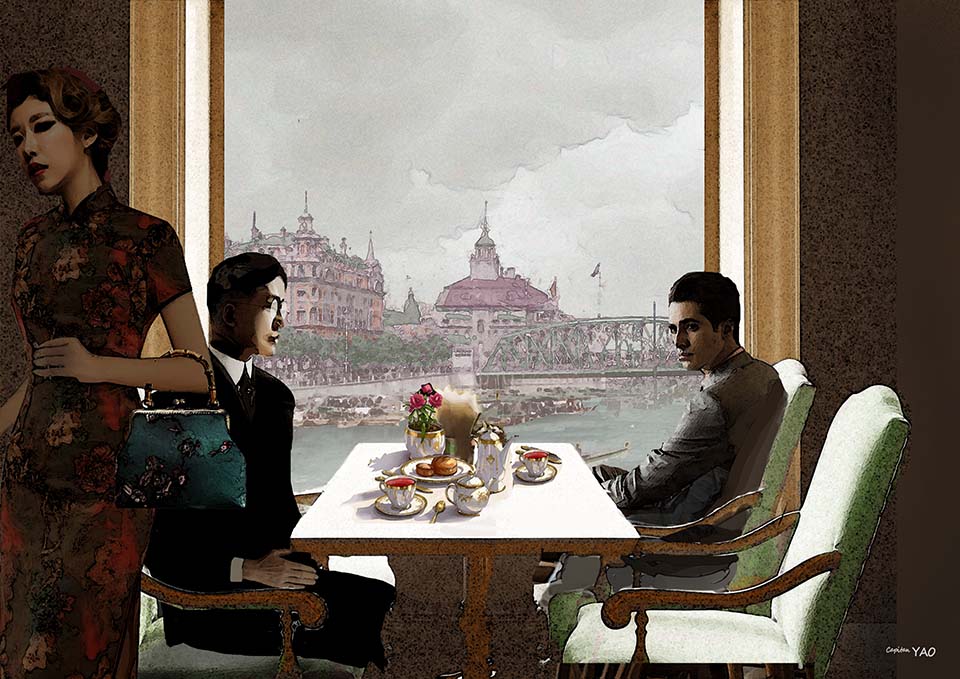
Before I left, Xu Zhimo invited me to meet for afternoon tea. Knowing I was going to Northeast China, he specifically came to tell me that Lin Huiyin was now teaching at Northeastern University in Shenyang, and that I could visit her on my way. Ever since he learned that I had known Lin Huiyin when I was in England, he had been particularly kind to me, probably because it reminded him of happy times from the past.
"You still think about her?"
"Don't misunderstand, Xiaoman and I are now a truly loving couple," Xu Zhimo said.
But then I remembered what I'd seen at the French Club ballroom last year. After much hesitation, I mustered my courage and said to him, "Mr. Xu, I think I should tell you that I saw your wife and..." at the French Club ballroom.
"Is it Mr. Weng Ruiwu?" Xu Zhimo replied calmly, "I agree that he and Xiaoman are kindred spirits!"
Such a unique person, I can't say anything more.


(Figure 3-2-2) The "China Pearl" took off from the Whampoa River in the early morning.
On the first day of the voyage, Annie and I took turns flying. When one of us was at the helm, the other was responsible for observation, positioning, and drawing the course on the nautical chart. Annie also had to do something I didn't have to do: cook dinner. I thought this young lady would be overwhelmed, but to my surprise, when I sat down at the table in Huludao that evening, I was greeted with dishes of almost the same quality as those served by the head chef of the Palace Hotel, accompanied by French red wine. I was truly impressed. I was deeply moved and felt that this rich heiress was quite likable, except for her occasional temper that was a bit unbearable. The nights in Liaodong Bay in October were already quite cold, and we were exhausted from flying all day, so we hugged each other and drifted off to sleep. The next morning, we were woken up by sailors from the Northeast Fleet who came to knock on the aircraft door in a boat. We quickly refueled and took off again for Harbin. This leg of the journey was the limit for the "China Pearl". We had to hurry. In addition, due to the urgency of the military situation, I did not have time to go to Mukden to find Lin Huiyin. So we flew directly over the river and arrived in Harbin before sunset, landing the plane on the Songhua River.
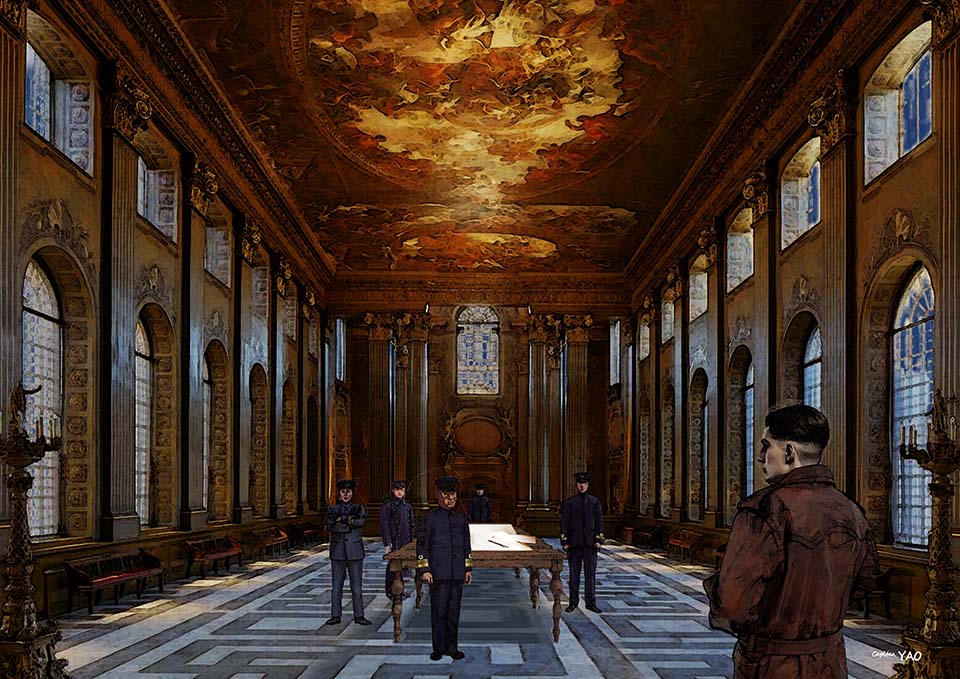
Admiral Shen had already arranged for a motorboat and a car to wait, and immediately took us to a brightly lit Russian-style building in the city to rest. Shen was holding a military conference there at the time. He led me into a magnificent hall decorated with crystal chandeliers and murals, where his adjutant had already spread out a map on a large table.
"The Chinese and Soviet navies are facing off at the confluence of the Amur, Songhua, and Tungkiang rivers, and war could break out at any moment," Shen said, pointing to the map. "Our side only has small boats like the 'Liche' and 'Liswui,' with the largest gun being only a 6-pounder; the Soviet Red Army, led by its flagship 'Sverdlov,' has nine large river-going armored monitors, plus air support. We are clearly at a disadvantage."
"So you called me here because..."
"I've called you here hoping you could guide our naval air force in air raids against Soviet ships," Admiral Shen said. "You're the only one in all of China with experience in this area!"
I knew he was referring to the air raid on Shanghai in 1927, but in just over two years, the world's naval aviation technology and ship anti-aircraft firepower had advanced considerably. It was impossible to win using such primitive methods. Especially when I learned that his planes were still the same old, slow seaplanes and that they were not escorted by fighter planes, I strongly opposed his idea.
"No, no, that's just suicide!"
"Don't be afraid. The Red Army consists of amateur militia members who are no match for us. We knew that when we cooperated to fight the Japanese in Nikolaev incident!"
"Are you still stuck in your old impressions? Our intelligence shows that after Stalin came to power, the Red Army's personnel training and equipment have improved dramatically, making it completely different from the Red Army of the past, or even the Tsarist Russian army!"
However, I later learned that there was another reason why he was so eager to find me: his current squadron leader is a White Russian, and he was worried about the Russians fighting each other!
"Then, what do you suggest we do?" Admiral Shen asked, looking at me.
Even the resourceful Admiral Shen was at a loss, so what could I do? I could only reply for now, "I'll fly to the site tomorrow to observe and then we'll see!"
"The defense of the river defense fleet is currently being handled by Captain Yin of the 'Kiangheng' . I don't trust Captain Yin's abilities, so I hope you can go and supervise for me. I'm giving you full authority. I'll arrive shortly after this meeting," Admiral Shen added.
The next day, we flew northeast to Tungkiang on the Sino-Soviet border. I originally intended to fly directly over the confluence of the three rivers for reconnaissance, but after learning that Red Army fighter jets were operating in the area, I abandoned that idea and chose to land on the upper reaches of the Songhua River. I left Annie on the plane to keep the engine warm and be ready for takeoff at any time. Then I unloaded the motorcycle and walked along the riverbank to the forward command post in Tungkiang County. I met with Captain Yin Zuochien, who was acting as commander. I sensed that he seemed somewhat hostile towards me.
(Figure 3-2-4) Paul Draken observes the movements of Soviet monitors from the reeds.
Ignoring Captain Yin's advice, I crossed the Songhua River with binoculars and a camera to scout the delta area where it forms an angle with the Amur River. As I approached the confluence of the three rivers, I noticed that the Chinese army had deployed visual mines and iron chains to block the river. Behind them, several civilian boats were submerged, their masts still wrapped with barbed wire. Just then, a Soviet monitors approached from upstream. I quickly hid in the reeds. The Soviet ship rumbled past me without noticing anyone spying on me from the reeds.
Then I was shocked to discover that the Soviet warship had anchored in the river and begun shelling the Chinese army troops on the shore. By this time, the Chinese gunboats had already disappeared upstream on the Songhua River. The Red Army was so confident because they knew that with the thickness of the Soviet monitor's armor, the Chinese 6-pound cannons were completely ineffective, and the Soviet warship's guns had a longer range than the Chinese ones, so the Chinese gunboats dared not approach. Since there was no threat, they could leisurely anchor in the middle of the river and carefully aim and bombard from a distance.
The Soviet monitors weighed anchor and left after bombarding me several times. As it passed by the reeds where I was hiding, I thought that if I had a large enough cannon, I could definitely sink it. Unfortunately, all I had at that moment was the Mauser pistol that Chang Hsueh-Liang had given me. But then a flash of inspiration struck me, and I thought I had found the way to defeat the enemy!
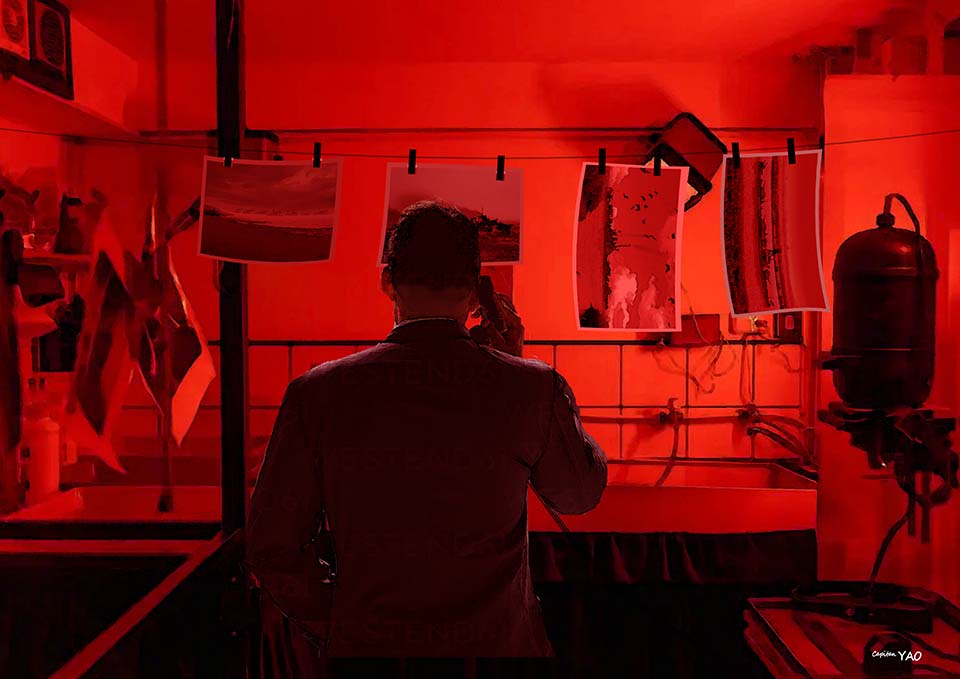
I sped back to the command post on my motorcycle, quickly found a place to develop the photos, and called Admiral Shen in Mukden: "Admiral, I think we can't view this battle from the perspective of naval warfare!"
"Not a naval battle? What do you mean?" Admiral Shen didn't understand.
"Today I discovered that Soviet warships were anchored in the river and firing, which means we have the opportunity to transform naval warfare against moving targets into land warfare against static targets. For example, if we can hide our large-caliber guns in the reeds, precisely measure the fixed distances and angles beforehand, and when the Soviet warships come to anchor, we'll be almost certain of victory!"
"Hmm! That sounds feasible!" Admiral Shen on the other end of the phone expressed his agreement.
"But there's a problem: how do we hide the cannons in the soft mud of the swamp among the reeds?" I asked.
"That's easy! Just tow a barge over to use as a floating gun emplacement!" Shen said on the phone. "As for the artillery, that's no problem either. The Japanese promised to lend us two 4.7-inch Amostron guns with a range of 8,000 meters. Artillery commander, please have Chief Instructor Zhang Chucai come over as soon as possible!"
After hanging up the phone, Admiral Shen directly ordered from Harbin that preparations proceed quickly. Under cover of darkness, tugboats towed the barge "Tungyi," already equipped with two 4.7-inch cannons, to the reeds along the Songhua River opposite Tungkiang County, where it was hidden. Colonel Zhang Chucai rushed from Changshan Island to lead artillery observers in carefully measuring the target's distance and angle, ensuring that the enemy ship, regardless of its position in the river, would not require corrections before firing and that the first shot would hit its target. All of this was carried out in extreme secrecy, completely undetected by the Soviet army. Once completed, Gunnery Sergeant Gong Runxing and 15 gunners remained hidden in the reeds every day, ready for action.
At approximately 5:30 AM on October 12th, I observed through binoculars from my command post on the riverbank that nine Soviet warships of the Amur River Fleet appeared in a long line at the confluence of the three rivers on the hazy river surface in the distance. The lead ship, weighing over a thousand tons, had a main gun with a caliber of at least 6 inches. After the ships reached the middle of the river and dropped anchor, they prepared to fire. At that moment, a burst of light suddenly erupted from the reeds opposite me. The first shot hit the conning tower of the Soviet flagship, the "Sverdlov," instantly killing many officers and men, including the commander, chief of staff, and captain. Subsequent waterline shots caused the ship to explode and sink. The second Soviet ship was then sunk in the same manner, and the remaining ships hurriedly weighed anchor and fled.
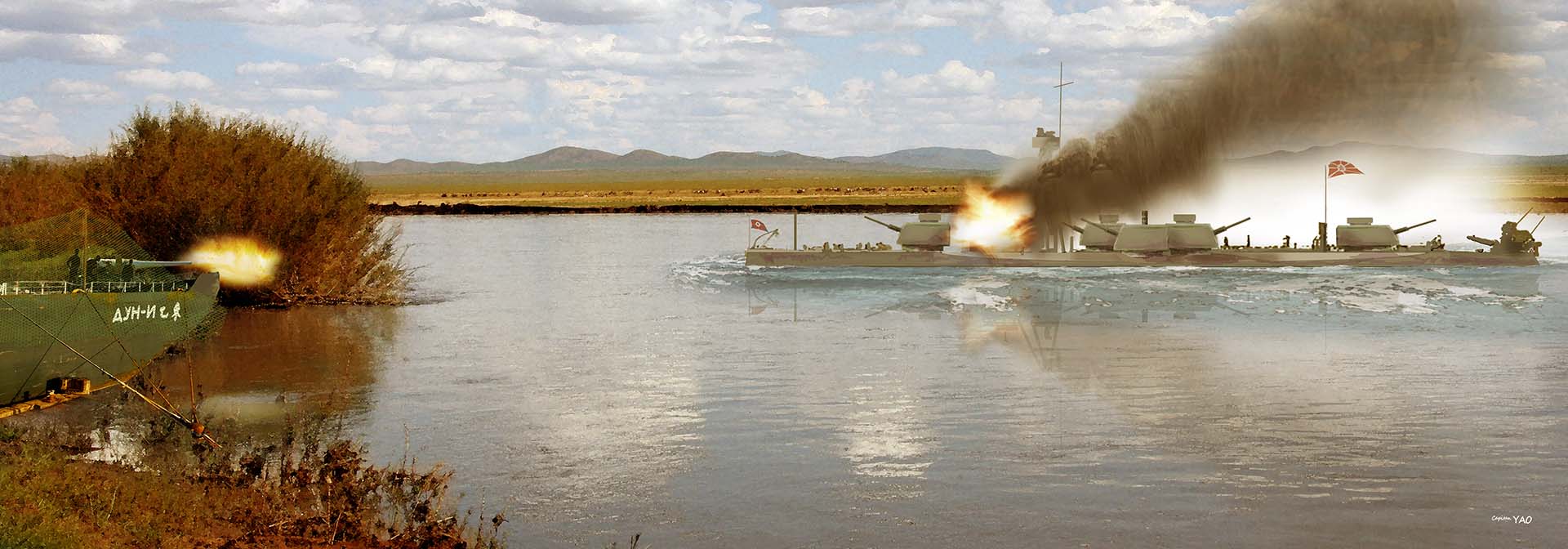
(Figure 3-2-6) The 4.7-inch gun on the barge "Tungyi" hidden in the reeds hit the Soviet flagship "Shernov".
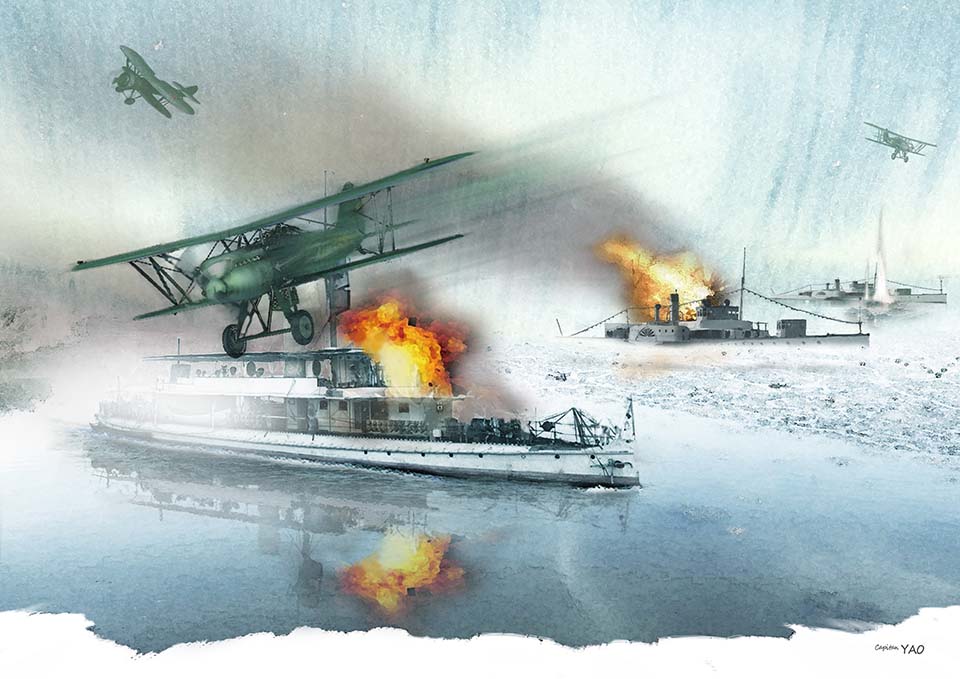
The Chinese army won the first round, but the situation began to change after 25 Soviet aircraft took to the skies at dawn. Due to the enemy's air superiority, four Chinese ships, namely the Lichie, Kiangping, Kiangtai and Kiang'an, were sunk, and the flagship Liswui was damaged. The Tungyi barge, which was hidden in the reeds, was also discovered. Colonel Zhang had no choice but to order it to be scuttled and the personnel to be evacuated to shore.
At this time, several thousand Soviet ground troops stormed into Tungkiang County. The command post personnel scattered, and I quickly jumped on my motorcycle and fled upstream. At the last moment, I boarded the "China Pearl" and took off. I didn't want to be captured by the Russians. A few days later, China and Russia clashed again in Fujin on the upper reaches of the Songhua River. In the end, because the Songhua River was about to freeze over, the Red Army retreated back into Soviet territory after looting.
Although the Soviet Union ultimately won this first-ever naval battle between China and the Soviet Union, it came at the cost of enormous losses in personnel and equipment. According to reports from spies who infiltrated the memorial service, at least several hundred Red Army soldiers were killed in the battle, including General Bostkov, commander of the Soviet Far Eastern Fleet.
As soon as our mission in Northeast China was over, we flew back to Shanghai, because our departure time back to England was drawing ever closer. Upon arriving in Shanghai, we saw the newspapers reporting a major stock market crash in New York, with all of Anne's family's investments plummeting, undoubtedly resulting in heavy losses. Anne's mood was greatly affected, and she became depressed.
Before heading back to England, I still had to go back to the intelligence group to give some instructions. Although I was the least senior member of the unit, I had the best understanding of Chinese society, especially the so-called Chinese Navy (which Westerners considered to be just a coast guard). So this had become my specialty. But I might be gone for a year, and my work couldn't be left unattended, so my superiors assigned Willie to be my proxy.
"Willie, I heard that Nanking might be ordering large warships from abroad soon. You'd better keep a close eye on things during this time!"
I'm reminding you of this because since the Republic of China split into North and South in 1917 (Editor's note: referring to the Constitutional Protection Movement), foreign powers have imposed an arms embargo. During this period, China did not import any warships from abroad until the end of last year when China achieved formal unification, after which the embargo was lifted. Because I've been frequently visiting the Kiangnan Shipyard recently, various clues indicate that the Nanking government is secretly planning to purchase several large warships from abroad. I'm very afraid that they will make a decision that will disappoint us while I'm away from China.
"Don't worry! All of China is busy fighting a civil war right now, who has the spare money to buy warships?" Willie said dismissively. "Besides, the Chinese naval leadership is heavily influenced by Britain, so even if they wanted to buy them, they couldn't escape the deal!"
"London thinks the same way you do, but if the final outcome isn't..." I said, "God knows what will happen to us!"
Willie trusted his own judgment too much and didn't take the matter to heart. Later, the sure thing fell through, and Willie paid a heavy price for it.
|