11. The Code Wars
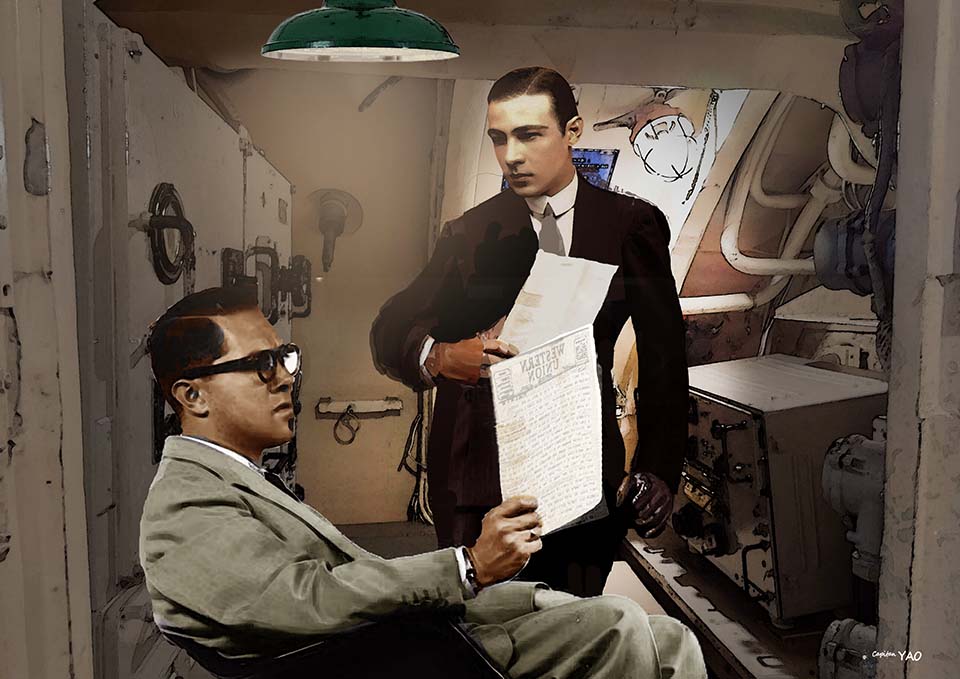
After my trip to Port Arthur ended, the Japanese secretly transported me to Tiantsin by merchant ship. I immediately contacted the British intelligence station in North China and sent the message via top-secret telegram. The person in charge of coded communications there happened to be my classmate from my training in London. I told him about the cipher machine Doihara had mentioned, and he slapped his forehead, saying, "No wonder so many telegrams lately haven't been able to be deciphered using the old methods! Now I understand! It must be a cipher machine!"
He picked up the telegram I had just sent and said, "Comparatively speaking, our secret communication system is far too outdated, like this telegram..."
"It's okay! Anyway, this is what the Japanese wanted, they already knew the contents!" I said.
"That's the problem: if the Japanese know the content first, they can then guess our code!"
That's true! Conventional intelligence gathering involves cracking codes to obtain information, but counterintelligence involves knowing the content first and then comparing it to the code to find the key to crack it. However, because it's difficult to consistently obtain a large number of comparison samples, this method remains theoretical and difficult to implement.
However, things are different when there's an intelligence exchange relationship. During that relationship, you can actually track the content and timing of their communications, and the more you provide, the more they'll send, leading to faster sample accumulation. Suddenly, a thought struck me: if we exchange intelligence with the Japanese, could we use this method to decipher their cipher machine?
"Hmm! This seems to be getting interesting!"
Upon returning to Shanghai, I immediately sent my suggestion back to headquarters in London via diplomatic envoy. I suggested that my superiors provide Japan with some less important intelligence, and then compare it with the telegrams sent by the Japanese embassy to find connections between them, which might allow us to crack the cipher machine. My superiors agreed to my suggestion. Because we had the content and timing, we quickly grasped the pattern of the Japanese code through cross-comparison, and then used the same principle to crack the German code.
Cracking the German and Japanese codes was crucial to the Allied victory in World War II, and this matter remained top secret for many years after the war. Recently declassified documents allege that after the outbreak of war in 1939, Britain established the headquarters of the GC&SC (Government Code and Code Institute) in Bretchley Park, London, and assembled more than 10,000 experts to work day and night to crack the Axis codes.
This is not entirely true. The wealthy Americans spent ten years trying to obtain intelligence on the Japanese attack on Pearl Harbor, and the French, who began their research in the late 1920s, failed to do so even after the entire country was occupied by the Germans in 1940. How could Britain possibly have obtained all the coded communications of the German navy and air force as soon as the war began in 1939, allowing the inferior Royal Air Force fighters to take off and gain altitude to intercept German bombers before they arrived?
Actually, we started cracking the cipher machine as early as 1933, but the origin of this matter was my unexpected trip to Port Arthur. Britain never mentioned its cracking of German and Japanese codes to its allies, the United States and France, nor did it allow them to share intelligence, I think for the sake of protecting its intelligence sources. Frankly speaking, our British intelligence agencies have always disliked the loose tongues of the Americans and French, and dared not tell them any truly valuable intelligence.
London wanted me to spend more time assisting with the work related to cracking the cipher machine. After several years of traveling, I also wanted to settle down, but this would reduce my fieldwork time. My team leader and the consulate disagreed because my connections and resources in Chinese society were irreplaceable. In the end, I had to juggle both jobs and had even less time to be with Annie. This not only affected my marriage but also caused irreparable consequences.

Our initial concerns about the Chinese government's stance turned out to be unfounded. The following year, the Japanese army invaded the Great Wall and Rehe, and was about to reach the gates of Peiping. The Chinese government took the initiative to sign the Tanggu Truce with Japan, relinquishing control of most of North China. If we had known this earlier, we wouldn't have been so secretive. I'm unsure how my superiors will handle my report; clearly, Britain has no intention of recognizing Manchukuo. I believe Britain's policy towards the expansion of Japanese influence in China is one of active opposition, not out of favoritism towards the Chinese government but rather out of consideration for the interests of the British Empire itself. However, despite our concerns about China's position, Nanking government officials actively courted the Japanese and frequently complained that the British government wasn't providing aid to help them resist Japan. This made London ultimately unwilling to deal with the Nanking government anymore. This conflict persisted into World War II and the post-war period. The Chinese and British armies did not get along well during the Burma campaign against the Japanese. At the Cairo Conference, Prime Minister Churchill was also unfriendly to Chiang Kai-shek and his wife. In 1949, Britain's preemptive recognition of the Communist-led People's Republic of China brought an end to a century of Sino-British relations. I am well aware that within Chiang Kai-shek's Kuomintang, the British were portrayed as stingy, pragmatic, and opportunistic politicians, incomparable to the image of Americans as Santa Claus delivering presents. Regardless, I believe the Japanese must have been extremely disappointed in me, because Britain not only refused to recognize Manchukuo, but the Lytton Commission's report in October of that year also bluntly labeled Japan as an aggressor. However, this did little to help China, as the Japanese, in a fit of anger, withdrew from the League of Nations the following March. Nevertheless, Jin Bihui continued to provide me with a steady stream of intelligence on Communist activities in Shanghai, as promised. With the help of Anne's godfather, Huang Jinrong, I became the most well-informed person in Western intelligence agencies regarding Communist activities. Political intelligence wasn't originally our responsibility, but because my intelligence was so useful, I was frequently asked for help by other units and even the authorities of the French and American concessions, thus having a significant impact on later history. At that time, the Communist forces in China were divided into the "Third International" in metropolitan areas such as Shanghai and the Chinese Soviet regime that was causing chaos in the countryside of Kiangsi. The Nanking government had launched several large-scale military suppression campaigns against the latter; as for the former, since most of them were hiding in the concessions, the Chinese government was unable to reach them. In addition, many members of the Third International were Westerners from Europe and America, and if not handled properly, it could cause international disputes.
Here I would like to specifically mention Agnes Smedley, a reporter from the Frankfurter Allgemeine Zeitung in Shanghai. She was an American and became Annie's friend in Shanghai, and I would occasionally attend their gatherings. This Ms. Smedley made no secret of her pro-communist stance, and my professional instincts made me pay special attention to her every move, trying to find something out about her.
Although Agnes Smedley was married, she had a lover in Shanghai at the time, Dr. Richard Sorge, also a German journalist. Sorge was of German and Russian descent and shared strong leftist leanings; he even helped the 19th Route Army carry grenades while covering the "First Shanghai Incident." However, the two separated in 1933 after Sorge went to work in Tokyo, Japan, and Sorge even transformed into a supporter of the Nazis. I will mention these two famous figures later, so I will not go into details here.
Basically, the concession authorities were anti-communist because countries like Britain, the United States, and France were afraid that a communist revolution would overthrow their capitalist governments. Moreover, many Chinese and foreign businessmen and even gangsters in Shanghai also held anti-communist views for their own vested interests. However, the concessions had to act according to the law and could not arrest people arbitrarily without evidence. On the other hand, as long as the Chinese authorities could provide evidence, the concessions were happy to extradite communists to the Chinese government, and their fate would be dire.
The question was whether Chinese intelligence agencies could provide enough evidence to convince the concession authorities. I thought it would be difficult without my intelligence, so Dai Yunong and his colleagues often came to me for help. I was happy to exchange some intelligence for information about the Chinese government, which allowed me to provide my superiors with more information in this area and to understand the Chinese government's decision-making process in advance, which was very important.
Thanks to my intelligence, the Third International in Shanghai was almost completely wiped out in the mid-1930s, and eventually all of them withdrew from the city to develop in the countryside, allowing Mao Tse-tung to gradually become the sole leader of the CCP, even though he was being driven to the southwest by Chiang Kai-shek's fifth encirclement campaign at that time.
I belong to the working group investigating the Japanese consulate in Shanghai and the Japanese naval fleet stationed in China. Since the telegraph office was handled by a separate person, I planned to hack into their wired communication system, which is the preferred channel for all countries to transmit highly classified intelligence because it is the least likely to be eavesdropped on. Through surveillance and decryption of Japan, we sometimes obtained intelligence related to the Soviet Far East, the Chinese government and the Communist Party, or French Indochina. This was an extra bonus, but the results were often more immediate. The "Fookian Incident" at the end of 1933 is an example, which also showed us the efficiency of Japanese intelligence work.
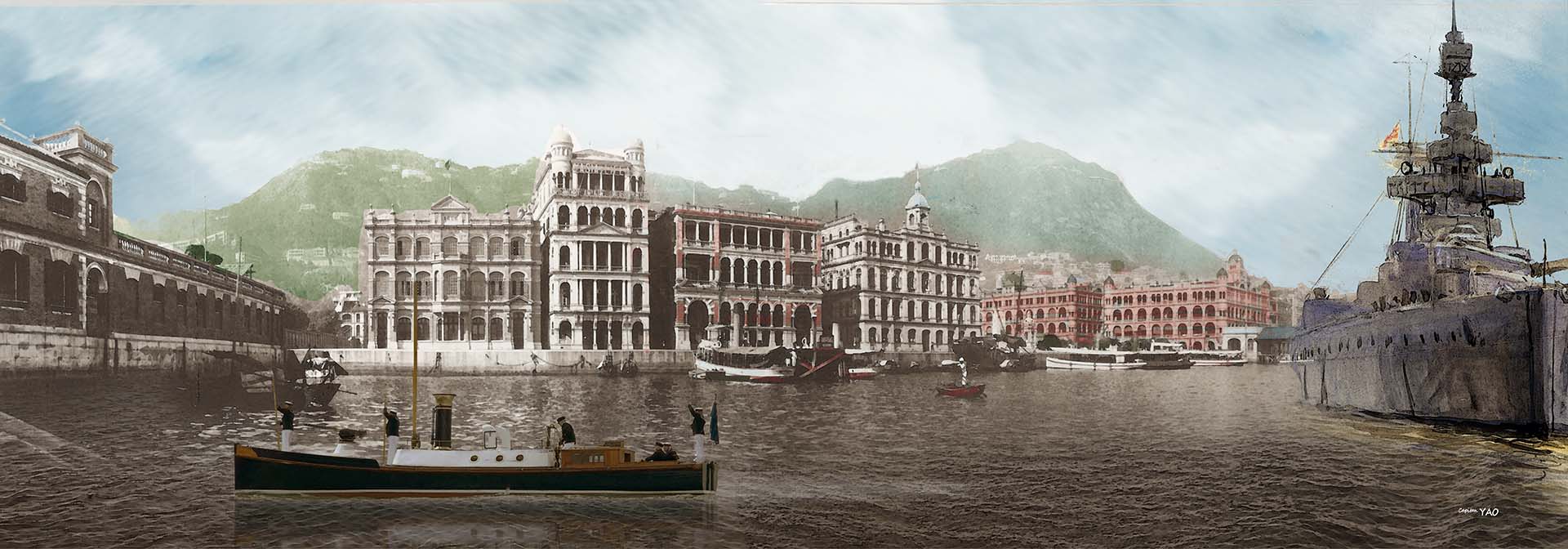
Participating in the deciphering of Japanese cipher machines gave me the opportunity to frequently travel to Hong Kong. Due to the complex geographical environment of Shanghai, London decided to use Hong Kong as the core, and all intelligence had to be brought to Hong Kong for centralized analysis. After being warned by my superiors, I dared not sail the "China Pearl" around ostentatiously anymore. Usually, I traveled on Royal Navy warships between Shanghai and Hong Kong, and only took Swire ships when there was no available sailing schedule.
To decipher Japanese secret telegrams, one must first understand Japanese; otherwise, there's no point in trying to decipher them, as they're incomprehensible. However, few people in the British intelligence system understood Japanese, and given the classified nature of the information, we couldn't ask outsiders for help. So, we selected a few officers and sent them to Japan in 1930 for a three-year exchange program. One of them, Captain Charles Boxer, was sent to Hong Kong in 1936 after completing his studies to specifically handle Japanese intelligence. Only then was our problem solved. Before that, we were relying on makeshift methods, which were naturally very inefficient. But I also took the opportunity to learn Japanese to a certain extent.
Unlike most Westerners who start learning Japanese by speaking, my Chinese upbringing meant I began with Chinese characters. The difference was that I learned to read and write faster than others, but the pronunciation was often confused with Chinese because the same Chinese characters often had completely different pronunciations in Japanese. At the time, Japanese telegrams still used a considerable number of Chinese characters because the same content required far fewer characters than pinyin, and telegrams were charged by the number of characters, giving Chinese characters a cost-effective advantage. Secondly, intelligence required accuracy, and homophones in pinyin often caused misunderstandings, so intelligence telegrams used even more Chinese characters. Westerners learning Japanese found it difficult enough just to understand the Chinese characters, let alone their meanings. Especially since high-ranking Japanese officials often used Chinese idioms in their telegrams, driving Western intelligence officers crazy. This is where my value came in.
Captain Boxer was sent to Hong Kong by the War Department to serve as General Staff Officer 3rd grade (GSO3), coordinating all intelligence agencies in the Far East, including our naval intelligence group. In 1935, the Far East Combined Bureau (FECB) was established to unify codebreaking work against Japan, China, and the Soviet Union, and to oversee units in Shanghai, Hong Kong, and Singapore. "Petro," mentioned earlier, was in charge of Soviet intelligence. The FECB was rife with internal factional struggles. Most officers had studied in Japan. Because I was a latecomer to the field and was affiliated with Mr. M, I wasn't considered a core member. However, I actually laid many important foundations for the FECB, and problems often required my intervention to resolve. I'll discuss this further later.
In 1940, Boxer became the second-in-command of the FECB and was promoted to major. I mention him specifically for another reason: in 1941, I brought Emily Hahn from Shanghai to Hong Kong and entrusted her to his care. The two developed feelings for each other and had a child out of wedlock. During the Japanese occupation of Hong Kong, Boxer was imprisoned in a concentration camp, and Emily Hahn waited patiently outside the camp with her illegitimate child. The two eventually married after the war. However, Boxer's special status caused considerable trouble for the unfortunate Shao Xunmei after the Chinese Communist Party liberated mainland China.
Apart from Boxer, the other British intelligence officers in Hong Kong joined me in breaking through torpedo boats to the Chinese mainland at the end of 1941. Also traveling with me were Admiral Chan Chak, whom I mentioned earlier, and his adjutant, Major Henry Heng Hsu. But that's another story.
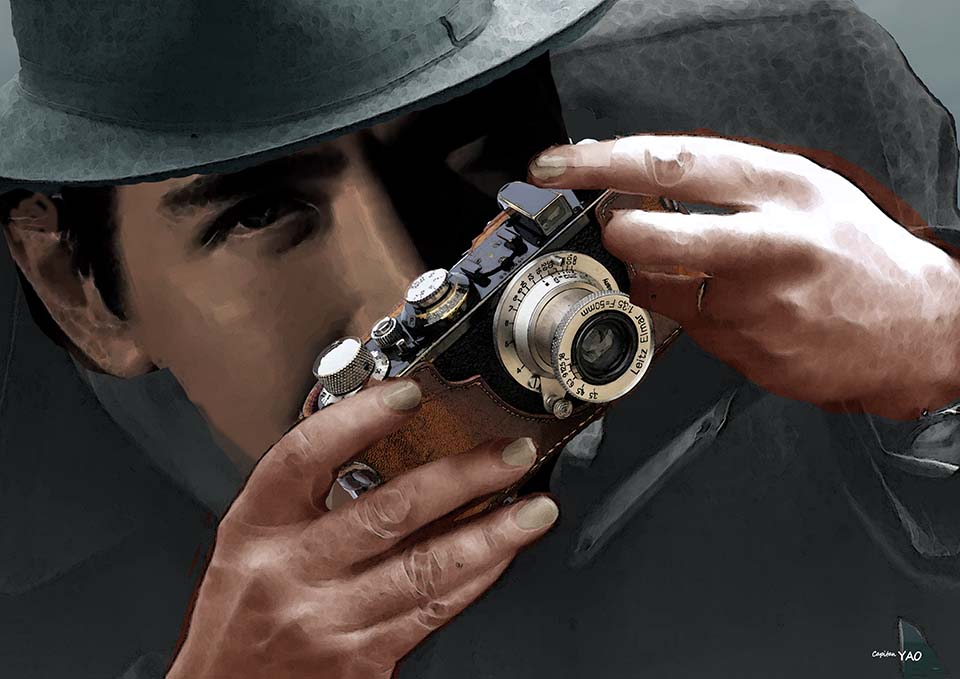
I often had the opportunity to see the latest warships from various countries, including Japan, and I thought that if I had a camera, I could take pictures of them as valuable intelligence data. However, the cameras I had before were all bulky and unsuitable for espionage work. Fortunately, a foreign trading company in Shanghai had just acquired a batch of Leica I(C) cameras, which were very compact, had interchangeable lenses, and could use 35mm movie film. Traditional cameras required extremely large film to capture details, but such equipment was very cumbersome. Leica lenses were very sharp, and even when enlarged from 35mm film, the images remained clear, making it possible to reduce the size of the camera. Moreover, a roll of film contained many exposures, allowing for continuous shooting without frequent changes, making it convenient to capture shots.
This camera wasn't cheap. When I applied to my superiors for its purchase, they were very stingy and refused to pay. Coincidentally, I received a year-end bonus for my contributions to Manchukuo mission and after buying a necklace for Annie, I used the rest of the money to buy it myself. This Leica has been with me for many years and is still working perfectly.
As mentioned earlier, I come to Hong Kong on average once a month, and the frequency increases if there is urgent intelligence or a special mission assigned by my superiors. One of my trips to Hong Kong in 1932 was because I received a secret telegram from Mr. M, who was then serving as a special envoy to Moscow. Mr. M requested that I rush to Hong Kong as soon as possible to try to rescue a man named "Nguye na'i quoc," who was being held in a Hong Kong prison.
"Nguye na'i quoc? This is Vietnamese, right? Why would we rescue a Vietnamese person from our own people?" I was very puzzled. "Could this be another trap?" I never had much faith in Mr. M's jobs.
Mr. M probably guessed that I would think this way, so he described the cause and effect in detail in the following telegram. It turns out that this man named Nguyen Ai Quoc was the leader of the Communist Party in French Annam. He was arrested by the police in Kowloon last June on charges of plotting to disrupt public order. He was someone who had been sentenced to death in absentia by the French Annamite government as early as 1929. Therefore, after hearing the news, the French government requested the Hong Kong British government to extradite him back to Annam through diplomatic channels. If Nguyen Ai Quoc were sent back to Annam, he would probably only face death.
From the British government's perspective, there was no reason to break ties with France over a trivial criminal. However, the Soviet MI6 unit recognized Nguyen Ai Quoc's value, and at the time, the Soviet Communist Party was mobilizing all its resources to rescue him. Secretly assisting the Soviet Union in this matter would benefit Britain throughout the Communist International. Mr. M knew I frequently visited Hong Kong and had close ties with Hong Kong intelligence agencies, so he hoped I could assist in the rescue.
|