After the Japanese surrender, a conflict immediately broke out between the Kuomintang and the Chinese Communist Party over the takeover. In North and Central China, the Communist army had a distance advantage because its garrisons were close to the Japanese-occupied areas. The Northeast region of China, which originally belonged to Manchukuo, was occupied by the Soviet Red Army. Only South China and major coastal cities were able to retain territory for the Kuomintang thanks to the landing of the US Marines.
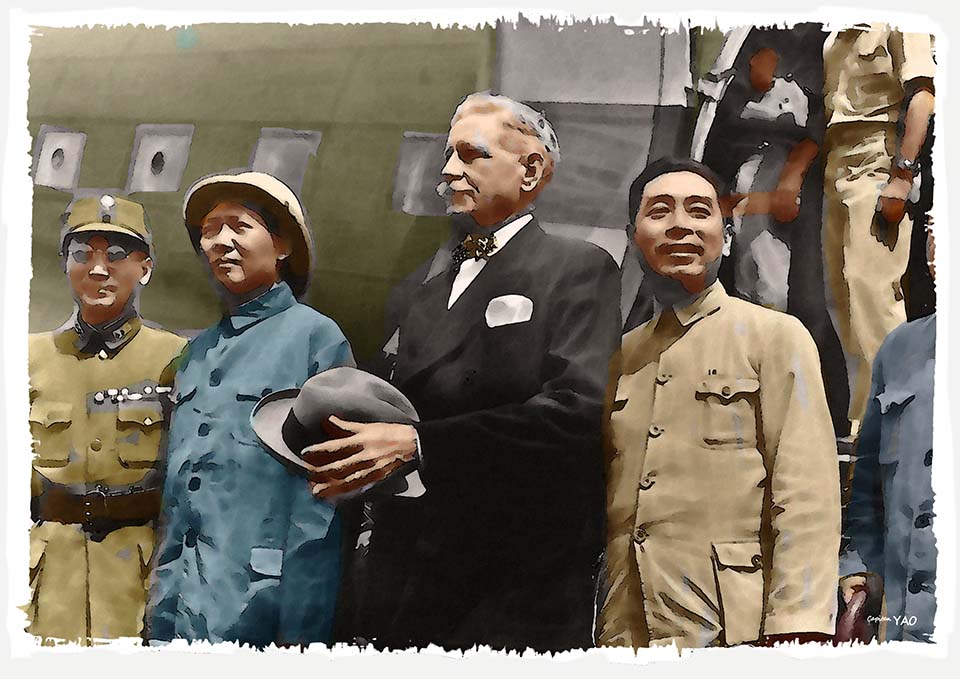
Because Chiang Kai-shek's troops were located in the southwestern inland region, he needed time to mobilize his own forces to take over. To delay the Communist army and offset its geographical advantage, Chiang invited Mao Tsetung to Chungking for talks. This invitation caused great anxiety in Yan'an; they feared being assassinated by Chiang if they went, and feared public criticism for obstructing peace if they didn't. Finally, accompanied by U.S. Ambassador Patrick J. Hurley, Mao Tsetung arrived in Chungking on the afternoon of August 27th aboard a U.S. military plane.
(Figure 5-11-1) Mao Tsetung, accompanied by U.S. Ambassador Patrick Hurley, flew to Chungking on a U.S. military plane.
The Americans' dominance in the negotiations between the Kuomintang and the Communist Party made London very jealous. Although everyone knew that the United States had contributed the most to World War II and was the true mastermind behind the war, Britain, once the elder brother of the great powers, was not used to being sidelined. It was only then that London secretly telegraphed me to pay attention to developing relations with Yan'an.
At that time, I was about to fly to Hong Kong to arrange the British Navy's presence for the surrender ceremony. After understanding the situation, I realized that we knew absolutely nothing about the CCP, not even the most basic intelligence sources, while the United States had already sent a military observer group to Yan'an as early as 1944.
This reminds me of 1917 when my father, stationed in St. Petersburg, Russia, received an order from the London Foreign Office to develop relations with Lenin. But it was too late. On April 16th of that year, Lenin was escorted back to St. Petersburg via Finland by German intelligence. Then came the momentous Communist Revolution, the overthrow of the Tsar, and Russia's withdrawal from World War I, allowing German troops on the Eastern Front to be redeployed westward. The British and French defenses on the Western Front were under unprecedented strain. Britain failed to seize the initiative, and relations with the Soviet Union were severed for many years. London certainly didn't want to repeat that mistake this time!
For those involved in diplomacy and intelligence, it's crucial to consider how Hong Kong's status could be maintained should China one day fall under the rule of a communist party hostile to Western imperialism. This concerns vital interests of the British Empire; we had finally managed to reclaim Hong Kong from Chiang Kai-shek, and we certainly didn't want it to be handed back to Mao Tsetung a few years later. While waiting to enter Hong Kong aboard Rear Admiral Harcourt's flagship, I pondered this very issue every day.
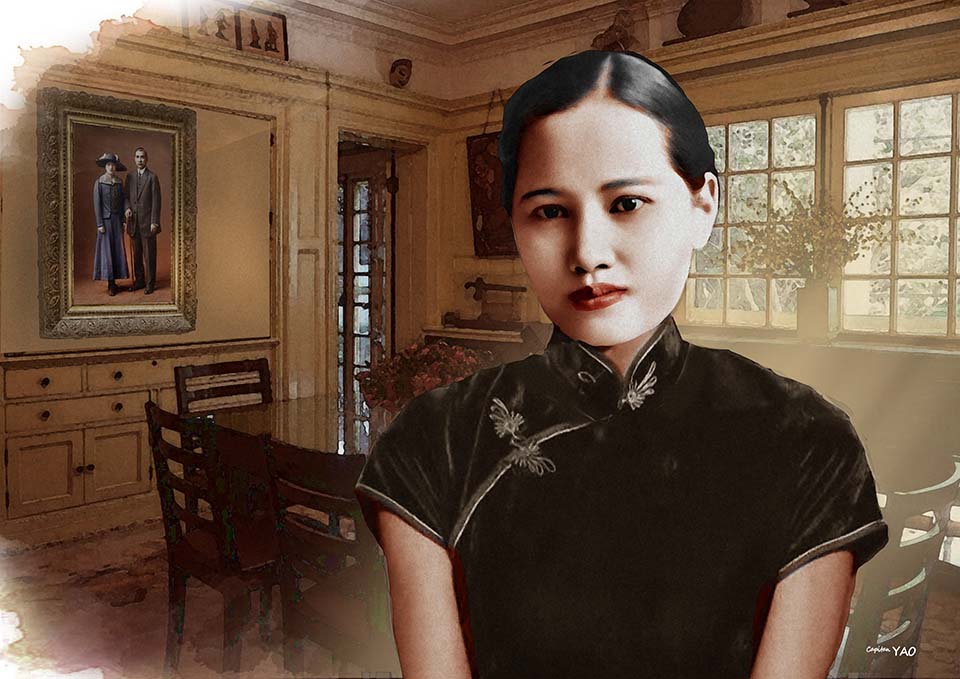
What advantages did I have against the Americans? I had no money, no manpower, and the wartime Sino-British relations were a complete mess. But as the saying goes, a cornered dog will fight, and when pushed to the limit, there's always a way. Finally, I remembered that I held a super trump card: Soong Ching-ling. Soong Ching-ling was the wife of Sun Yat-sen, the founding father of the Republic of China, and was known as the "Mother of the Nation." Soong Ching-ling's younger sister, Soong Mei-ling, married Chiang Kai-shek, but Soong Ching-ling and Chiang were always at odds, with Soong publicly denouncing him as a traitor to Sun Yat-sen, even though Chiang Kai-shek often claimed to be Sun Yat-sen's successor. During the Sino-Japanese War, Soong Ching-ling returned to Chungking, China, from abroad to show her support for the united front against Japan, but her relationship with Chiang's Nationalist government remained very tense. However, Soong Ching-ling had a very good relationship with the Chinese Communist Party, and Mao Tsetung often addressed her as "Big Sister."
I had the opportunity to travel by plane with Soong Ching-ling. In July 1923, Sun Yat-sen's Kuangchow government was embroiled in a dispute with various countries over tariffs. Britain and the United States were preparing to mobilize their fleets to resolve the issue militarily. My father, an old acquaintance of Sun Yat-sen, was sent to Kuangchow by the London Foreign Office to negotiate. I, then sixteen years old, accompanied him. We happened to be there at the unveiling ceremony of the Kuangchow government's first domestically produced aircraft, the "Rosamond" at Tashatou Airport. After the pilot took Soong Ching-ling for a couple of laps, she said to me, "Paul! Do you want to ride in an airplane? It's a lot of fun!"
(Figure 5-11-2) Soong Ching-ling, wife of Sun Yat-sen.
So I boarded a plane and flew five times over Kuangchow. I immediately fell in love with flying, and that's how I became a pilot. Later, whenEmily Hahn was writing "The Soong Sisters," she wanted to interview Soong Ai-ling, Soong Ching-ling, and Soong Mei-ling. I helped arrange it. I had met Soong Ching-ling several times at that time, and I believe she still remembers me.
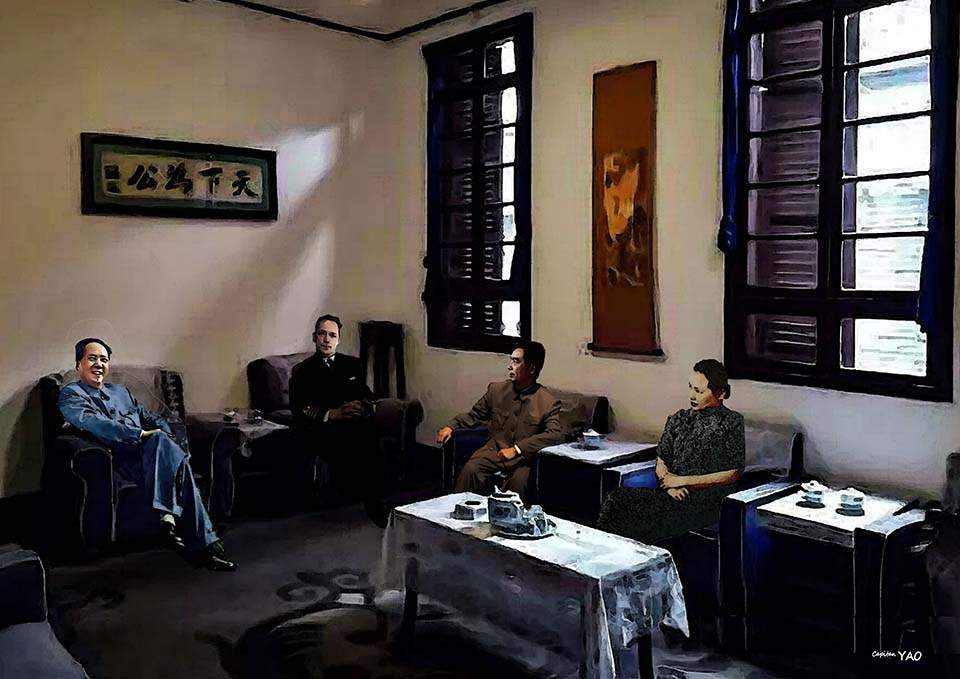
I sent a telegram from Admiral Harcourt's flagship to Soong Ching-ling in Chungking, hoping she could help me arrange an opportunity to visit Mao Tsetung. I quickly received her reply agreeing. Coincidentally, on the same day that Harcourt's fleet entered Hong Kong to take over, that is, August 30, Mao Tsetung met with Soong Ching-ling. Soong suggested to Mao that he arrange a meeting with me, and Mao agreed on the spot. The time was left to his secretary to arrange. However, due to the tense Mao-Chiang talks, and my busy work in Hong Kong and Shanghai on the takeover, the time could not be arranged for both parties. It was not until September 27 that I flew back to Chungking from Shanghai and finally met with this CCP leader at Kuiyuan in Shangching Temple. In addition to Mao Tsetung and Soong Ching-ling, Chou Enlai was also present.
"So you're Captain Paul Draken?" As soon as I entered, Mao Tsetung came forward to shake my hand. "Happy birthday!"
"Oh? Thank you!"
I was momentarily stunned and only gave a polite response. Then a chill ran down my spine. The CCP leaders actually knew it was my birthday? That's some serious intelligence! My facial expression froze instantly.
At this moment, Soong Ching-ling interjected, explaining how she and I met and the relationship between my father and Sun Yat-sen, which temporarily eased my embarrassment.
"Your country is now in power under the Labour Party; this is the trend of the times!" Mao said. "Especially since this revolution was bloodless, Britain can be said to have made great progress."
"I'm sorry! I'm a soldier, I don't understand politics!" I said.
"Captain Draken, you're too kind! I've heard some of what you've done," Mao said.
(Figure 5-11-3) Paul Draken visited Mao Tsetung at Kuiyuan Garden in Shangching Temple, Chungking, accompanied by Soong Ching-ling and Chou Enlai.
I was a little nervous, afraid that what he said about me came from Kiang Ching, also known as Li Yunhe. I had already heard that Mao had married Li Yunhe in Yan'an and changed her name to Kiang Ching. I wondered if Yunhe had mentioned anything about me to Mao, and whether her relationship with Tai Li was the reason she got close to Mao. These things were disturbing my thoughts.
Fortunately, Mao did not continue to dwell on this topic. I think he probably just wanted to give me a warning, to tell me that I, a mere British spy, should not try to pull the tiger's mouth out of me. The Communist Party knows everything about me!
"I'd like to discuss our future relationship with the CCP," I quickly changed the subject. "If the CCP becomes the ruling party in China, would you want to maintain diplomatic relations with the UK?"
"We have always advocated peace, and it is only natural that we maintain normal diplomatic relations with all countries!" Mao said.
"If there are diplomatic relations with the UK, what is your view on Hong Kong's status?" I asked tentatively.
"Isn't this your main purpose for coming here today? All the unequal treaties that China signed with imperialism must be abolished. Only such diplomatic relations can be considered normal. This is the consistent position of our Party. We will never fawn over imperialism like Chiang Kai-shek did."
Mao pointed at me with his finger holding a cigarette and said, "But since you've come prepared today, I'd like to hear what you have to say."
"Which is more advantageous, China occupying Hong Kong or China utilizing Hong Kong?" I asked.
"How can China utilize Hong Kong if it does not occupy it?" Chou Enlai said.
"If a Communist-led China were to occupy Hong Kong, the US would certainly blockade the entire country, and Britain would definitely support it, putting the new regime in grave danger," I said. "But if China allows Britain to continue governing Hong Kong, with Hong Kong Island and Kowloon separated from the mainland by only a thin line, it would effectively be a gateway for China to the world. Even if the Americans are unhappy, they can't very well target a British colony, can they?"
"Hmm! Interesting!" Mao said, squinting through a puff of smoke. "But the prerequisite is that Britain must recognize the Communist government."
"That's for sure. Our country will recognize any government that legally acquires power!" I replied confidently. This was actually far beyond my authority, but under these circumstances, I had no choice but to offer the checks I had on hand.
"I will consider your statement." As I was leaving, Mao shook my hand and said, "Then London will send you as ambassador!"
"Thank you for your kind offer. I hope your meeting with Chiang Kai-shek will be successful; that would be a blessing for all of China!" I said.
Mao also asked Chou to arrange a code name for telegram communication with me, which gave me a direct channel of communication with the top leadership of the CCP. This was of great help in avoiding misinterpretation of each other's messages in the future. I thanked Soong Ching-ling again and then left.
I later learned that the negotiations between Chiang Kai-shek and Mao Tsetung had stalled, and Mao only had time to meet with me because he was temporarily free in Chungking. Furthermore, at that time, U.S. Ambassador Hurley, representing Chiang Kai-shek, was pressuring Mao to make concessions in the agreement, causing Mao to develop resentment towards the Americans. He thought that perhaps he could use Britain to counterbalance the United States, which is why he was interested in talking to me. After understanding British policy, he had a general idea of the situation, just as he later often said: "Western imperialism is not a monolithic entity!"
Mao Tsetung stayed in Chungking for forty-three days. After the agreement was signed between Mao and Chiang on October 10th, he flew back to Yan'an the following day. I believe Mao remembered my words. After the liberation of all of China at the end of 1949, Hong Kong was always maintained as a window to the West. Under British rule, Hong Kong was able to escape the vortex of Eastern-style political struggles and usher in nearly half a century of economic prosperity. The proletarian Communist Party and Western capitalism can coexist and prosper. Hong Kong became the most special case in the Cold War era. I believe that Deng Xiaoping's reform and opening-up policy after the 1980s, and the Hong Kong experience, should be the source of his confidence to boldly experiment with "socialism with Chinese characteristics."
However, this historic meeting between Chiang Kai-shek and Mao Tsetung completely shattered any hopes of peace. Chiang's actions were merely a delaying tactic, while Mao was unwilling to easily relinquish the hard-won advantage. Although both sides signed the meeting record, the ink was barely dry before a full-scale war broke out. The scale of the war, the extent of mobilization, and the casualties far exceeded those of the War of Resistance against Japan. The Chinese people were plunged into the agony of civil war once again. Due to widespread anti-war sentiment, Chiang Kai-shek's regime gradually lost popular support and retreated to Taiwan after a complete defeat at the end of 1949.
This meeting in 1945 was the first and last one between Chiang Kai-shek and Mao Tsetung.

I was assigned this task because I was quite famous in London for my research on Japanese naval vessels. The story begins in 1934 when I returned to Britain with a large amount of intelligence on Japanese warships that I had photographed in China to participate in the London Naval Treaty negotiations. It was the first time that Britain had obtained such complete intelligence on Japan's new warships. This not only shocked the Prime Minister and the Admiralty, but also led to a meeting with the Prince of Wales, which started my long-standing friendship with Edward VIII, who later became the Duke of Windsor. When we arrived at Kure Port, a large number of Japanese warships were already moored there, many of which were still armed. Our mission was to register and hand over the ships and disarm them to serve as transport vessels for Japanese military personnel and civilians overseas to return home. Most of my companions were young U.S. Navy officers of the rank of lieutenant commander; I was the highest-ranking officer, a colonel, so they made me their leader. We also had a group of former Japanese naval officers and men who had surrendered to help us with errands and translation. Because I was very familiar with Japanese warships, the handover process went very smoothly. I was particularly interested in a small, lone ship nearby, labeled "Sentry Boat No. 102" on the documents. I pulled aside a U.S. Navy lieutenant commander and said, "Hey! Isn't this one of your Clemson-class flush-deck destroyers? It looks so much like one, if you straighten out the first funnel." "It does look similar, but that's impossible, because there's no record of any of our destroyers being captured by the Japanese. I wonder if it's one of the fifty ships Roosevelt gave you that was captured by the Japanese?" The American Lt. Cmdr. replied, "I heard there was one when Hong Kong surrendered at the end of 1941?" He was referring to how, before World War II, President Roosevelt provided fifty of these types of destroyers to the British Navy, which desperately needed anti-submarine vessels, under the Lend-Lease Act in exchange for the right to use overseas bases. These young officers were quite different from the U.S. Navy officers I knew before the war. Previously, the U.S. Navy held the Royal Navy, its elder brother, in high esteem because the Royal Navy's fleets and bases were spread across the globe, and its officers were highly qualified and professional, making them role models for the U.S. Navy. However, these young officers had grown up during World War II. Their impression of the Royal Navy was that of a declining aristocracy dependent on American handouts. Their greatest pleasure was finding opportunities to embarrass you and showcase the power of the new post-war world superpower. "Impossible!" For the sake of the Royal Navy's reputation, even without evidence, I had to righteously refute the Americans' inference: "Besides, my intuition tells me she must be the USS Stewart!"
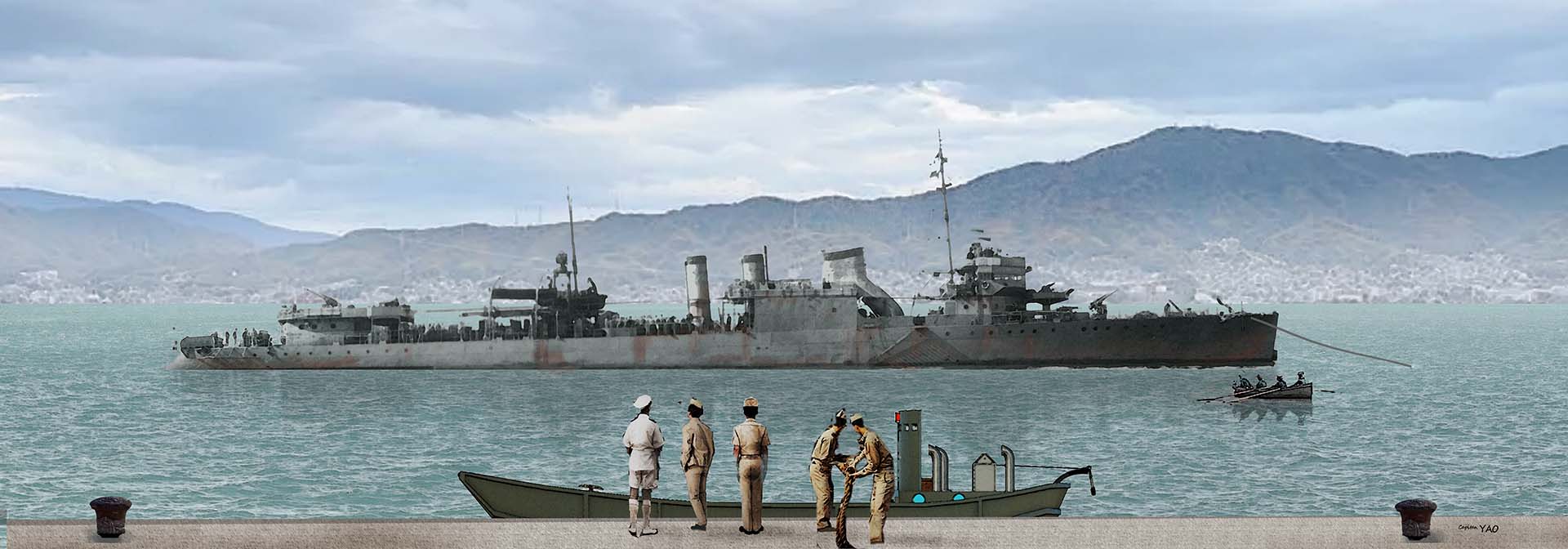
(Fig. 5-11-4) A distant view of "Sentry Boat No. 102", captured from the US, at Kure Harbor.
"You've memorized the information very well, but I sailed on her in Tokyo in 1923, and I have a gut feeling that she's different from others," I said. "However, we won't get the answer by guessing from a distance; we need to board the ship for inspection!" I beckoned the boat to shore, and the American Lt. Cmdr. had no choice but to follow. After approaching "Sentry Boat No. 102," the boat circled the ship for inspection. Usually, we can identify a ship by its name engraved in metal on the stern, as even after repainting, the original lettering is still visible. However, the stern of this ship seemed to have been reworked; the name was completely unrecognizable. In the end, we had to go aboard to inspect it. The ship had undergone extensive modifications, from its weapons and masts to its funnels, boilers, and cabin structure, to its almost unrecognizable state. Searching for ship registration information, I entered the captain's quarter. The furnishings suddenly reminded me of the secret document compartment used by the captain of the "USS Stuart". After so many modifications, did it still exist?
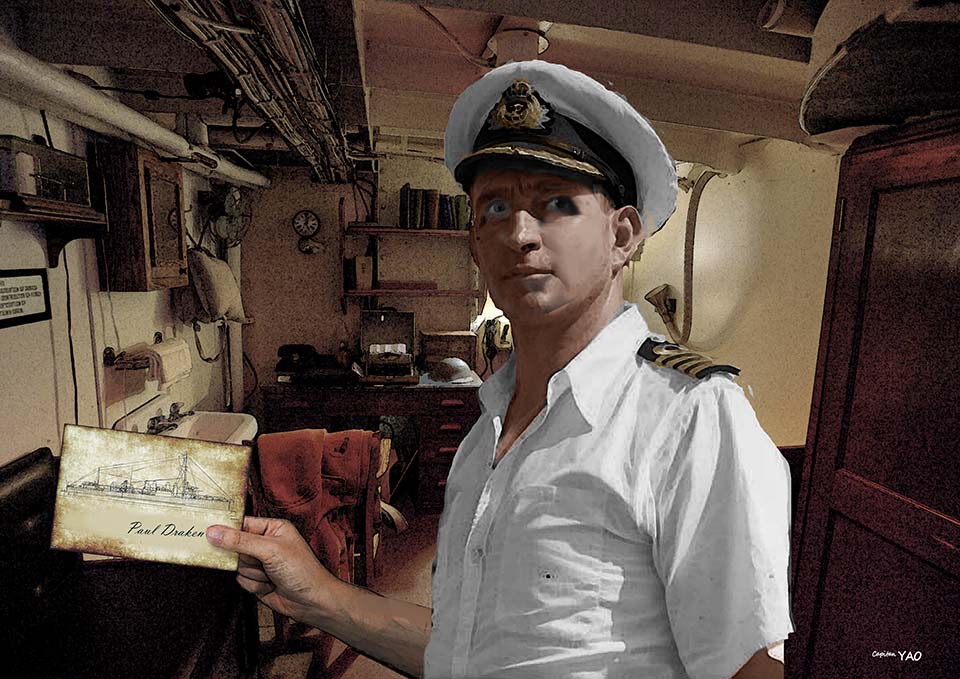
(Figure 5-11-5) Paul Draken found the graffiti from back then in the captain's private file box in the secret compartment.
Based on my memory, I reached into the bulkhead and pulled a lever. Sure enough, there was a cover that could be lifted. I reached inside and took out some yellowed documents, all of which were from the U.S. Navy. This meant that the Japanese had not discovered this secret compartment during the renovation. I flipped through the documents one by one, and a graffiti of the "USS Stuart" appeared before my eyes, with my signature on it.
"That...that's what I drew!"
In September 1923, my father and I went to Japan to attend the opening ceremony of the Imperial Hotel. Coincidentally, the Kanto Earthquake struck, and the U.S. Navy's Asiatic Fleet dispatched three destroyers to assist in evacuating Western passengers, one of which was the "USS Stuart". The graffiti I drew on the ship at that time was given to the captain and then hidden in this secret compartment until it saw the light of day again 22 years later.
"Well? Speechless now!" I looked around at the American officers who were exchanging bewildered glances, their expressions as if they had fallen into Ali Baba's mysterious cave.
"Captain Draken...you...you're not doing magic, are you?"
The identity of "USS Stuart" has been confirmed, but how did she become the Japanese Navy's "Sentry Boat No. 102"? It turns out that when the Japanese army entered Surabaya, they repaired the "USS Stuart", which was not completely destroyed, and named it "Sentry Boat No. 102". It served in the Dutch East Indies, and was later transferred to Korea, where it met the end of the war at Kure Port.
I wrote a report on the capture and discovery of the "USS Stuart", along with the old documents I found, and submitted it, but I left the graffiti where it was. I believed that since it had been given to the ship, it should remain on board forever. Based on the "USS Stuart"'s special history, the U.S. Navy, although other ships of the same class had long been out of service due to age, ordered her to be immediately reinstated, retaining the designation "DD-224" and mobilized a group of reserve officers and men to sail her back to the United States. I heard that she might become a museum.
On November 7th, I saw off the "USS Stuart" at the Kure Port pier as it returned home. It felt almost unbelievable that my connection with it would be rekindled 22 years later. However, by the time the "USS Stuart", battered and bruised, finally arrived in San Francisco after four months, the initial enthusiasm had waned. Ultimately, the "USS Stuart" was decommissioned again and used as a target ship, eventually sinking in 1946 off the coast of San Francisco, taking my graffiti with it.
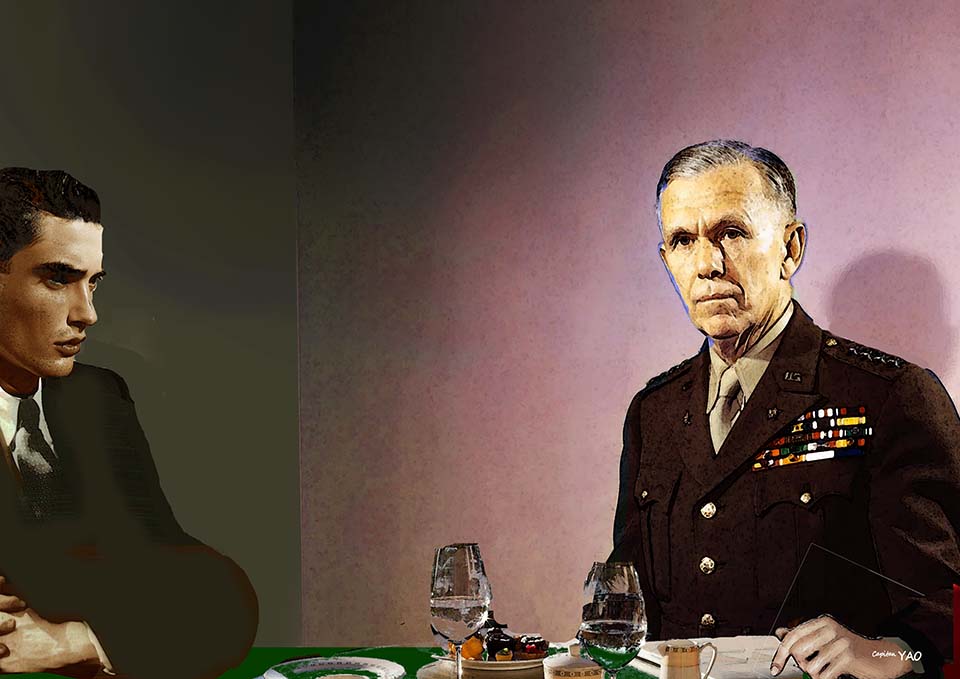
Although Chiang Kai-shek and Mao Tsetung had only signed the "Double Tenth Agreement" two months prior, due to their own ulterior motives, the flames of war reignited immediately after Mao left Chungking. Ambassador Hurley, humiliated, resigned on November 27th. President Truman decided to send a highly respected special envoy to China to mediate, and Field Marshal Marshall, who had recently retired, was entrusted with this important task, flying to Chungking before Christmas. Marshall served as the lieutenant colonel and deputy commander of the 15th Infantry Regiment of the United States Army. He was stationed in Tiantsin in 1927. At that time, his residence next to the barracks in the U.S. military compound was the official residence of my father when he served as the Consul General in Tiantsin. I visited him when I came to China in 1927. There was also a battalion commander, Major Stilwell, who later became the Allied Chief of Staff of the China Theater and had a falling out with Chiang Kai-shek.
(Figure 5-11-6) Paul Draken and Marshall meet again in China after twenty years
I visited him in early 1946. He had been in Chungking for less than a month and was full of confidence about the trip. Although I was a British spy, he was quite frank with me.
"Paul, it's been almost twenty years since we last met in Tiantsin," Marshall said. "After this great battle, many things are different."
"Yes! I was only in my early twenties back then!" I said. "Many things are different now. For example, you went from lieutenant colonel to five-star general, and the United States has become the world's leading superpower."
"I have a deep affection for China, so even after retirement, I am willing to accept the President's call to contribute to the cause of peace in China. This time, the sword I bring is American aid. If the United States does not aid Chiang Kai-shek, he cannot continue the civil war for even a day. Therefore, I believe the war will end within half a month, and everyone will return to the negotiating table." Marshall said, "Peace is what we need most right now. This is in the best interest of the United States, and I believe it will also be in the best interest of Britain."
"London should share your views," I said. "However, stopping American aid only puts pressure on Chiang Kai-shek; what effect will it have on the Communist army? They weren't fighting on American aid in the first place!"
"This..." Marshall hesitated for a moment, then leaned closer to me and whispered, "Paul, I know you've been in China for a long time. Although you're British, I'd love to hear your opinion. You can disregard the British or American positions for now."
"Without a stance, there can be no opinion," I said. "From the perspective of American interests, you should support Chiang Kai-shek in eliminating the Communists in the shortest possible time. Chiang Kai-shek has a military advantage, and as long as you Americans continue to provide financial and material support, this is entirely possible."
"But from a Chinese perspective, it's a different story." I continued, "We also know that Chiang Kai-shek did not meet American democratic standards, but that depends on whether you value tangible American interests or abstract American democratic standards. That's a choice you have to make."
"If Chiang Kai-shek continues with this military dictatorship, it will be very difficult for us to help him." Marshall: "The American people find it hard to accept that we have just overthrown a Hitler, but then we support another Chiang Kai-shek who is no better than Hitler."
"Chiang Kai-shek now certainly wants to use his military advantage to achieve a swift victory, lest things get complicated. Mao Tsetung, on the other hand, wants to use the fait accompli of having substantial control over the liberated areas to gain a legitimate and equal political status, but this is something Chiang Kai-shek is absolutely unwilling to concede." I said, "If American aid is cut off, Chiang Kai-shek will not be able to achieve a swift victory, and the Communist Party's influence will quickly spread. If China is completely communist as a result, will American interests still exist in China?"
"Paul, what you said has exceeded my expectations. I will think about it carefully." Marshall stood up to see him off: "Thank you for your visit."
My conversation with Marshall ended abruptly, and I had no choice but to rise and take my leave. What I didn't actually say was, "By this logic, your mediation is doomed to fail!"
My words proved prophetic. A year later, exhausted both physically and mentally, Marshall left China and returned to the United States, shifting the blame for the failed mediation onto both the Kuomintang and the Communist Party, especially Chiang Kai-shek.
Chiang Kai-shek was forced to cease hostilities at crucial moments by Marshall's threat to end US aid, allowing the Communist army to survive and eventually grow stronger, for which Marshall deserves much credit.
On the eve of Marshall's departure from China, I visited him again to say goodbye. He had been appointed Secretary of State and would soon take office upon returning home. He proactively told me about his European recovery plan, which later became the famous "Marshall Plan." However, we both avoided mentioning his role in mediating the Chinese Civil War, as that year was undoubtedly the most unpleasant year of his life.
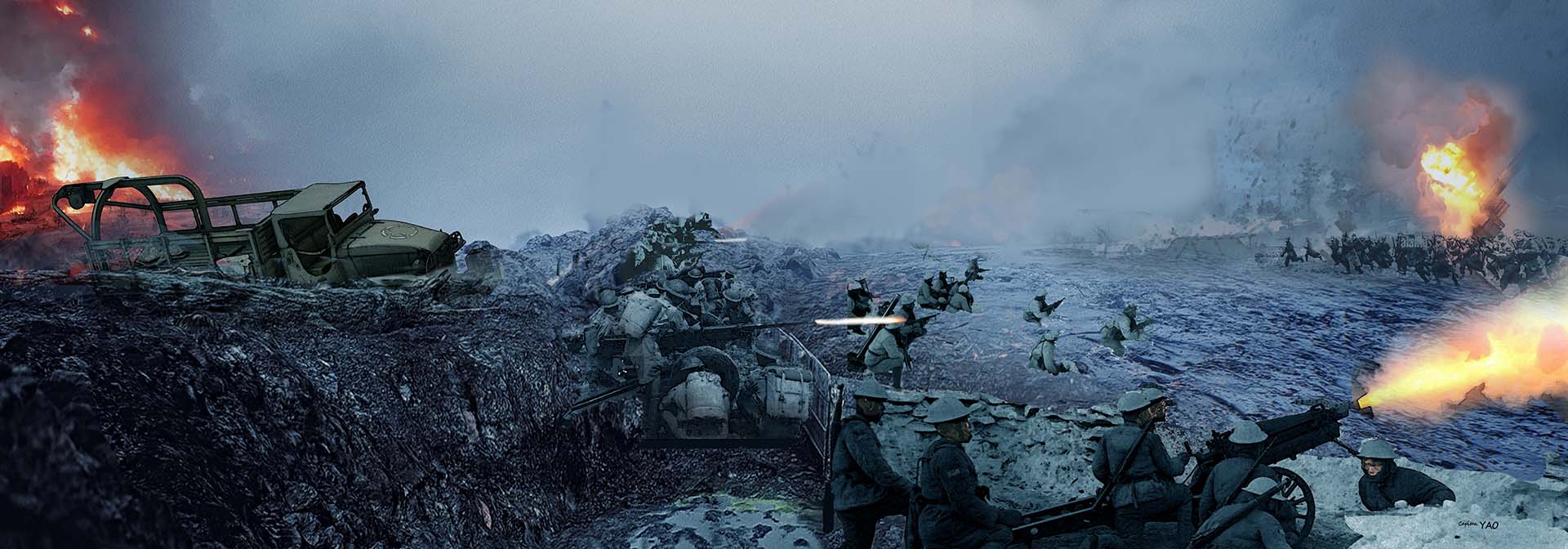
(Figure 5-11-7) The New Sixth Army fought against the Communist army in Northeast China. Worse still, in Northeast China (Manchuria), the Soviet Red Army intervened heavily at the last moment of the war, transferring large quantities of surrendered Japanese equipment to Lin Biao's troops. Chiang Kai-shek, in an effort to regain control of the Northeast, mobilized elite forces such as the New First Army and the New Sixth Army, hoping to use the advantage of American equipment to defeat the Communist army. However, American equipment is highly dependent on logistics, and the Nationalist army relied on the Americans for every bullet and every drop of gasoline. When Marshal's mediation failed, American aid ceased, rendering tanks and artillery useless. In contrast, the Communist army controlled the Japanese-left arsenals and supplies, ensuring a continuous supply and ultimately overwhelming the Nationalist army with firepower. Furthermore, the Nationalist army could only occupy scattered cities in the Northeast, surrounded by Communist control. The American-equipped troops in these isolated areas relied solely on airlift, making a long-term hold impossible. Ultimately, Lin Biao gradually decimated them, and when the Communists entered the pass, they suffered a series of crushing defeats, collapsing completely within two years. I once suggested in an internal meeting at the British Embassy in China that the most advantageous strategy for Chiang Kai-shek was to abandon the Northeast, hold onto the interior, quickly take over the prime coastal areas, and focus on improving the national economy and strengthening the country's power—only then could he have a future. However, my advice never reached Chiang Kai-shek's ears. Even if he had heard it, it wouldn't have been able to withstand the sycophants and opportunists around him, and the final outcome would likely have been the same. This was Chiang Kai-shek's limited vision, and also his destiny. I knew Sun Li-jen, the commander of the New First Army who entered Northeast China, before the war. At that time, he was the commander of the Special Forces Regiment of the Tax Police Corps, and the British tanks they used were ones I had sold to them. Sun was arrogant and clashed with his superior, Tu Yuming, which made him a target of Chiang Kai-shek's suspicion. In 1947, he stepped down as commander of the New First Army and went to Taiwan to train the New Army. Sun's demotion, however, turned out to be a blessing in disguise. He not only escaped responsibility for the loss of Northeast China, but when the Kuomintang retreated to Taiwan, the New Army trained by Sun Li-jen became the only fully organized and most combat-effective force. Chiang Kai-shek, who fled to Taiwan, needed Sun's protection, and Sun was appointed Commander-in-Chief of the Army. However, this also sowed the seeds for his later purge.
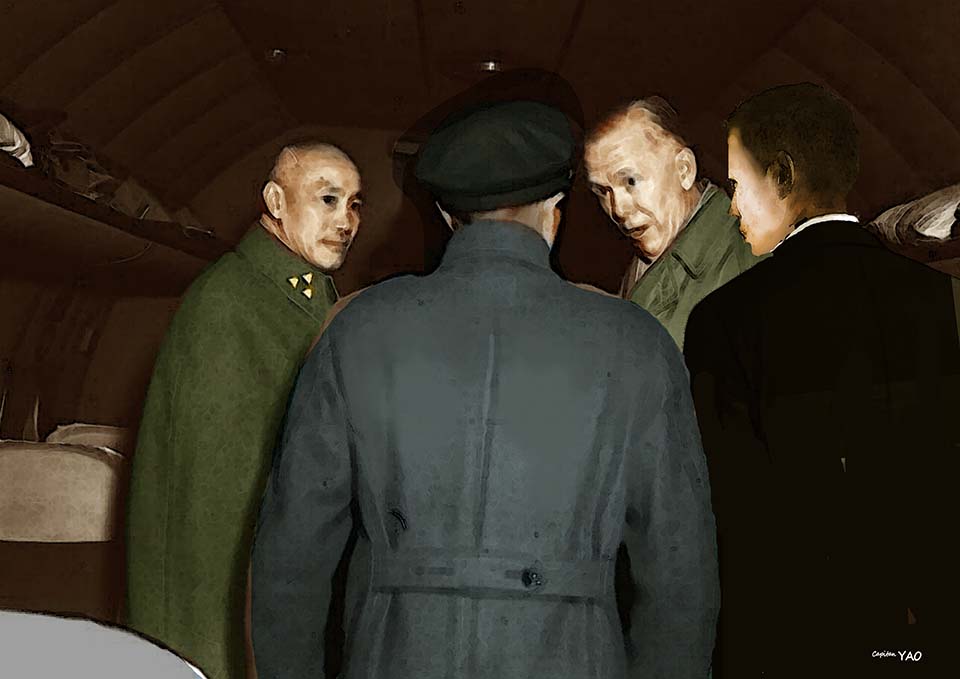
(Figure 5-11-8) Paul translates for Chiang Kai-shek on Marshall's private plane.
While Marshall was busy mediating the Chinese Civil War, I didn't forget the task assigned to me by the London side. The quickest way was to directly participate in the tripartite conference. I actively sought to attend the conference with Marshall, and he felt there was nothing wrong with that, and he probably thought I understood the Chinese better than he did and could be of help to him, so he agreed. However, the prerequisite was that I could not wear military uniform, I could not represent Britain, and I could not disclose the contents of the conference to the public. I readily agreed to all three points.
The Military Mediation Executive Headquarters was located in Peiping, and I always flew there from Shanghai on Marshal's private plane, which was quite easy. As an observer, I always sat in the second row during the meetings and could only listen, not speak. Knowing that the two sides wouldn't reach any conclusions, I found it rather boring. However, since Soong Mei-ling did not participate in the mediation meetings, sometimes when Chiang Kai-shek was in a hurry to speak to Marshall and the interpreter wasn't around, he would ask me to act as the interpreter.
Marshall agreed to let me attend, but of course he had his own purpose. He often asked for my opinion after the meeting. Actually, I was an outsider with a clearer perspective, but I didn't want to discourage him, so I could only give vague answers. Later, because I often had to travel to Tokyo for business, I gradually stopped attending.
However, I did meet some noteworthy people at the meeting. One of them was Yu Tawei, the Vice Minister of Military Affairs of the Kuomintang. He was a PhD from Harvard University in the United States and the University of Berlin in Germany, a famous ballistics expert, and a very intelligent man. Actually, I had known General Yu for a long time because in 1933, when he was the Director of the Ordnance Bureau in charge of weapons procurement, I visited him many times in order to promote British arms. Unfortunately, at that time, the Chinese army, from Chiang Kai-shek down, generally had a strong preference for German goods, and my salesman work was not very successful.
Actually, I have some personal connections with Yu Tawei. First, his son, Yu Yanghe, is an air force pilot I know who was considering switching to civil aviation and asked for my opinion. Second, his nephew, Yu Chiwei, was Li Yunhe's live-in boyfriend in Tsingtao, but I never dared to tell him about my relationship with Li Yunhe.
Not long after, Yu Tawei became Minister of Transportation and stopped attending meetings. After the Kuomintang's defeat on the mainland, he went to the United States under the pretext of recuperating. It was not until 1954 that he returned to Taiwan at Chiang Kai-shek's invitation to serve as Minister of National Defense. At that time, I was working in the CIA's Taiwan office, and we had a lot of contact due to professional reasons.
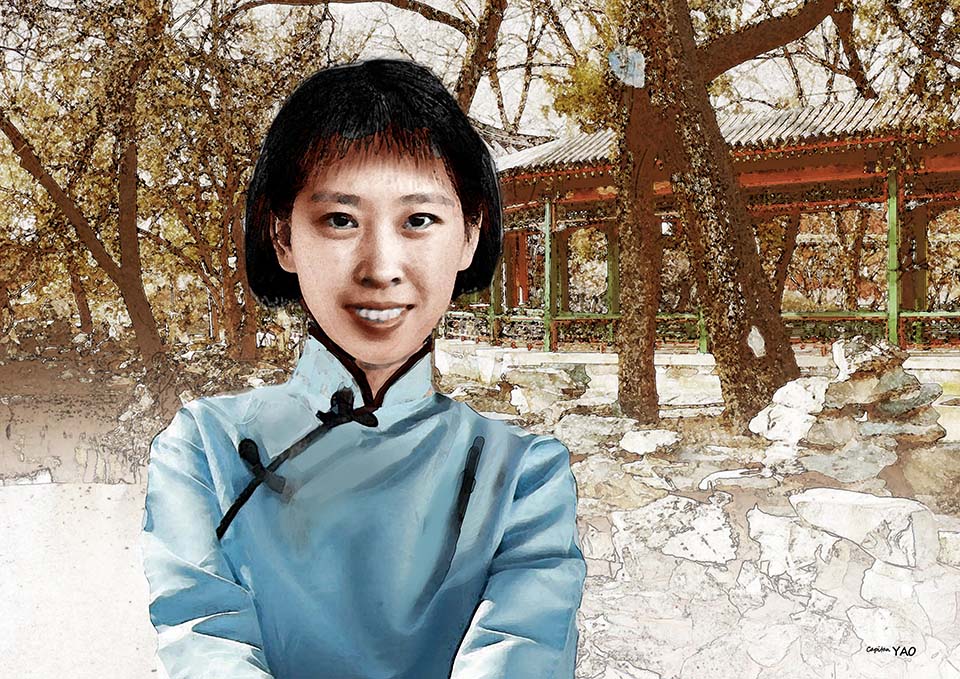
(Figure 5-11-9) Wang Kuangmei, the CCP's translator at the Marshall Mediation Conference.
Another person worth mentioning is Wang Kuangmei, the CCP's translator, a talented woman with outstanding temperament who had just graduated from Fu Jen Catholic University in Peiping. Her brother, Wang Kuangfu, was an ace pilot in the Kuomintang Air Force, known for shooting down eight and a half Japanese planes. I knew her very well, and I often used this as an excuse to strike up a conversation with her. I also discovered that our birthdays were only one day apart; hers was September 26th and mine was the 27th. Although I was fourteen years older than her, I deliberately called her "eldest sister," so we agreed to have a birthday party together. Unfortunately, I was unable to continue attending meetings due to frequent business trips to the Tokyo Allied Headquarters. Then, the negotiations between the Kuomintang and the Communist Party broke down, and the Peiping Military Mediation Office closed. Before we could even celebrate our birthdays together, she left Peiping for Yan'an.
In 1948, she married Liu Shaochi, one of the leaders of the Chinese Communist Party. In 1959, Liu succeeded Mao Tsetung as the President of China, and Wang Kuangmei became the First Lady. During diplomatic visits, her appearance, temperament and speech amazed everyone and created an excellent international image for the new China. However, this also made Kiang Ching both jealous and resentful. After the start of the Cultural Revolution, she launched a crazy revenge against the couple. Liu Shaochi was persecuted to death in 1969, and Wang Kuangmei spent twelve years in Chincheng Prison in a dark prison. She was not rehabilitated and released until 1979.
However, Wang Kuangmei was luckier than Kiang Ching. After her release from prison, she held many important positions and gained a good social image. She is still living happily in Peiking to this day (Editor's note: Wang Kuangmei passed away in Peiking in 2006). Unlike Kiang Ching, who, although she committed suicide while on medical parole in 1991, will likely forever be associated with the image of a heinous and wicked woman, unable to escape her fate for centuries. Both of these first ladies were connected to me, but neither of them was meant to be. Our life trajectories intersected by chance, and that is enough.
|