6. Taiwan Shrines
As we approach Taiwan, I'd like to first introduce its history. Taiwan, also known as "Formosa" by Westerners, is an island next to mainland China. In the early days, it was inhabited only by local aboriginals and a few Han Chinese who had illegally immigrated from the mainland to cultivate the land. In the 16th century, the Dutch from Java and the Spanish from the Philippines occupied the northern and southern ends of the island, respectively. Later, the Dutch drove out the Spanish and occupied the entire island. Soon after, Koxinga (Cheng ChengKong), a Ming Dynasty general who had retreated from mainland China, defeated the Dutch and occupied the entire island, establishing the Kingdom of Tongning. Then, China, which was under the rule of the Ch'ing Dynasty at the time, sent Shi Lang, a surrendered general of Cheng, to conquer Taiwan. From then on, Taiwan became part of China.
In 1895, China and Japan went to war, and China was defeated, ceding Taiwan to Japan in a peace treaty. After taking over, Japan used it as a test case for managing its overseas colonies, and in just a few years, it transformed Taiwan from a backward island into a modern place. However, there were still some forces on the island that resisted colonial rule or modernization and frequently caused trouble, creating problems for the Japanese colonial government.
The reason I keep introducing Taiwan is because it is closely related to the second half of my life. As for what that relationship is, I will tell you later. However, I never expected to come to Tamsui again a few years later, and even to return on the seaplane carrier "Chenhai"!
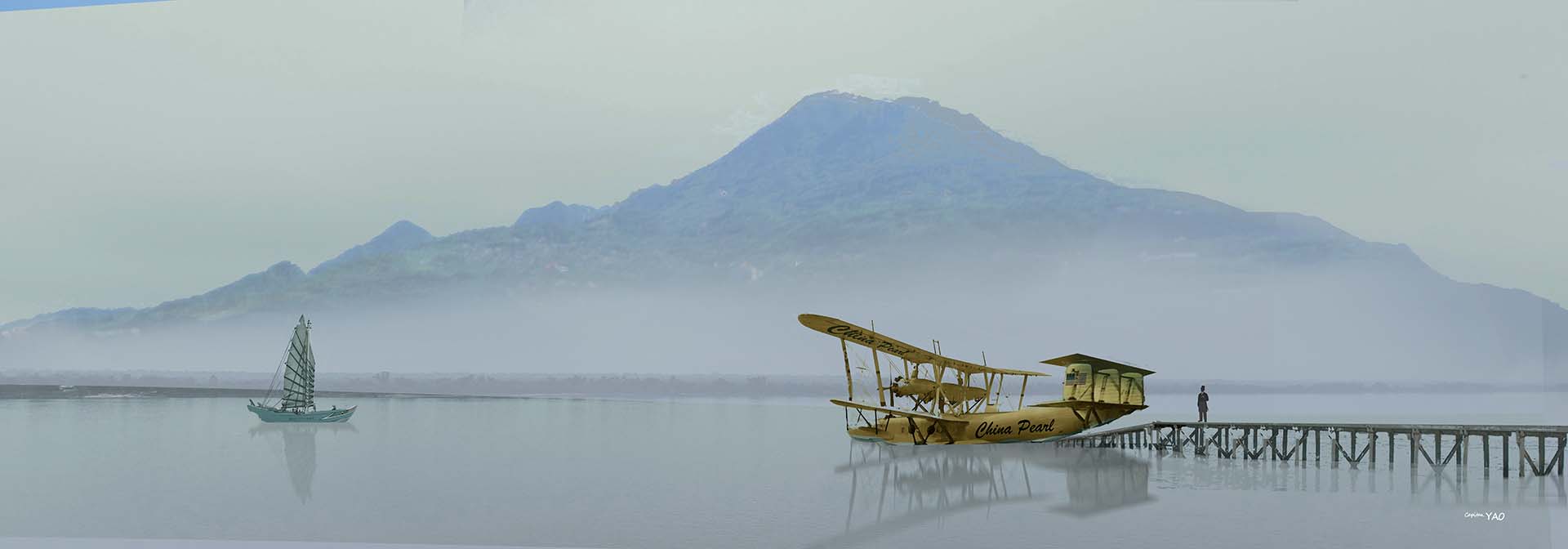
(Figure 3-6-1) The "China Pearl" landed at the mouth of the Tamsui River and moored in front of the seaplane base pier.
"Good day! Welcome to Taiwan. I am here on behalf of the British Consulate in Tamsui to welcome you! You must be Ensign Paul Draken? Please come with me. Our consul would like to invite you both to afternoon tea. The consulate is upstairs." I looked in the direction he was pointing and saw a small and lovely fort on the hill facing the river mouth. Later we learned that the locals called the fort, which was left over from the Dutch colonial era more than two hundred years ago, "Antonio Fort".
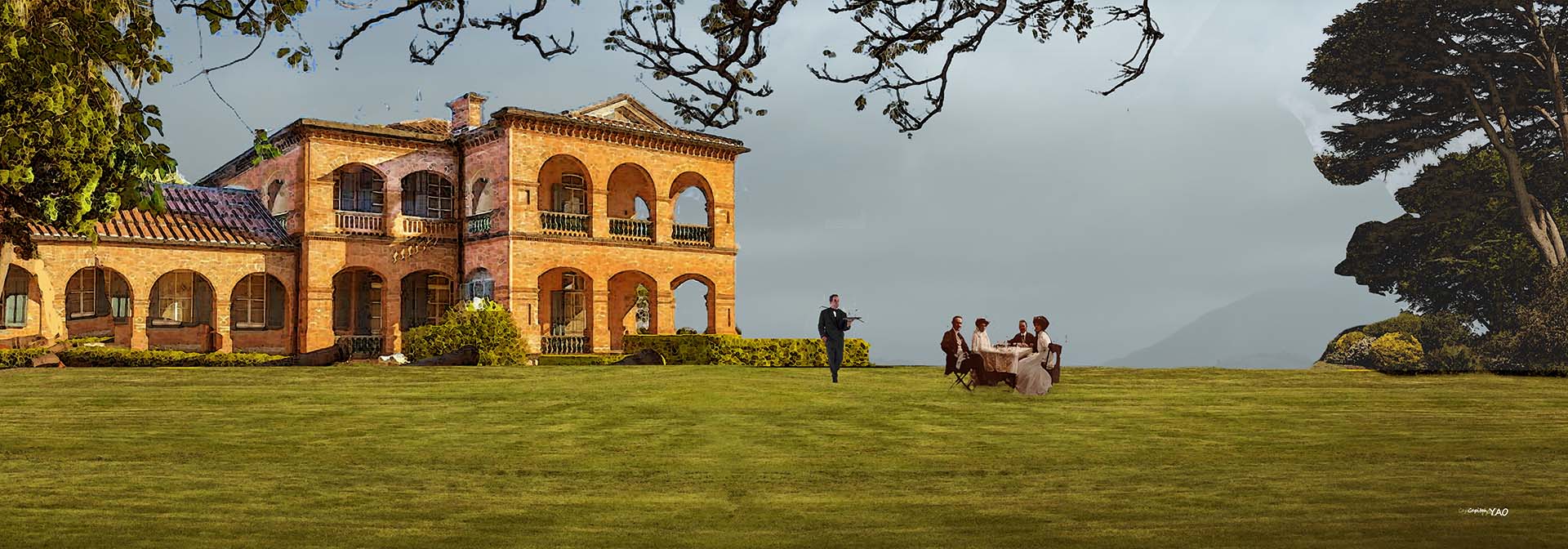
(Figure 3-6-2) The British Consul in Tamsui hosted Paul and Annie for afternoon tea at his official residence.
The consul said, "Much of the tea we drink in Britain comes from Formosa. This wonderful place was given to Japan by the Chinese government during a war 35 years ago! Speaking of Japan, your father and I were colleagues at the consulate in Yokohama, before you were even born!" "Yes! My father often mentions you. By the way! I heard that the Taiwan Shrine Festival is tomorrow. I was wondering if I could go and see it? It must be very interesting!" I tentatively suggested. The consul said, "This is the biggest official celebration in Taiwan, with events taking place all over the island. Our diplomatic corps is required to send representatives due to protocol, but it's so boring that nobody wants to go. Since you're interested, how about this: you go in my place, and I can play golf tomorrow!" I said, "That's great! Could I borrow a dress?"

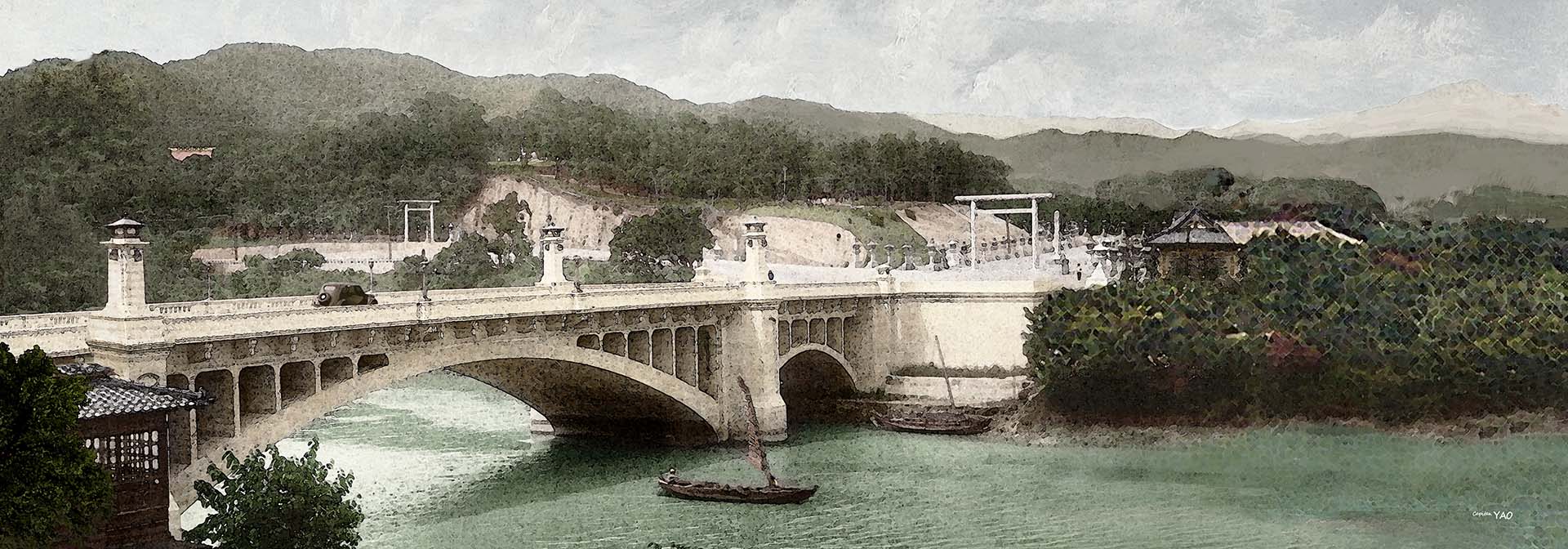
The next morning, I was dressed in a tailcoat and top hat. Annie and I took the train from Tamsui to a station called "Miyashita". It was a small station built specifically for Taihoku Shrine. From there, we walked across an iron bridge that spanned the river to reach the square in front of the shrine. Looking up from there, we could see that the shrine complex was built along a gentle hillside. By then, many officials and gentry dressed in formal attire, just like us, had gathered there. I handed out invitations at the door and followed the guests inside.
I heard that the shrine's festival was conducted according to ancient Japanese rites, which was a very new and interesting thing for me. Before the ceremony began, I took the opportunity to observe around and look for the treasure hall and the route in and out based on the map provided by Kim Bihui. Perhaps because I was representing the British consul, the Japanese were generally very respectful to me and did not stop me much. I guessed that the treasure hall was probably in a temple-like building behind the main hall.
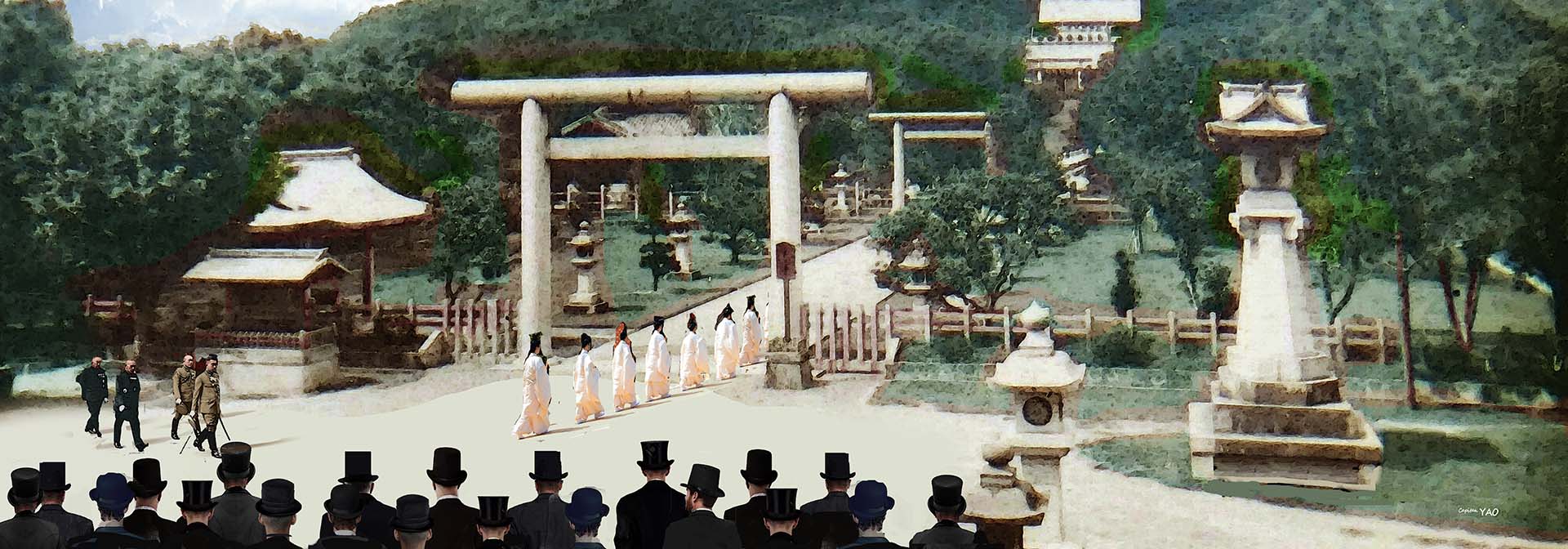
(Figure 3-6-4) The festival at the Taiwan Shrine begins.
"Whether we can find the luminous pearl depends entirely on this golden flute..." My father's words echoed in my ears. I also recalled the ground shaking when I played the flute over Peking in 1927. I thought that if I played it now, it would surely knock everyone over. I subconsciously touched my neck. Oh no! I had taken it off when I changed into my formal attire this morning. Fortunately, when the ceremony ended, the priest came out from the front hall. It was only when the group passed in front of the VIP seats that I saw the luminous pearl clearly for the first time. It was about the size of a ping-pong ball, with a dull and lackluster surface. I couldn't see anything magical about it. I was a little disappointed. Was this the luminous pearl that my father had been thinking about for more than 20 years? "How can I get my hands on it?" I pondered for a long time. "Do you expect me to become a thief?" The Chinese saying goes, "Nothing ventured, nothing gained." It seems the only option is to break into the shrine at night. Not only do we have to steal the food, but we also have to do it without anyone noticing. Otherwise, it's thousands of miles from Taiwan to Hsinkiang, and if the Japanese find out, we'll never be able to reach Loulan. "Why did Kim Bihui tell me the luminous pearl was in Taiwan? If she hadn't written to me, we wouldn't be here today!" Suddenly, a possibility occurred to me: "Could Kim Bihui be here too?" I looked around at the guests who were gradually leaving after the ceremony, hoping to see if I recognized any of them.
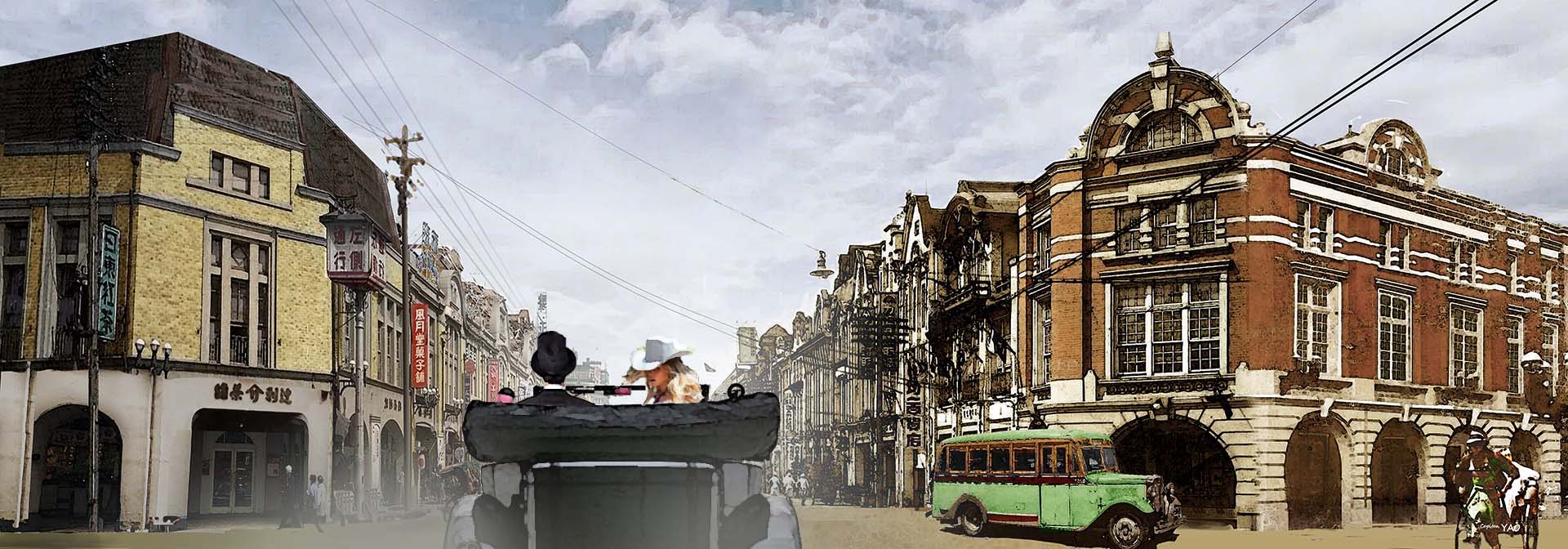
(Figure 3-6-5) Paul and Annie rent a car to tour the streets of Taihoku.
We toured Taihoku by taxi, and were particularly impressed by the magnificent public buildings of the colonial government, modeled after European cities, especially the Governor's Mansion with its central tower! We also explored the narrow, crowded, and bustling Chinese streets, which felt especially familiar to me, having spent my childhood in China. It was a public holiday that day; late October is the most comfortable season here, and people of all ages were dressed up and enjoying themselves – it was quite a lively scene! I gestured to myself and said to Annie, "My impression of Taiwan is: under the guise of Japan, there's a face of mixed Eurasian descent like mine, but inside, a Chinese heart!" Annie nodded, seemingly understanding but not quite.
Annie said, "I'll go with you!" "You should stay on the plane. I need the plane to be on standby to pick me up at any time. Remember! If you hear any movement on the shore, start the engine immediately and point the stern of the plane toward the pier," I instructed. "Be careful, Paul!" Annie hugged and kissed me. I started my motorcycle and drove onto the breakwater pier towards Taihoku. I quietly parked my motorcycle outside the shrine and sneaked in through the planned entry point. I quickly found the treasure vault, took out my tools, and tried to unlock the door, but after struggling for a long time, I couldn't get it open and was sweating profusely. Frustrated, I pulled on it, only to find that it wasn't locked at all. Opening the treasure vault door, I found a mirror, a puppet, a samurai sword, and the luminous pearl inside. Just then, I heard a commotion outside the hall. I quickly grabbed the luminous pearl, hid it in my bag, and grabbed the samurai sword as I left the hall.
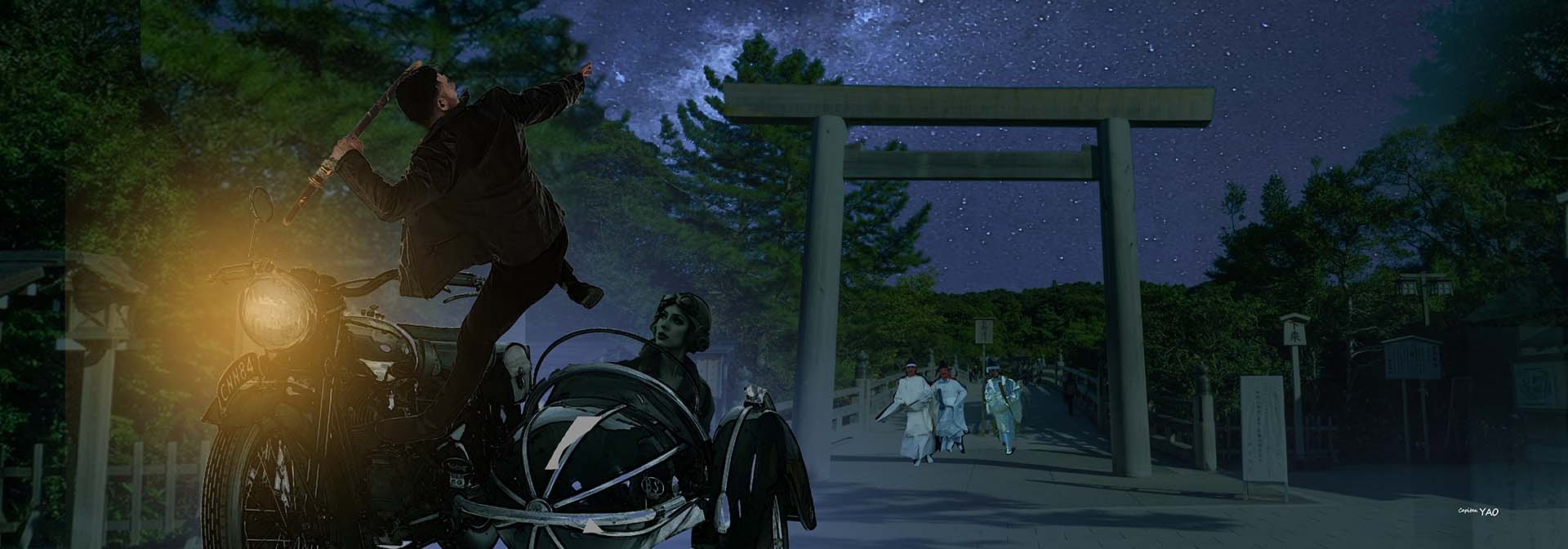
(Figure 3-6-6) Paul Draken threw the samurai sword at the guard and took advantage of the chaos to start his motorcycle and escape.
Kawashima jumped onto the side of my motorcycle and yelled, "Aren't you going to move?" By this time, the shrine guards had caught up to the torii gate. I threw the sacred sword into the air, and the guards rushed forward to catch it, crashing into each other. I took the opportunity to start my motorcycle and speed away. Kawashima and I sped along the narrow road toward Tamsui on our motorcycles, pursued by three Japanese motorcycles. One of them, unable to react in time at a sharp turn, plunged into the river. The Japanese soldiers on the other two motorcycles began firing machine guns. Kawashima, standing on the side of the motorcycle, laughed wildly and returned fire with her small pistol, as if playing a thrilling and fun game. The second Japanese motorcycle veered off course, rolled over, crashed into the mountainside, and exploded into flames.
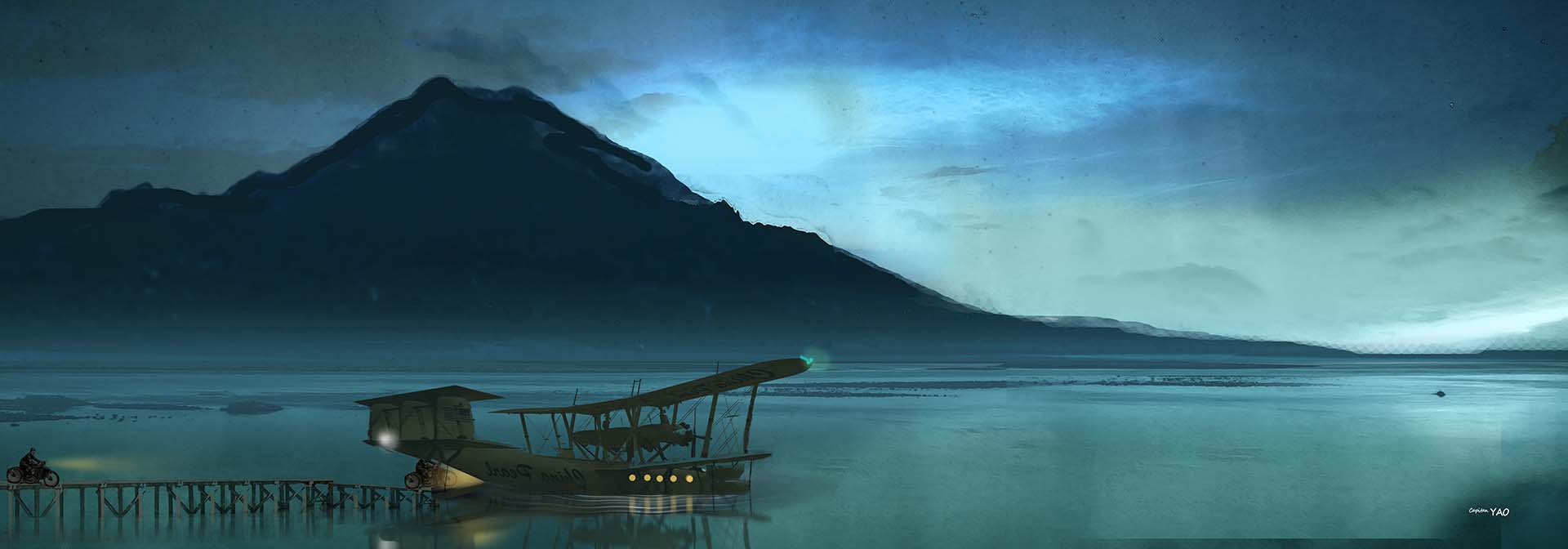
(Figures 3-6-7) Paul Draken rode his motorcycle into the rear cabin of the "China Pearl" while Japanese motorcycles were chasing after him on the pier.
Annie, who was left behind at the plane, saw the car chase on the shore and heard a series of gunshots. She knew something was wrong, so she immediately started the engine and pointed the stern of the plane at the pier. Soon after, I rode my motorcycle onto the pier. When I was almost at the end, I jumped and flew across the water with my motorcycle, crashing into the storage cabin at the stern of the plane. At the same time, the plane slid forward and distanced itself from the pier. The Japanese motorcycle that was following behind jumped and fell into the water. Annie, inside the cabin, was astonished to see Yoshiko Kawashima on the motorcycle: "Kim Bihui? What are you doing here?" I said, "Let's take off quickly, I'll explain later!"
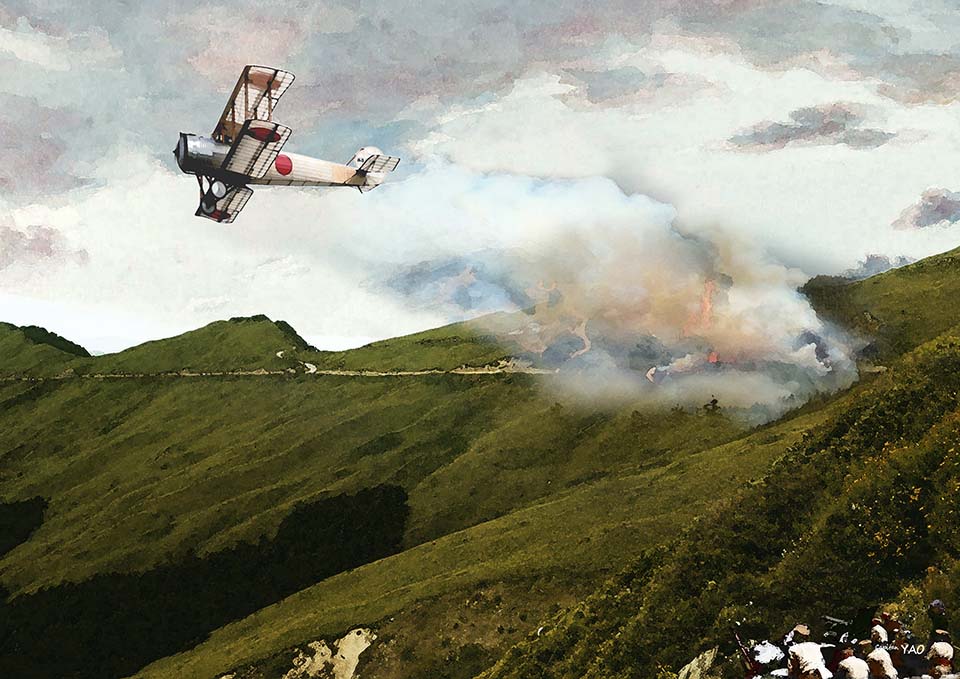
The "China Pearl" took off from the mouth of the Tamsui River in the dark. The Japanese did not pursue us. Later, I heard that a rebellion broke out among the indigenous people in the central mountainous region of Taiwan that day (Editor's note: the Wushe Incident). All the Japanese military aircraft were dispatched to quell the rebellion and had no time to pursue us.
Because this trip to Taiwan was undertaken with a clandestine mission, it was kept secret from the outside world. Only a telegram was sent to the British Consulate in Tamsui to handle the entry procedures, and the media was not notified. In addition, afterward, Kim Bihui used high-level connections to suppress the incident, so to this day, no documentary record has been left that the "China Pearl" ever visited Taiwan. However, while archives can be destroyed, it is impossible to completely silence those who witnessed the event.
At the time, the people of Tamsui all rushed to see the "giant airship." I only learned about this in the mid-1980s when I met Lee Teng-hui, who was then Chiang Ching-kuo's deputy. He mentioned that he was brought to the Tamsui pier by his father, who was a policeman, when he was a child. He was only seven years old at the time, and he only thought that the "China Pearl" was enormous and that its bright yellow paint job was very impressive.
This seven-year-old boy, then named Masao Iwasato, later earned a doctorate in agricultural economics from Kyoto Imperial University in Japan and the United States. He began to emerge in Taiwanese politics in the 1970s, rising from Mayor of Taipei to Governor of Taiwan Province, and finally succeeding Chiang Ching-kuo as President of Taiwan in 1988 after Chiang's death, a period of twelve years of turbulent rule. I have had many encounters with him, and the details are too numerous to recount in a few words; I will elaborate on them later.
|