3. British Spy
On June 18th of that year, Grand Marshal Chang Zuolin announced his inauguration as Grand Marshal of the Anguo Army in Peking and declared that he would exercise ruling power on behalf of the Republic of China, meaning that he had become the head of state of China.
It happened to be a weekend, and the Northeast Naval Air Force specially dispatched three aircraft, led by me, to fly over the Forbidden City in Peking to celebrate. However, by this time, the revolutionary army had already occupied the area south of the Yangtze River, and China was divided into north and south. Looking down at the endless rows of yellow rooftops of the imperial city from the air, I was filled with emotion. Every time I saw it, it was during a dynastic change; the political situation in China was truly unpredictable. But this was the first time I had ever seen the Forbidden City from the air!
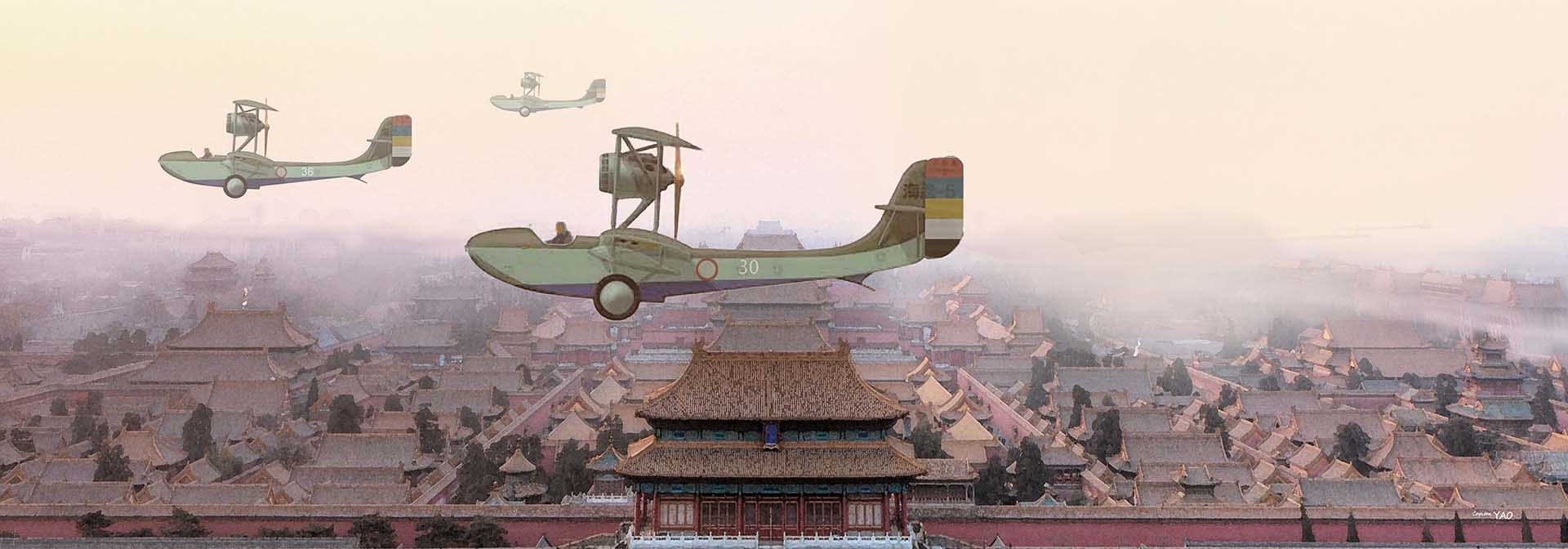
After the mission was completed, the two wingmen returned to Nanyuan Airport and landed first, while I went to the outskirts of the city alone to see the Eastern Tombs. From the air, I could only see many layers of bright yellow glazed tile roofs peeking out from the dense forest, and I couldn't tell which one was the tomb of Empress Dowager Cixi.
I suddenly remembered the golden flute that I had worn around my neck since childhood, so I picked it up, put it in my mouth, and blew it softly. At that moment, a cemetery on the ground suddenly glowed faintly, and the surrounding sea of trees spread outwards in waves from the center. It seemed that there was a huge energy underground that made my heartbeat synchronize with it.
"Could that luminous pearl really be right beneath my feet, nestled in the mouth of the Empress Dowager's decaying corpse?" A chill ran down my spine.
When I returned to my hotel from Nanyuan Airport, I saw a group of people surrounding an elderly man in the lobby. It turned out to be Chiu Taochi, the fortune teller who had told my fortune at the International Hotel. I went up to him and asked, "Why haven't the queen and princess you mentioned appeared yet?"
Chiu Taochi looked at me and replied calmly, "Your calamity has passed, hasn't it? You'll soon be a high-ranking official!"
"My ordeal? Oh right! I even became a minor official because of it!" I started to feel a bit curious and interested in him: "That's right! I'm an official now!"
"Not this one. You'll soon have an even higher position, and the Queen or Princess will arrive at the same time!" Chiu Taochi calculated with his fingers and said, "However... you won't be in it for long!"
"What's the point if you can't even last a few days?"
I took out a silver coin and offered it to him, but he insisted on refusing it and said he would continue to watch my fate.
As soon as I returned to my room, I received a mysterious phone call. The caller spoke fluent English, saying that my father had asked him to deliver a message to me, arranging to meet me in front of an antique shop in Liulichang. Ever since the kidnapping incident, I've been extremely wary of Liulichang. Although I'm now a minor warlord, with bodyguards standing on either side of my car as I speed through the streets, familial ties and curiosity compelled me to change into civilian clothes and go alone.
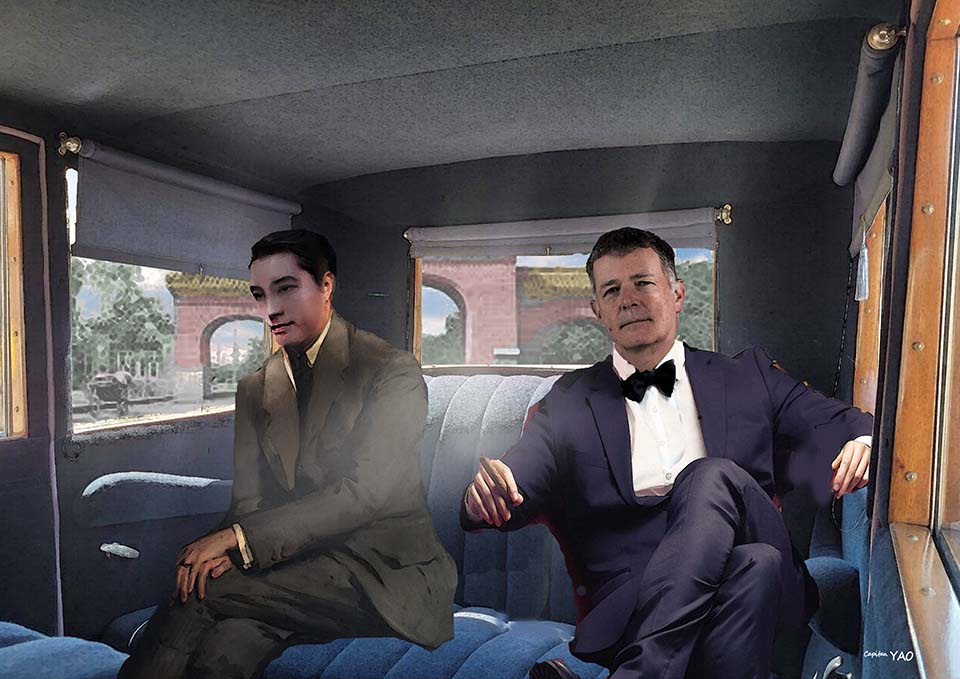
Shortly after arriving at the agreed location, a car pulled up beside me. A man who appeared to be a British gentleman, around 40 years old, sitting in the back seat, called me to get in. Before I could even sit down, the driver sped away. The man said, "Hello! Ensign Draken, or should I call you Lieutenant Colonel Long?"
"Who are you? What do you want with me?"
"I work for the British Embassy; you can call me Mr. M!"
"So, you're here to arrest me, this deserter?"
"Don't put it that way. Let's look at this from another angle. You're just one of dozens or hundreds of ensign pilots in the Royal Navy, but being the deputy squadron leader under Great Marshal Chang is an opportunity we've been dreaming of. Why would we bring you back?"
Figure 2-3-2) Paul Draken and Mr. M have a private conversation in the car.
I noticed the car was just circling around Beijing's streets without a clear destination. I turned to look at Mr. M, who smiled and said, "Let me be frank! I'm the head of MI6's naval intelligence in North China. Your father was our former superior. We're very concerned about the movements and intentions of Marshal Zhang of the Peking government, especially his attitude towards the Japanese. You can be of great help!"
"Am I that important?"
"Of course! A suitable person in a key position is worth more than a thousand troops. Take the anti-Western imperialist movements that have occurred in various places in recent months, for example. The only solution our idiot generals in London could come up with was to send 10,000 more troops to China. As a result, they added fuel to the fire and made the situation even more uncontrollable. Only our MI6 people saw that Chiang Kai-shek, the so-called Red General, was not actually a monolith. They sent someone to do some work and transformed him into a pro-Western and staunchly anti-communist leader of the new China. Tell me, isn't the power of one person great?"
"I'm a pilot, not an intelligence officer. Besides, what about my Royal Navy membership? I can't be expected to spend my whole life as a deputy squadron leader in China, can I? I was planning to go back to the Royal Naval College for further studies!"
"Don't worry! We'll arrange everything. Your promotion won't be affected at all. We might even be able to persuade the Great Marshal Chang to fund your studies at the Royal Naval Academy!"
This guy's really persistent, so I had to find out his intentions: "So... what do you want me to do?"
"Actually, there's no need to do anything special. Just get closer to the young marshal, gather some information, and report back to me when you find anything. Of course, it would be even more advantageous if you could gain the marshal's favor and climb to a higher position." He took out a business card: "This is my contact information!"
I shook my head and pushed his business card away, saying, "No way! Great Marshal is always talking about executing people. If he finds out I'm having an affair with you, won't I end up like Korniloff?"
"No, he wouldn't dare kill you since you're a Westerner."
"Isn't Korniloff a Westerner?"
"That's different! You're British, he's a countryless man: you could be stepped on like a cockroach and no one would care."
I started to feel nauseous and said, "I have to get off the bus! Where's my father's letter?"
"Oh! I'd completely forgotten. Here it is!" He pulled the letter from his coat pocket and handed it to me, saying, "Paul, I have another question for you. Do you have any brothers? I mean, twins!"
"My father only has one son, me!"
"That's really strange! I saw a captain in a warlord's army near Peking who looked exactly like you."
"With such a large population in China, it's not unusual for people to look alike, is it?"
"However, it's still quite rare to see people of mixed East and West descent in China, let alone look so alike!"
"Mr. M, aren't you asking too many questions? I'm getting off!"
Seeing my insistence, Mr. M had no choice but to order the driver to stop the car and let me out before driving off. I opened the envelope by the roadside, but what letter was inside? There was only a check for one thousand pounds and Mr. M's business card.
My concerns were not unfounded. Due to the successive victories of the Southern Revolutionary Army, Great Marshal Chang had begun to develop a hysterical fear of the Communists. Just recently, on April 6th, he even sent troops to search the Soviet embassy, arresting Kuomintang representative Li Dazhao and twenty others, and on the 28th, he and his daughter Li Yinlian were hanged. Although the Peking government did not have the same level of conflict with Britain as it did with the Soviet Union, the act of disregarding diplomatic protocol by storming the embassy to arrest and execute people still caused a great shock in the Legation Quarter. I did not want to take that risk.
I later learned that it was also Sergeant Show who persuaded me to join the Navy when I graduated from flight school. I was so naive to think that getting off the bus meant I was rid of this annoying guy. In fact, this Mr. M had controlled me for most of my life, and no matter how much I struggled, I couldn't escape his clutches.

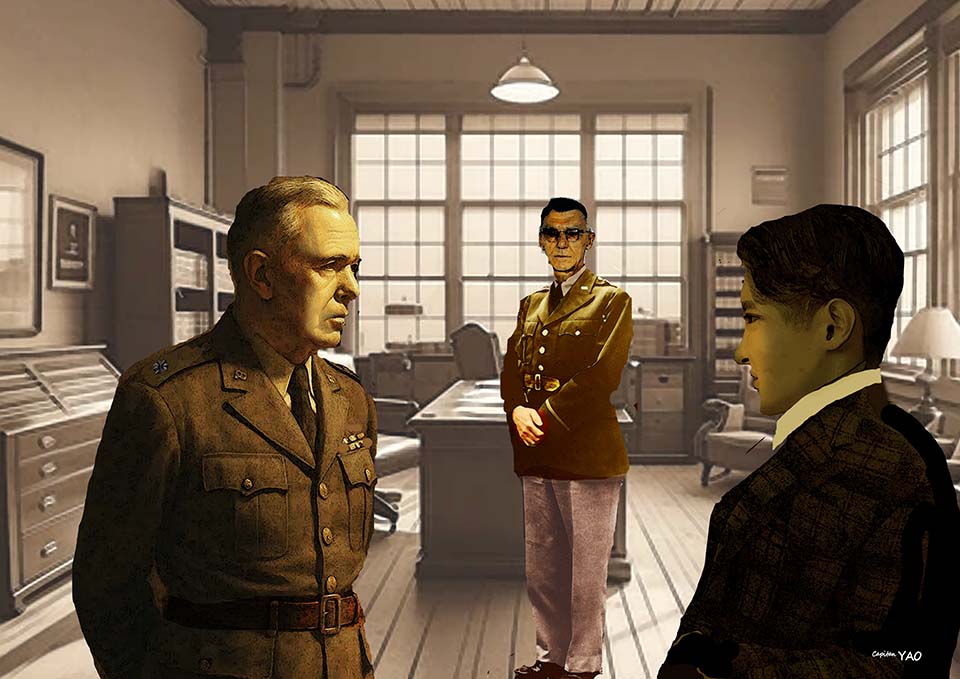
On my way back to Tsingtao from Peking, I visited Lieutenant Colonel Marshall and Major Stilwell in Tiantsin. Only three months had passed since we parted ways, but the situation had changed dramatically. Stilwell had just returned from observing the war in southeastern China and should have a lot of useful information and intelligence. We met at the headquarters of the 15th Infantry Regiment in the "American Compound," and I noticed that Stilwell's already thin face looked even more haggard.
(Figure 2-3-3) Paul Draken met again with Marshall and Stilwell in the office of the 15th Infantry Regiment of the U.S. Army in Tiantsin.
"I heard you've become the deputy commander of Great Marshal Chang's naval air squadron," Marshall said.
"Where should I begin? I've been kidnapped," I said. "I think we should start by talking about Major Stilwell's inspection tour."
"Yes! Major Stilwell has just returned from an inspection tour of the South; he has firsthand intelligence from the battlefield," Marshall said.
"I traveled alone across the front lines of both sides, through Xuzhou, Nanking, and Shanghai. Every place was littered with corpses; it was truly horrific..." Stilwell said. "The Chinese people were so pitiful! Those warlords only cared about their own interests and completely disregarded the lives of the people."
"So who do you think will ultimately be the leader of China, Major Stilwell?" I asked.
"I think the Southern Revolutionary Army is a more idealistic and disciplined force, and should be able to defeat the Northern forces and achieve final victory," Stilwell said. "Their commander, Chiang Kai-shek, was decisive and energetic. I didn't see him as qualified to be a party leader, at most a faction leader; however, things may have changed after the April 12 Incident."
I know that the "April 12 Incident" that Stilwell referred to was the bloody suppression launched on April 12 by Chiang Kai-shek's army in conjunction with the Ch'ing Gang against the armed workers' militia who had liberated Shanghai from the warlords. As a result, thousands of workers' militia members trained by the Communist Party's Chou Enlai were brutally executed in the April 12 Incident. The Peking government publicized this incident extensively to emphasize the terror of the revolutionary army.
"Originally, Chiang Kai-shek was seen as the vanguard of the Comintern, but after the April 12 Incident, he had basically gained the trust of Westerners in Shanghai and capitalists in Jiangsu and Zhejiang, who believed that he was not a Red general but a protector of capitalism. With the help of these people, Chiang Kai-shek could become the leader of the new China."
Stilwell continued: "Although others like your boss Chang Zuolin or Chang Zongchang also used the anti-communist banner, they would eventually be abandoned by the West, so I think it should still be Chiang Kai-shek during the transition period."
"The transition period? What about the future?" Marshall asked.
"It's not clear yet, but perhaps it's another real peasant revolution!" Stilwell said. At the time, no one knew that while the April 12 Incident in Shanghai had forced the Communist forces out of the city, it had also made Mao Zedong's peasant revolution in Jinggangshan mainstream, culminating in the establishment of the Red Army on August 1st, shortly after my meeting with Marshall and Stilwell. At the time, not only Stilwell, but no one else could see the impact of this event, but the fact that he raised the possibility of a peasant revolution at this critical juncture demonstrates Stilwell's exceptional political acumen. Marshall, on the other hand, lacked this sensitivity; his views were purely military in nature.
"Furthermore, Chiang Kai-shek's military advisors have recently been changed from Soviets to the German General Bauer. If I'm not mistaken, his troops will soon transform from the Red Army model to a militaristic, iron-fisted model!" Stilwell said. "Militarism will inevitably lead to Chiang Kai-shek's military dictatorship!"
"So, the German officer corps, who were unemployed after the European war, found their battlefield again," Marshall said.
"And then there's the huge arms deal," Stilwell added. "China will use tungsten and antimony from Hunan as payment!"
Speaking of Chiang Kai-shek's mysterious transformation reminds me of Mr. M: "By the way, do you know Mr. M from the British Embassy?"
I handed Mr. M's business card to Lieutenant Colonel Marshall, hoping they could help me solve this mystery: "Or perhaps MI6 Naval Intelligence Group?"
"I don't know!" Marshall shook his head and handed the business card to Stilwell.
Stilwell looked at it and said, "If it's the naval intelligence attaché from the British Embassy, then it should be Lieutenant Commander John Gaffrey. Who is this Mr. M? Did he kidnap you?"
"Oh! Time is running out, I have to rush back to Tsingtao..." I didn't answer directly, and stood up to say goodbye: "Goodbye, both of you!"
"It's fate that we can live in the same house. Wait a minute, I have something to give you." Marshall took a package out of the cabinet, and when he opened it, he found a group of toy tin soldiers.
"My toy soldiers!" I asked him in surprise, "Where did you find them?!"
"Found it in the basement," Marshall said. "I guess you left it there."
"That's right! It's been thirteen years. I couldn't find them anywhere back then; they'd fallen into the basement." Looking at the tin soldiers, my thoughts drifted back to my childhood in China: "Half of these tin soldiers are with Puyi. Every time I went to the palace, I'd take them to play war games with him!"
I carefully wrapped the tin soldiers up, stepped back, stood at attention, and saluted: "Thank you, Lieutenant Colonel Marshall!"
"I'll be transferred back to China soon! If you have time to come to the United States, be sure to visit me," Marshall said, standing up to return the greeting.
Unlike other countries that had helped Sun Yat-sen in the past, Soviet advisors were driven by the fervent political motives of communists. As the Northern Expedition began, Soviet-trained student propaganda teams first launched demonstrations and protests against Western industries, communities, churches, and even official institutions in various places. Then, workers' pickets carried out armed uprisings, often liberating the revolutionary army before it even arrived. This was the reason for the revolutionary army's unstoppable advance.
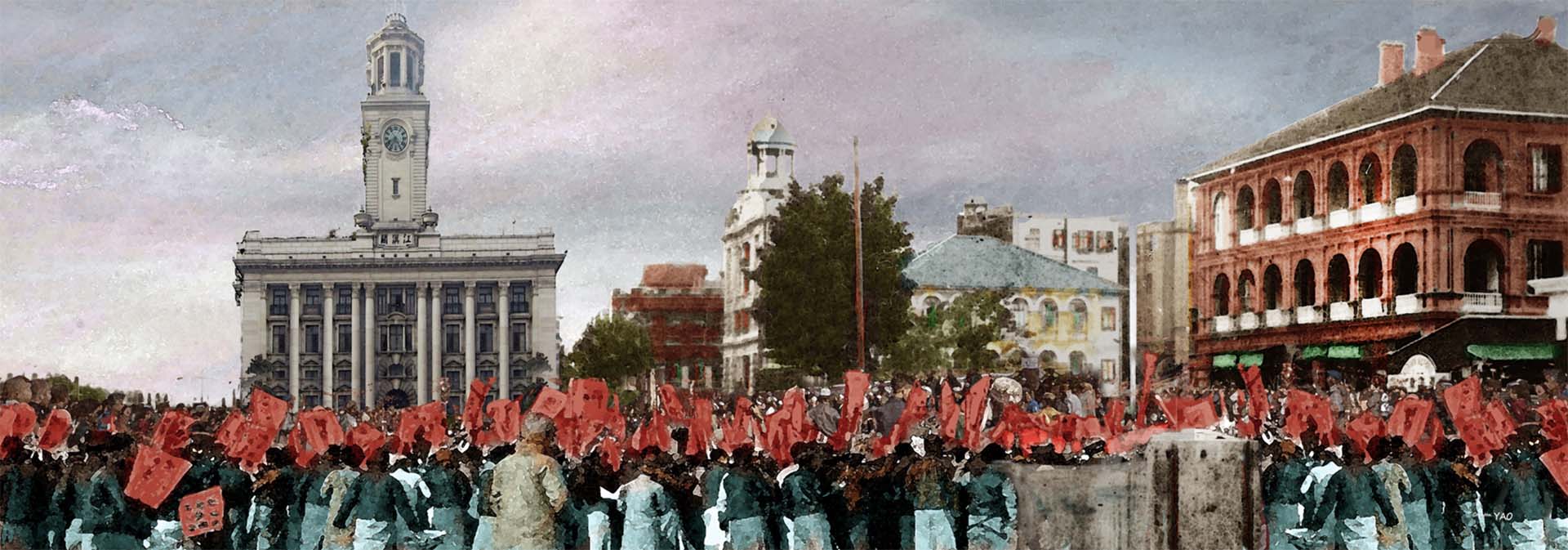
Large-scale anti-foreign movements had already begun before the Northern Expeditionary Army set out. On January 5, 1926, more than 200,000 people in Hankow stormed the British concession, and all British residents left by warship. On February 19, Chen Youren, the Foreign Minister of the Wuhan Nationalist Government, signed the "Agreement on the Recovery of the Hankou British Concession" with the British Minister. Hankow became the first concession in the country to be recovered. This case prompted other regions in China to follow suit. Nanking and Shanghai launched anti-foreign riots in this atmosphere.
The Northern Expedition began on July 9, 1926, and on August 29, the "Wanxian Incident" occurred in Sichuan. On that day, the British-owned Swire Steamship "SS Wanliu" was speeding on the Yunyang River in Sichuan, creating huge waves and sinking three Chinese wooden boats. One company commander, one platoon leader, and 56 soldiers of Yang Sen's troops stationed in Wanxian drowned. The ship lost 56 rifles, 5,500 rounds of ammunition, and 85,000 yuan in pay.
On the same day, when Yang Sen dispatched the ship's chief inspector with eight men to investigate the incident on the "SS Wanliu", they were attacked by the nearby British river gunboat "HMS Cockchafer," resulting in several serious injuries. Therefore, on August 30th, when the Swire Company's "SS Wantung" and "SS Wanhsian" vessels arrived in Wanxian from Chungking, they were detained by Yang Sen's troops. On September 4th, the British consul issued an ultimatum demanding the release of the two vessels within 24 hours. This is the background to the "Wanxian Incident."
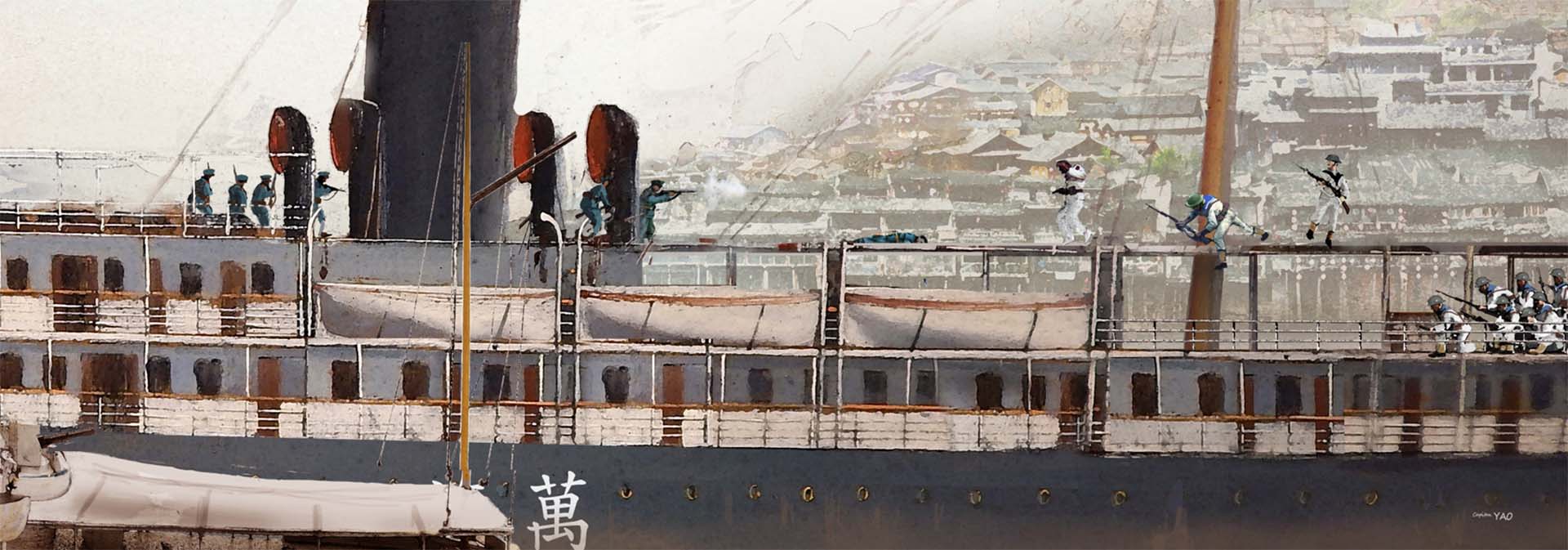
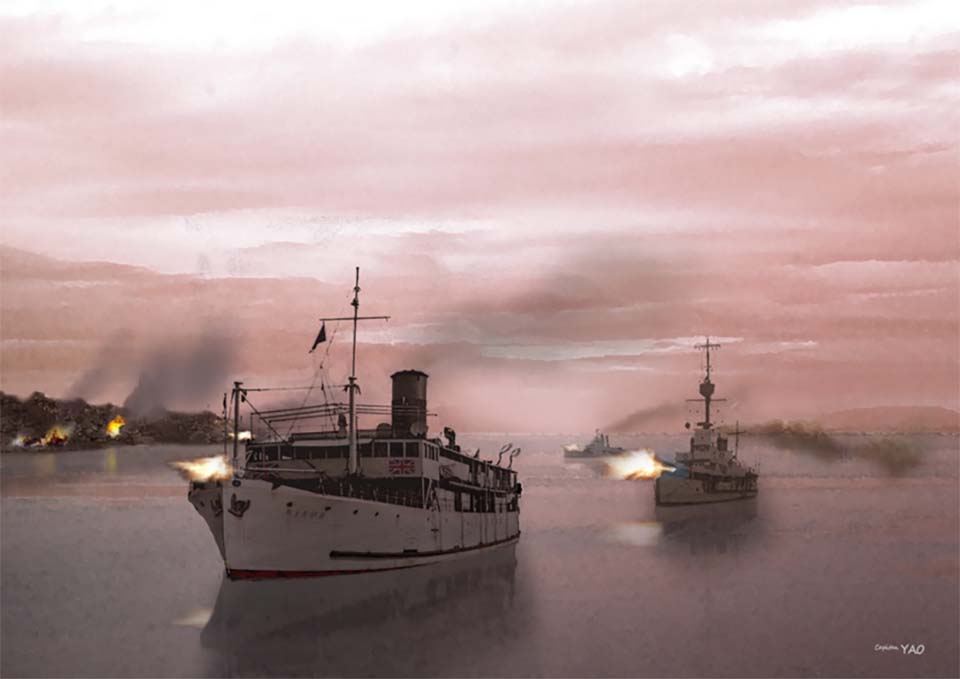
On September 5, British naval personnel, aboard the armed merchant ship "Kiawo", a former Jardine Matheson steamship converted into a tugboat, along with two river gunboats, "HMS Widgeon" and "HMS Cockchafer," approached the detained "SS Wanhsian". British sailors shot and killed two soldiers guarding the "SS Wanhsian" and boarded the ship to cut the mooring lines. Yang Sen's troops guarding the ship returned fire, forcing the British troops to retreat. The British troops then boarded the "SS Wantung" and were met with fierce resistance from the Sichuan Army. The British commander, Lieutenant Colonel Daly, was killed on the spot.
(Figure 2-3-6) The British Navy failed to seize the ship, so they bombarded Wanxian to vent their anger, resulting in the "Wanxian Massacre" in which thousands of people were killed or injured.
Enraged by the British forces' failure to achieve their objective, the British ship "HMS Kiawo" along with the "HMS Widgeon" and "HMS Cockchafer," sailed close to the riverbank near Wanxian and bombarded the city for nearly three hours, firing over 300 shells and incendiary bombs. The Chinese suffered 604 deaths and 398 injuries among the civilians and soldiers in Wanxian, and over a thousand houses and shops were destroyed. This incident is known as the "Wanxian Massacre" by the Chinese. Following diplomatic negotiations by the Beiyang government, Yang Sen was forced to order the release of the "SS Wantung" and "SS Wanhsian" ships on September 23.
On the surface, the "Wanxian Incident" appeared to be an isolated incident caused by inland waterway navigation, but it was actually closely related to the anti-Western imperialist and xenophobic movements that were sweeping across the country at the time. The National Revolutionary Army, supported by the Soviet Union and based in Guangzhou, incited anti-imperialist movements in various places to coordinate with military operations, and the outbreak of the "Wanxian Incident" only added fuel to the fire.
During this period, my father was unable to come to China, but seeing that the United States wanted to incite various countries to increase their troops in Shanghai, he thought it was impossible. He contacted the MI6 representative in China and tried to persuade Chiang Kai-shek to side with the West, and surprisingly succeeded. After Chiang Kai-shek came to power, he transformed into a leading figure in the anti-communist movement, and the history of being called the "Red General" became the biggest taboo in his life, and no one in the Kuomintang dared to mention it.
|