12. The First Flight
Following the incident, the ministers of Britain, the United States, France, Italy, and Belgium lodged a protest with the Peking government and decided to form a joint force to rescue the victims. The United States was the most enthusiastic, wanting to send troops directly from Peking to participate.
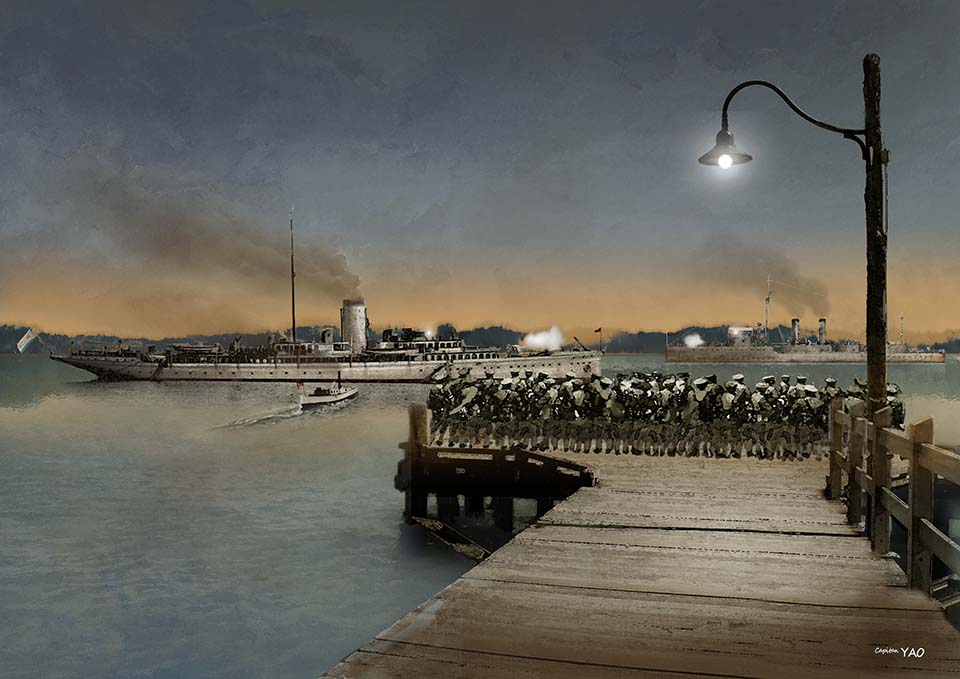
(Figure 1-12-1) The scene of the "Lincheng Train Robbery" that shocked China and the world.
Britain hadn't been this proactive even after the death of a single person. America's actions aroused suspicion in Britain, who saw it as an attempt to usurp Britain's position as the elder brother in China. At the time, my father and I were in Hong Kong, and we were suddenly ordered to go to Zaozhuang to assist in the handling of the situation. I, at sixteen, went with them. By then, my father seemed to have started to treat me as an adult, often having me assist him with official business. I had practically become his adjutant.
Upon arriving in Zaozhuang, my father immediately understood that Sun Meiyao's true intention was to use the train hijacking to negotiate with the government for incorporation. Therefore, the pressure should have been directed at the Chinese government, not Sun Meiyao herself. Only if the Chinese government agreed to incorporation could the hostages' safety be guaranteed. What price they paid was none of our concern. However, if they rashly launched an attack like the Americans, the lives of the foreign hostages might be in danger. So, my father exerted all his efforts to persuade the Chinese government to promise incorporation. Sure enough, on June 12th, all the Western hostages were released and arrived in Shanghai on the 13th. My father greeted them at Shanghai North Railway Station, and the incident came to a successful conclusion.

At that time, China had already split into two governments, North and South. The Beijing government was the legitimate Republic of China government, recognized by Western diplomacy since Yuan Shikai. The South, on the other hand, was a military government headed by Sun Yat-sen as Extraordinary President, based in Kuangchow. This was his third time establishing his government in Guangzhou, and he had begun cooperating with the Communist Party of the Soviet Union. When we arrived in Kuangchow by ship from Shanghai via Hong Kong, we happened to be there for the unveiling ceremony of the first domestically built airplane in the area. The airplane was named "Rosamond" after Madame Soong Ching-ling, the wife of Sun Yat-sen. At Kuangchow Dashatou Airport, we saw the "Rosamond" a beautiful aircraft with a green fuselage and yellow wings. It was assembled locally using parts from a Curtiss JN-4D Jannie aircraft brought from the United States by Yang Xianyi, an overseas Chinese from America. Huang Guangrui, a pilot also of overseas Chinese descent, flew Mrs. Sun Yat-sen around the airport twice. When she saw my envious look, she said to me, "Paul! Do you want to ride in an airplane? It's a lot of fun!"
So I put on my leather hat and goggles and sat in the front seat of the plane, with the pilot in the back. We took off from the airport and arrived over Kuangchow. The humid and sweltering summer heat of South China instantly became cool and refreshing in the air. I leaned down and looked down at the buildings below, which seemed so small. Even the vast Pearl River looked like a ribbon. Many boats of all sizes were moored on the river, and a small Chinese gunboat was slowly sailing downstream. When the plane turned a certain angle, the sunlight shone brightly on the water, making it hard to open my eyes.
The most fascinating thing about flying is that it's a three-dimensional movement; takeoffs and landings, dives and rolls, sideways and inverted flight are all things that people accustomed to life on the ground can't imagine. We flew at least five circles before landing. Although I had flown in St. Petersburg in 1917, it was a rushed trip, and I was pinned under the cockpit by my father and couldn't see anything. This flight was much longer, and the pilot even let me try piloting it; the feeling was completely different. I immediately became fascinated with flying, which is how I later aspired to become a Royal Naval Air Corps pilot.
After the plane landed, I excitedly ran to where my father and Sun Yat-sen had been chatting, eager to report on the flight. Sun Yat-sen was wearing a white Zhongshan suit and a pith hat. My father, on the other hand, wore a summer suit and a flat-topped straw hat. The two sat chatting in wicker chairs under the shade of a tree near the airport. Although my father and Sun Yat-sen had parted on bad terms at the Shanghai docks six years prior, he was here on official business, sent by the Ministry of Foreign Affairs to mediate, and had to put aside past unpleasantness.
Sun Yat-sen: "Sir Draken, your son seems to love flying!"
Draken: "He... he probably inherited his talent from his mother!"
Sun Yat-sen: "Mother? That's really interesting! My wife also loves flying!"
"I didn't know you were married again, Dr. Sun Yat-sen!"
Actually, my father said this on purpose. Although we were in Russia when Sun Yat-sen and Soong Ching-ling got married in Japan in 1915, my father had actually met her at the Shanghai dock in 1917 when he saw her off. However, he and Sun Yat-sen did not get along at the time, so there was no formal introduction.
Sun replied somewhat awkwardly, "Oh! Her name is Soong Ching-ling, she used to be my English secretary... Let's talk about flying instead! China needs many young people who love flying to build a strong air force, and your son would be a very good candidate!"
"He's practically half Chinese," said Draken.
Sun Yat-sen exclaimed in surprise, "Oh? Really?"
At this point, the photographer asked Mr. Sun and his wife to stand in front of the "Rosamond" aircraft for a photo. This photo, accompanied by the four characters "Aviation Saves the Nation" personally inscribed by Sun Yat-sen, was frequently used in Chinese Air Force propaganda materials. I saw many of these when I worked with Chennault's Flying Tigers. However, when I saw this photo again in Taiwan after 1949, Soong Ching-ling had been erased! I want to make it clear that Mr. and Mrs. Sun stood together in front of the aircraft for the photo that day; Sun Yat-sen did not pose for a photo alone. Therefore, I am certain that the later photo must have been altered.
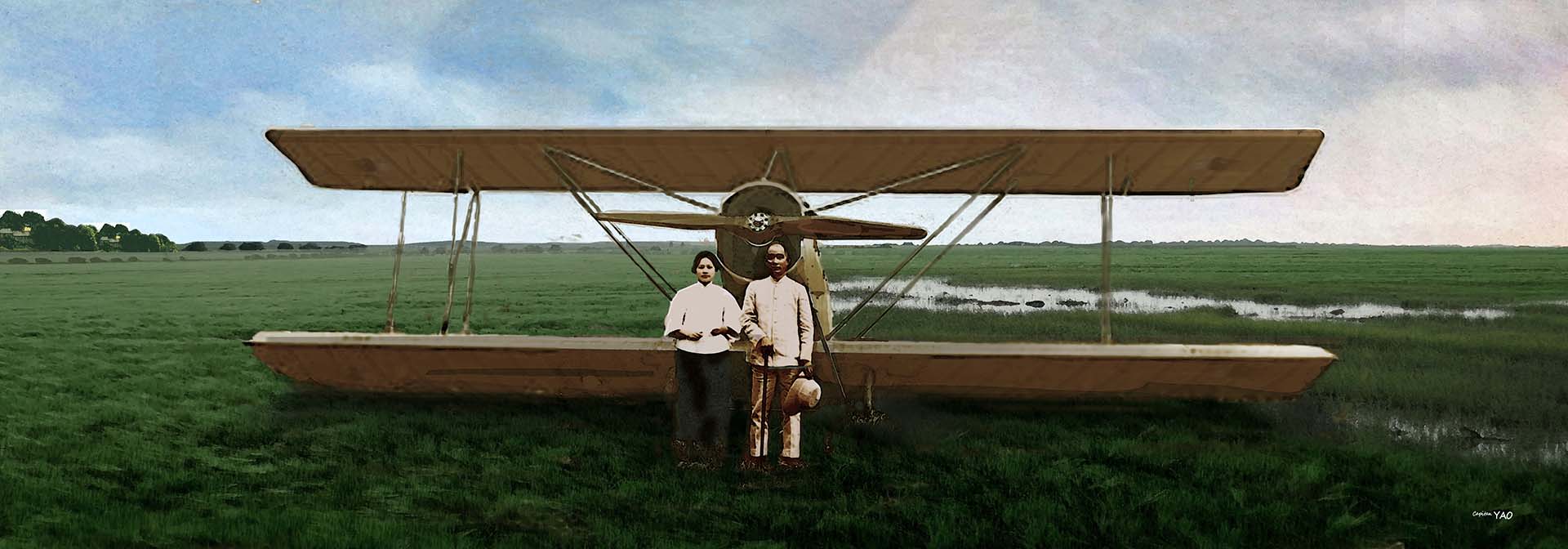
(Figure 1-12-2) A photo of Sun Yat-sen and Soong Ching-ling standing in front of the "Rosamond" airplane.
After taking the photos, Sun Yat-sen returned to his seat to continue his conversation with my father. At this moment, a serious-looking military officer approached and asked, "Premier! Who do you intend to appoint as the principal of the military academy?"
Sun stammered, somewhat bewildered, "This... James, this is my Chief of Staff, General Chiang Kai-shek!"
"General Chiang, hello! I am James Draken, representative of the British Foreign Office. Uh... have we met before?"
It turned out that the father had discovered that Chiang Kai-shek was actually Jiang Ruiyuan, the man who ran the Shanghai stock exchange back then. However, Chiang ignored him and continued speaking to Sun Yat-sen: "Premier! I think you've already decided to appoint General Xu Chongzhi as the principal, haven't you?"
"Chiang Kai-shek, I have friends. Let's talk about this later!"
The bald officer could only bow and tiptoe as he left, adding before departing, "Prime Minister! You'll regret this!"
Sun shook his head and sighed, "Alas! This Chiang Kai-shek is really..."
My father said, "I think he'll be a person worth paying attention to. Let's send him abroad to broaden his horizons!"
On August 16th, Chiang Kai-shek was sent by Sun Yat-sen to the Soviet Union for a four-month inspection tour. Upon his return, he successfully took over the Whampoa Military Academy, which was funded and supported by the Soviet Union. My father was still proud of the accuracy of Chiang's judgment on this matter until his death. As for the "Rosamond" aircraft, it is said that it was later destroyed by fire!
Chen Jiongming opposed Sun Yat-sen's immediate Northern Expedition, believing it would only lead to a bloody civil war. This caused a conflict between the two, and Sun Yat-sen threatened to send gunboats to fire. Since Sun had done the same thing before, everyone took it seriously. Chen Jiongming could only silently resent the humiliation he received despite providing Sun Yat-sen with all the resources he needed. However, his subordinate Ye Ju preemptively struck, sending troops to surround the Presidential Palace on Guanyin Mountain on June 16, 1922, and firing three warning shots, intending to expel Sun Yat-sen from Kuangchow. Sun Yat-sen hastily disguised himself and fled at night, seeking refuge on the gunboat "Yungfeng". At this time, Sun Yat-sen was practically deserted by his followers. He telegraphed Chiang Kai-shek in Shanghai, requesting that he come south to assist him. Chiang Kai-shek had previously been noncommittal about Sun's invitation because he was making good money in the stock market in Shanghai and enjoying a comfortable life in the bustling metropolis. He had little interest in coming to Kuangchow to engage in revolution, and Sun Yat-sen's seniority within the party meant he saw little opportunity for advancement in Kuangchow.
However, in February 1922, the Shanghai Stock Exchange collapsed due to excessive speculation, and Chiang Kai-shek lost 200,000 silver dollars. Creditors came knocking on his door, and Chiang had nowhere to turn but south. This was the most important decision of Chiang's life, and the timing was just right, turning misfortune into blessing.
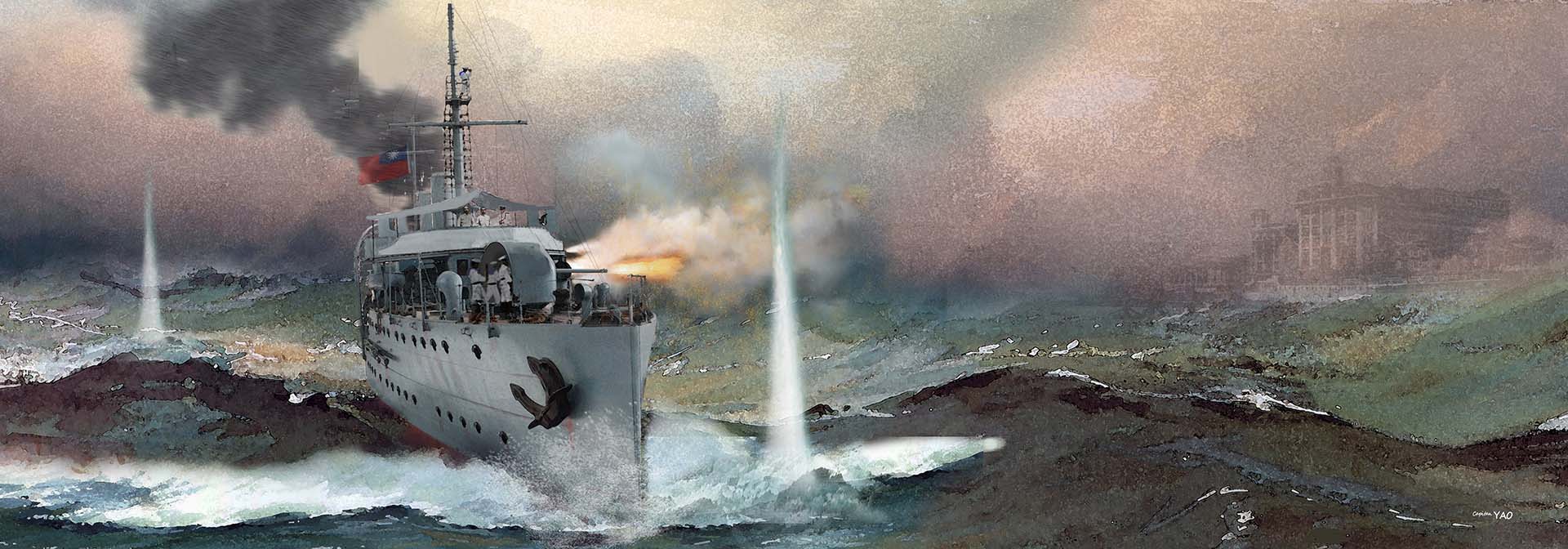
(Figure 1-12-5) Chiang Kai-shek's protection of Sun Yat-sen on the "Yungfeng" gunboat became a story that the Kuomintang later heavily publicized, and it was also the most important turning point in Chiang Kai-shek's life.
On June 29, Chiang Kai-shek arrived in Kuangchow and boarded the gunboat "Yungfeng". At that time, seven naval vessels supporting Sun Yat-sen were hiding in the waters of Baietan next to the British Consulate and were engaged in combat with Chen Jiongming's troops on land. Shells frequently flew over the city, causing panic among the citizens and threatening the property and lives of local Westerners. As a result, the British Consulate intervened and demanded that the ships leave Baietan. Sun Yat-sen and others had no choice but to take the British gunboat "HMS Moorhan" to Hong Kong on the afternoon of August 9 and transfer to a ship to go to Shanghai.
(Figure 1-12-6) Sun Yat-sen was pressured by the British and transferred from the "Yungfeng" to the British gunboat "Mohan" before leaving Kuangchow.
When Sun Yat-sen returned to Shanghai from Kuangchow, everyone thought he was past his prime. Only the Soviet Union was willing to lend a helping hand. In January 1923, Sun Yat-sen and Soviet representative Adolf Abramovich Joffe issued a joint declaration in Shanghai, declaring for the first time the policy of alliance with Russia and tolerance of the Communists. After several rounds of negotiations, including the Soviet Union providing military and financial aid, Sun Yat-sen also reinterpreted his political ideas using the logic of the Communist Party in order to make them more rational. Under this environment, a large number of Chinese Communist Party members joined the Kuomintang. On March 2, Sun Yat-sen established the Army and Navy Marshal's Headquarters in Kuangchow for the third time.
Due to the influence of the Soviet International, relations between the Kuangchow regime and Western countries began to become tense, which is why my father was ordered to come to Kuangchow in August 1923 to mediate.
The Army Military Academy, located on Huangpu Island in Kuangchow, opened on June 1, 1924, with Chiang Kai-shek serving as its principal. Initially, it only had about thirty miscellaneous rifles, barely enough for basic training. In early August, it received a secret report from Hong Kong stating that Chen Lianbo, a member of the Kuangchow Merchant Corps, had purchased a large quantity of arms in Hong Kong and entrusted them to a Norwegian merchant ship for transport to Kuangchow.
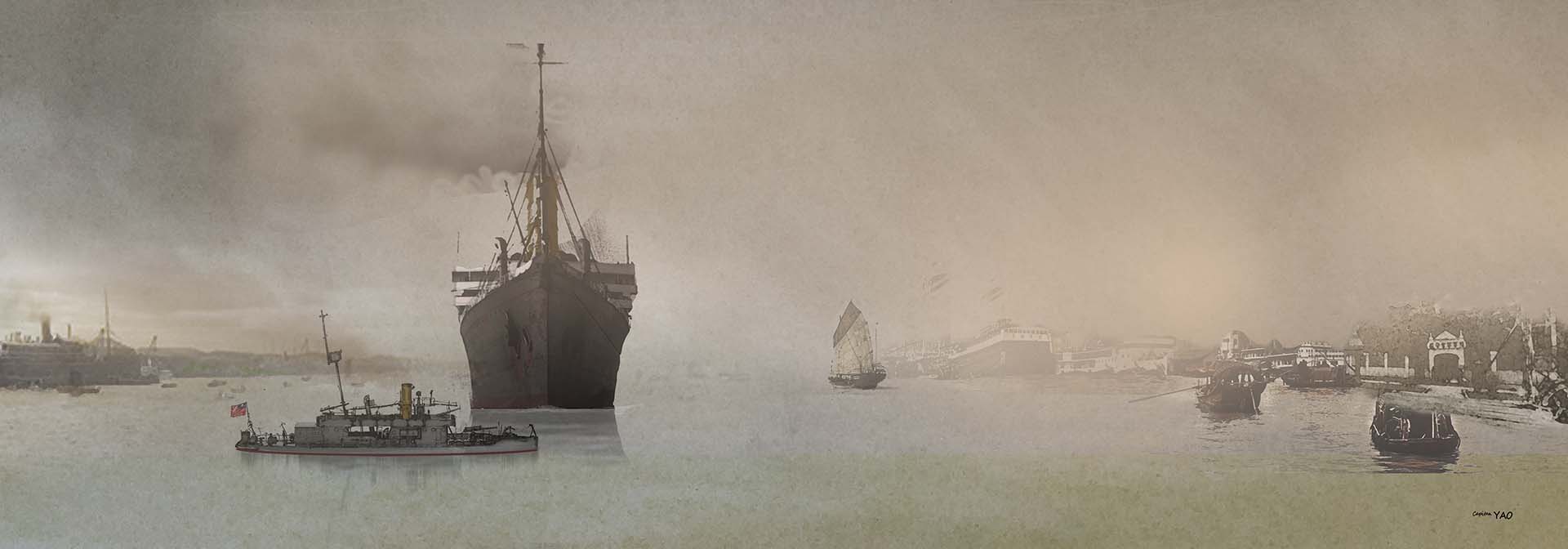
(Figure 1-12-7) The "Kianggu" gunboat seized a Norwegian merchant ship carrying munitions to Kuangchow.
Upon hearing the news, Chiang Kai-shek ordered Zhang Jingyu, the English secretary of the military academy, to board the Kuangchow Navy's gunboat "Kianggu" and wait in the Pearl River with his adjutant. Finding the ship anchoring, they boarded and demanded it move to a designated location. The Norwegian captain initially refused, but yielded under the threat of gunfire from the gunboat, and was guided by the "Kianggu" to anchor at Huangpu Wharf. Zhang Jingyu reported back to Chiang Kai-shek, who ordered the unloading of all munitions, including over 8,000 rifles and pistols, 5 million rounds of ammunition, and 14 machine guns, which were then handed over to the Huangpu Military Academy after being inventoried.
Upon hearing that the munitions had been seized, the Kuangchow merchant corps immediately sought help from the British consulate. The consul rushed to the principal's reception room and questioned Chiang Kai-shek about why the ships had been seized. Chiang, through Zhang Jingyu's translator, said: "As the commander of the Changzhou Fortress, I have the right to prohibit ships smuggling munitions from entering."
(Figure 1-12-8) The Soviet ship "Vorovsky" carrying a large amount of military supplies is docked in front of the Huangpu Military Academy pier in Kuangchow.
As for the Soviet aid that Sun Yat-sen was most concerned about, it was secretly transported to the Whampoa Military Academy pier on the evening of October 8th by the "Vorovskiy". The "Vorovskiy" was a fishing protection vessel converted from a yacht, but it was equipped with four large-caliber naval guns. Because its appearance did not resemble that of a warship, it was chosen for this secret mission to evade Western surveillance. The "Vorovskiy" departed from the Baltic Sea, rounded most of the world, stopped in Hong Kong, and pretended to be heading to Japan. As soon as it left port, it turned and sailed into the Pearl River Estuary to Whampoa Island.
The day after the arrival of the "Vorovsky," unloading began, including 8,000 rifles, a large quantity of machine guns, artillery, ammunition, and funds. The entire student body of the Whampoa Military Academy spent an entire day unloading. This arsenal, along with the Soviet advisors who accompanied the ship, immediately proved invaluable in the Kuangchow Merchant Corps mutiny that erupted two days later. The heavily armed Kuangchow Merchant Corps was defeated and disarmed, and the large amount of weaponry incorporated into the Whampoa Military Academy became the capital for the later Northern Expedition. Had the "Vorovsky" not arrived at the opportune moment, the Whampoa Military Academy might have already been shut down, and the history of modern China would have been rewritten.
Britain was the biggest loser in this battle, as the Kuangchow Merchant Corps had been supported by the British at great expense for many years. This battle made the Kuangchow military government appear as a thoroughly communist regime in London's eyes, and Chiang Kai-shek was given the title of "Red General." However, by this time my father and I had already left Kuangchow, returning to England via Japan and the United States. If my father had remained in Kuangchow, things might not have turned out this way.
|
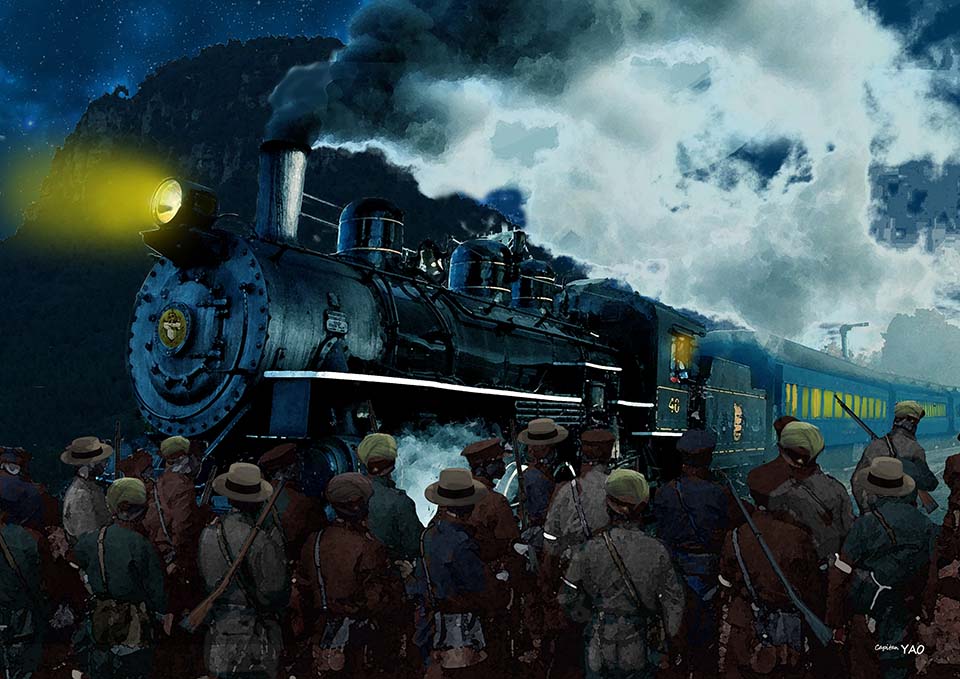 In mid-1923, after graduating from Eton, my father took me on a trip to the Far East. In the early morning of May 6, the express train on the Kingpu Railway, traveling from Pukou, Nanking to Tianjin, was suddenly intercepted by an armed gang of the "Shantung Founding Self-Government Army" led by the bandit Sun Meiyao when it derailed at Shagou Mountain, three miles from Lincheng Station in Shantung. One British man was killed on the spot for resisting, and the remaining thirty-nine foreign passengers and seventy-one Chinese passengers were abducted to the mountain stronghold of Baodugu. This was the "Lincheng Train Robbery" that shocked China and the world.
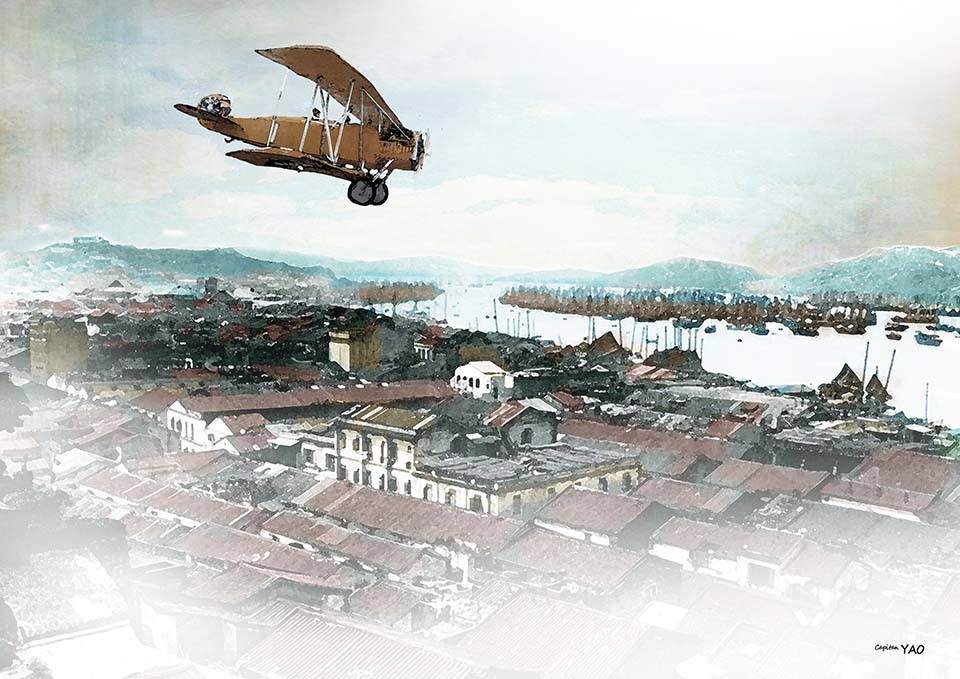 (Figure 1-12-2) The "Rosamond" is flying over the Pearl River in Kuangchow.
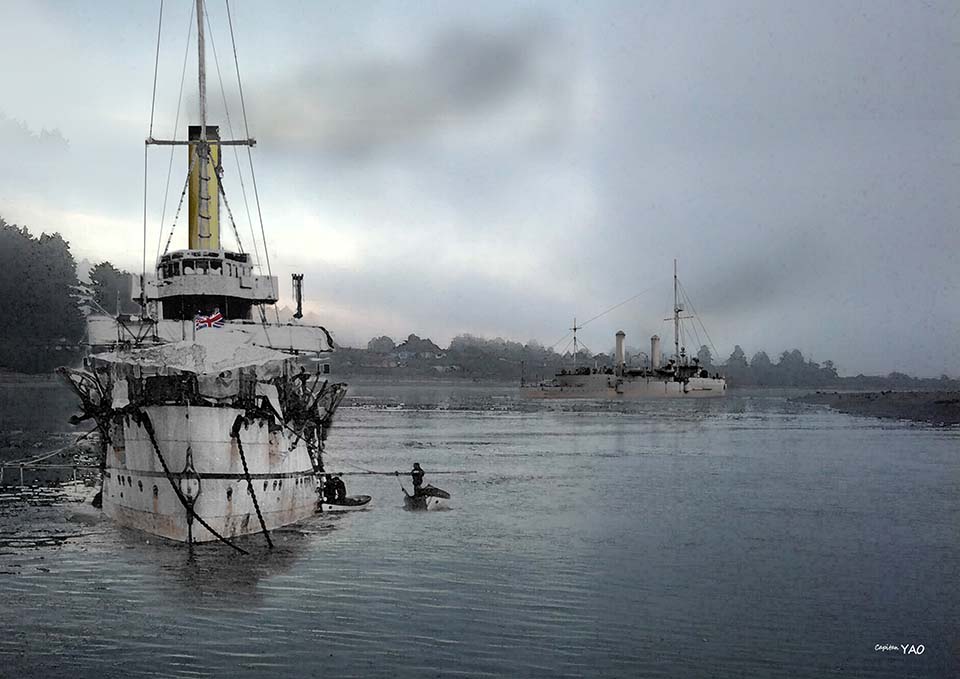 This was the extremely important "Yungfeng Incident" in the history of the Kuomintang. Although Chiang Kai-shek's trip lasted only a month and a half, he spent his days and nights with Sun Yat-sen on the "Yungfeng" gunboat, an opportunity he had dreamed of but could never obtain in the past. As a result, Chiang Kai-shek began to be valued by Sun Yat-sen. In 1923, when Sun returned to Kuangchow to continue serving as Grand Marshal, Chiang was appointed as Chief of Staff of the General Headquarters.