
10. The End of the WWI
1917 was a pivotal year in the European war. The United States, which had previously adhered to the principle of neutrality, declared war on the Central Powers on April 6th of that year. The reason for the US Congress's declaration of war was related to Germany's "unrestricted submarine policy." Britain took the opportunity to portray Germany as a sea monster, but according to my father's private account, the Germans were really wronged.
The German navy was weaker than the Royal Navy and could only rely on submarines (U Boat) to blockade the British Isles, hoping to cut off the British Empire's supply lines from its overseas colonies. The Germans were very honest and strictly adhered to the treaty of engagement. Before attacking, their submarines were required to surface first, signal the other ship to stop, and then an officer would lead a small team of men in small boats to board and inspect the documents and cargo holds. Only if they found strategic materials destined for Britain would they sink the ship, and then the crew would be taken into custody.
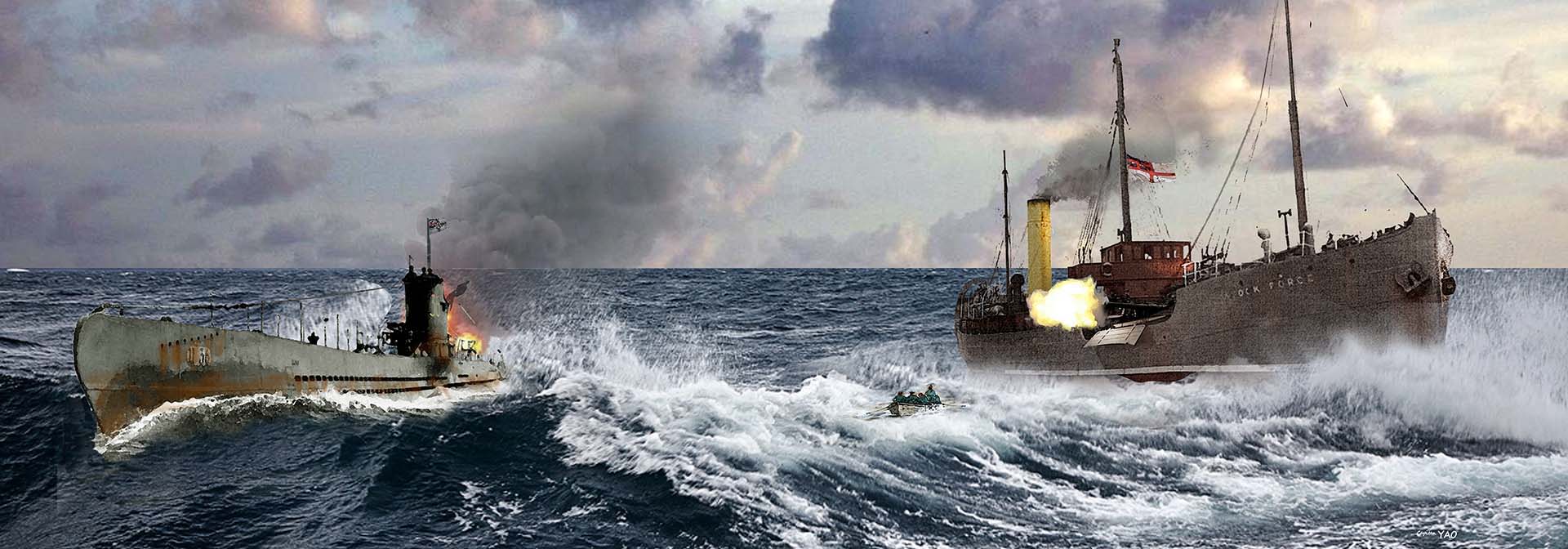
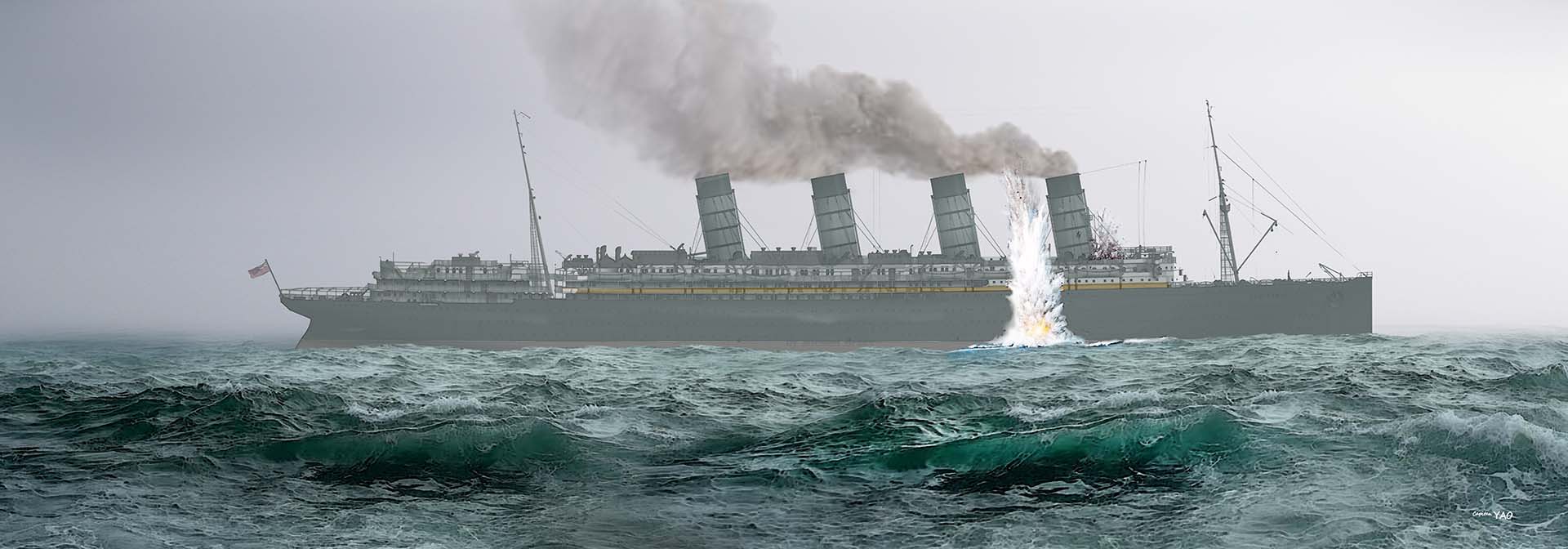
This tactic is entirely suited for surface ships and is completely unsuitable for submarines. A submarine's greatest weapon is stealth; it is extremely vulnerable when surfaced, and prolonged exposure is even more dangerous. If the enemy refuses to stop or even rams the submarine, it will be in a highly disadvantageous and passive position—and this has actually happened before. Furthermore, how could a submarine's confined space accommodate the crew of an enemy ship? But allowing them to pass could lead to a leak of information. Even more problematic was the British invention of the "Q-ship tactic", which involved recruiting fishing boats to conceal 6-inch cannons below deck to lure German submarines for inspection, then suddenly revealing the camouflage and firing at close range to sink the submarine. This was actually a violation of the treaty of belligerency and could be considered equivalent to the capture and execution of guerrillas. German submarines suffered several losses but couldn't find a solution, so they temporarily suspended the blockade, giving Britain a much-needed respite. A few months later, the Germans couldn't hold back any longer and announced an "unrestricted submarine policy," meaning they would no longer surface as warnings and would sink any ship heading towards Britain. The sinking of the RMS Lusitania in 1915, although a British ship, resulted in the deaths of 198 Americans. Extensive British media coverage ultimately dragged the Americans into the war in 1917.
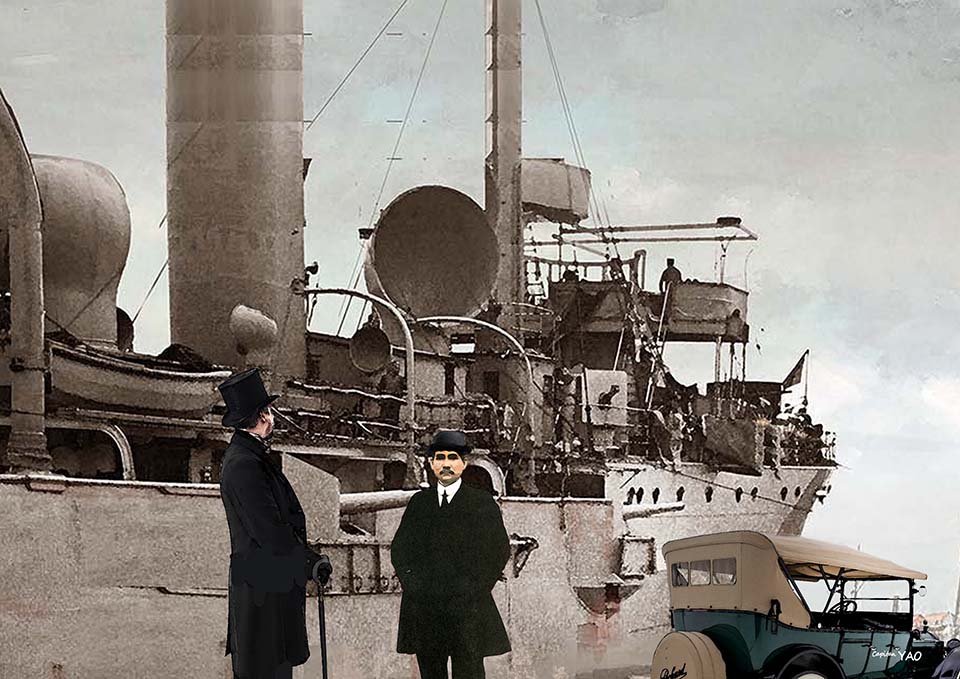
The massive human and material resources the United States poured into the European theater after entering the war tipped the scales of war in favor of the Allied Powers, which impacted China's political situation. Premier Duan Qirui at the time hoped to participate in the war to change China's international standing afterward, but President Li Yuanhong and the National Assembly held reservations, leading to the so-called "Presidential-National Assembly Conflict." Li Yuanhong brought Zhang Xun's troops into Beijing as a form of support, but Zhang Xun unexpectedly restored Puyi to the throne on July 1st. Duan Qirui launched a military campaign against Zhang Xun, who was defeated, forcing Li Yuanhong to resign. After regaining power, Duan Qirui dissolved the National Assembly. It was at this time that my father returned to China. His mission was to coordinate with the United States and France to support Feng Guozhang of the Zhili clique, and to discuss with Duan Qirui of the Anhui clique (supported by the Japanese) and Zhang Zuolin of the Fengtian clique to reorganize the government and declare war on the Allies. At this juncture, Sun Yat-sen opposed participating in the war and called on members of parliament to move south to Kuangchow to establish a government—what the Kuomintang later called the "Constitutional Protection Movement." Since a large number of parliamentarians lost their jobs after Duan Qirui dissolved the National Assembly, Sun Yat-sen's offer of incentives was indeed quite attractive. However, Sun Yat-sen was always a hollow figurehead; where would he get so much money? This was what my father wanted to find out. This wasn't difficult to handle. The British had many informants in Shanghai, and they quickly discovered that Zhang Jingjiang and Chiang Ruiyuan (Chiang Kai-shek)'s stock accounts were seeing large sums of money flowing in and out to Sun Yat-sen, with the source of the funds surprisingly being the German government. It turned out that the German Consul General in Shanghai, Hubert Knipping, had been ordered to bribe Sun Yat-sen with 2 million gold marks to prevent China from declaring war on Germany. Upon hearing this news, my father decided to personally go to Shanghai to meet with Sun Yat-sen. My father rushed to the Shanghai docks to meet Sun Yat-sen and earnestly said to him, "Yat-sen, you are using German money to subvert the government; this is an act of treason!"
(Figure 1-10-3) Sir Draken rushed to the pier to dissuade Sun Yat-sen, but the two parted on bad terms.
My father had barely arrived in Shanghai when he heard that even the navy had announced its support for Sun Yat-sen. Leading the charge was Admiral Cheng Biguang, who had led the "Haichi" cruiser on its visit to Britain and the United States years before. He was now serving as the Minister of the Navy in the Peking government. Cheng Biguang first dispatched two warships to transport Sun Yat-sen and his entourage to Kuangchow in a grand manner. Afterward, he would lead the remaining nine warships south, becoming Sun Yat-sen's biggest backer.
"Mr. Draken, if Britain were to give me the same amount of money, I would obey your call to join the war. If I can't even see a penny, what right do you have to speak?"
With the support of the German goldmark and Cheng Biguang's fleet, Sun Yat-sen was in high spirits at this time, completely unlike his previous servile attitude towards British diplomatic officials and his deliberate flattery. The two had a falling out, and my father stormed off.
Sun Yat-sen intended to use German financial aid to lure unemployed members of parliament south to Kuangchow to support the legitimacy of his regime. At the time, there were 274 senators and 596 members of the House of Representatives in Peking. Out of a total of 870 people, only 150 went south, less than one-fifth. In the end, only 91 people actually voted, of whom 84 supported Sun Yat-sen as the Grand Marshal of the Army and Navy of the Kuangchow Military Government. The legitimacy of his regime, less than one-ninth, was clearly just a farce.
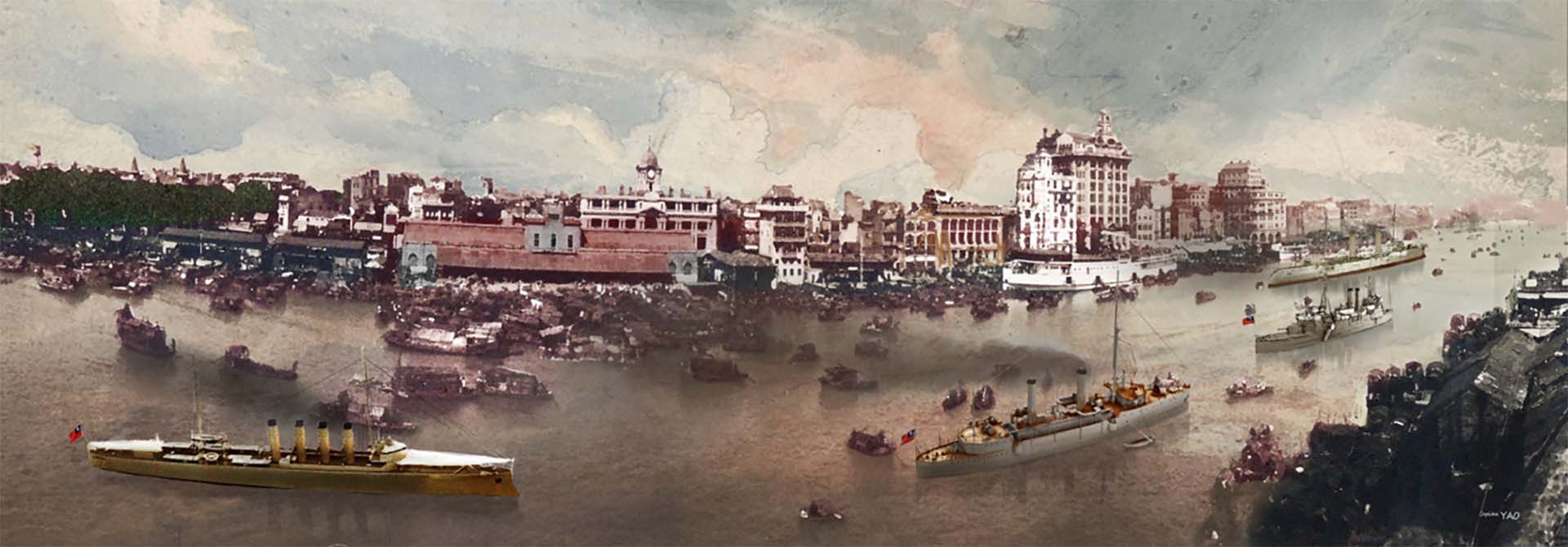
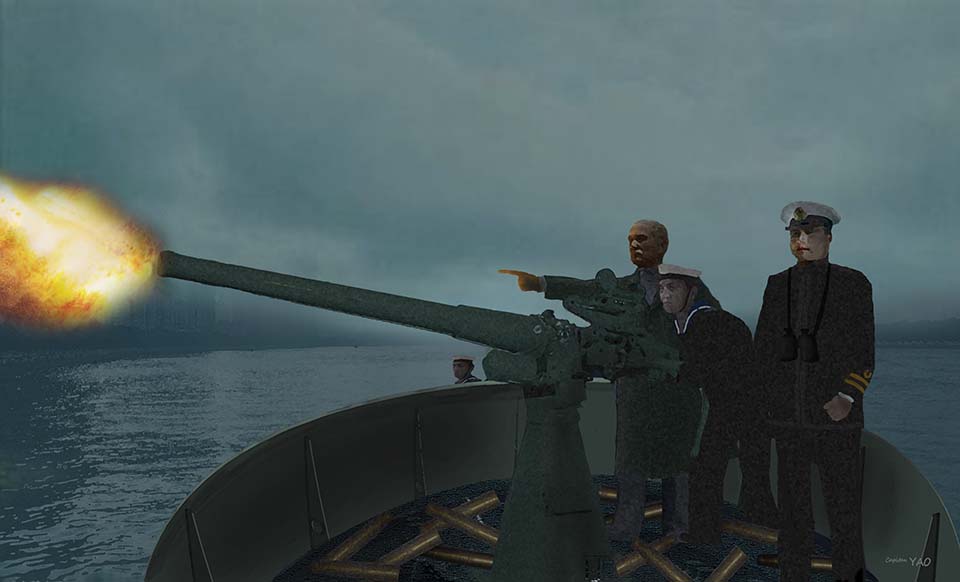
(Figure 1-10-5) Sun Yat-sen bypassed Cheng Biguang and ordered the deployment of warships. He also personally fired cannons to bombard the military governor's mansion on Guanyin Mountain, which aroused dissatisfaction among the local forces that originally supported Sun Yat-sen.
Sun Yat-sen's ability to establish his government in Kuangchow was primarily due not to the support of members of parliament, but to the support of the southwestern warlords, including the Canton and Kwangsi. cliques. However, these warlords only wanted provincial autonomy and had no interest in the Constitutional Protection Movement, which challenged Peking's legitimacy. Moreover, these southwestern warlords were backed by British and French forces, preventing Sun Yat-sen's orders from reaching the capital. Sun Yat-sen believed that he could teach these warlords a lesson with his navy, so he bypassed Cheng Biguang and ordered the deployment of warships, even personally firing cannons at the Governor's Mansion on Guanyin Mountain. This greatly angered Cheng Biguang, creating a rift between the two. Later, Cheng Biguang was assassinated, and everyone pointed the finger at Sun Yat-sen. In the end, Sun Yat-sen was dismissed from his post as Grand Marshal and had no choice but to return to Shanghai in May 1918 to live in seclusion.
My father often said that Sun Yat-sen was willing to take any amount of money and agree to any conditions in order to become president, but the British government did not support him because London never thought he could become a force to be reckoned with. Later, even Japan stopped supporting him, so Sun Yat-sen had no choice but to side with the Soviet Union.
When my father returned to Peking, his old classmate, Backhouse, having heard rumors, went to the International Hotel where my father was staying. Knowing that Backhouse rarely visited without a reason, my father was wary. However, Backhouse only engaged in rambling, irrelevant conversation before leaving, so my father didn't think much of it. Later, rumors circulated in Peking that Sir Draken, a British diplomat, had personally come to Peking and authorized Backhouse to sell weapons to China; there were even photos of the two of them together. It turned out that Backhouse had hired a photographer to secretly take pictures of his meeting with my father at the International Hotel that day.
My father was furious about this. Coincidentally, Sun Yat-sen's Constitutional Protection Movement triggered a North-South conflict, severely impacting British interests in China. Furthermore, the Bethlehem Contract, a naval loan signed between the Peking government and the United States, was about to be implemented, threatening Britain's long-standing naval dominance in China. My father decided to take drastic measures, telegraphing London suggesting that all countries adhere to a strict arms embargo against China, citing the pretext of "China's civil war." This embargo lasted for ten years, beginning in 1917, until Chiang Kai-shek's Northern Expedition in 1927, which nominally unified China. During the ten years of the embargo, not only was the sale and purchase of weapons and equipment and spare parts repair prohibited, but even education and training were forbidden. This was a stumbling block specifically designed to counter the Bethlehem Contract, and Backhouse's business was completely disrupted.

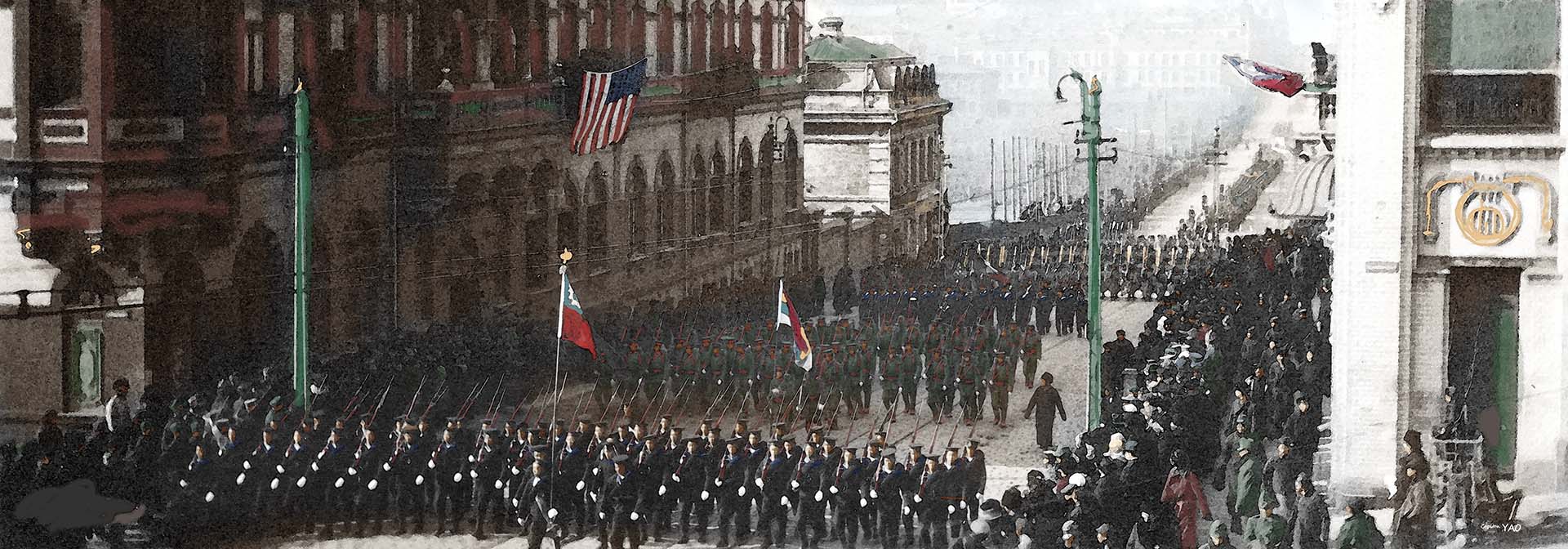
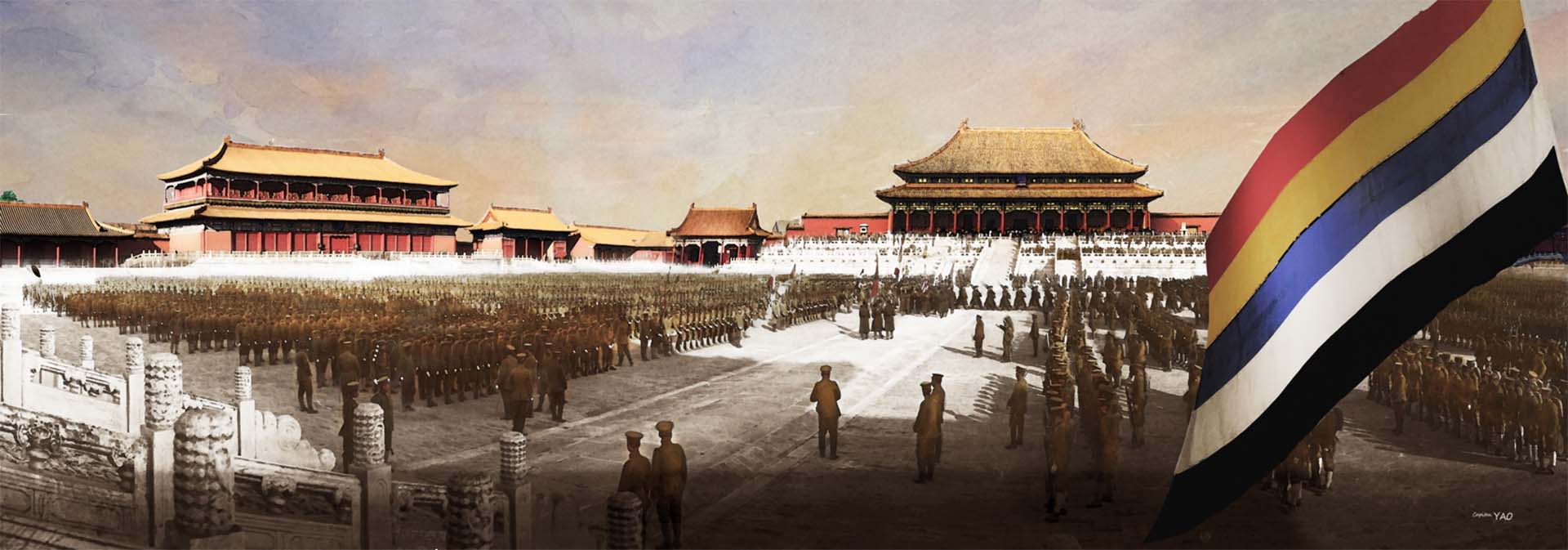
(Figure 1-10-6) Allied occupation forces parade on the main street of Vladivostok. The picture shows the Chinese army and navy contingent.
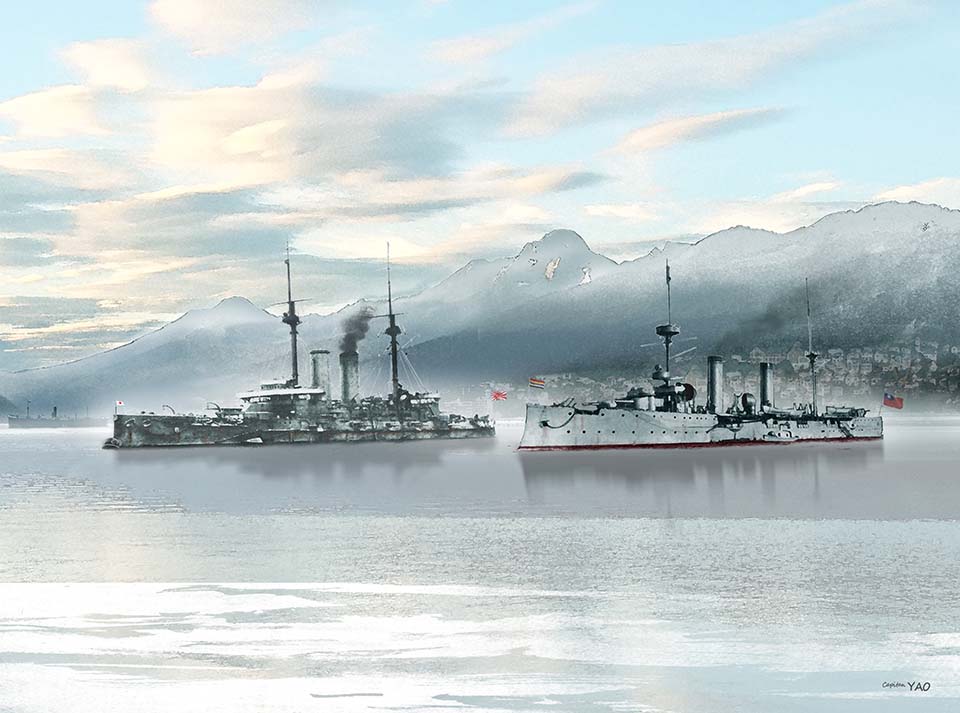
According to records left by his father, the Chinese army troops sent to Vladivostok were selected from a regiment under Wei Zonghan's Border Defense Army, commanded by Song Huanzhang. The navy selected the cruiser "Hai Yung," which had the most experience in overseas visits. After being urgently docked at the Kiangnan Shipyard in Shanghai for inspection, repairs, and winter equipment replenishment, and with 20 more sailors added to the ship's original crew, it set sail from Shanghai on April 9, 1918, under the command of Captain Lin Jianzhang. It passed Jeju Island in Korea and arrived in Vladivostok on April 17.
(Figure 1-10-7) The "Hai Yung" cruiser and the Japanese "Mikasa" battleship are moored side by side in Vladivostok.
To facilitate unified command of the army and navy and to ensure equal relations with senior Allied generals, President Feng Guozhang issued an order on August 3rd promoting Lin Jianzhang to acting general, placing him in command of all Chinese army and navy forces stationed in Vladivostok and in charge of all diplomatic affairs. Although Lin Jianzhang was only temporarily promoted to Commodore, his chief of staff was a major general sent from the army. This was his father's insistence, because he knew that only naval officers had the ability to handle foreign affairs.
The Beijing government, emboldened by its participation in the Vladivostok occupation, decided to seize the opportunity to reclaim the navigation rights in Northeast China, which had been occupied by the Russians. In July 1919, the Ministry of the Navy dispatched the ships "Chiang Hung," "Li Sui," and "Li Jie," along with the tugboat "Li Tong," to Northeast China. Since the ships were originally shallow-draft gunboats, their hulls had to be temporarily raised to facilitate navigation. The transport ship "King An" was also assigned as the flagship and to provide logistical support. The ships sailed from Shanghai through the East China Sea, Yellow Sea, Sea of Japan, and the Strait of Tartary, reaching the Russian territory of Nikolayevsk-on-Amur by the time they arrived. The sea was already frozen, so they had to spend the winter there, planning to cross the Songhua River via Khabarovsk the following year to reach Harbin.
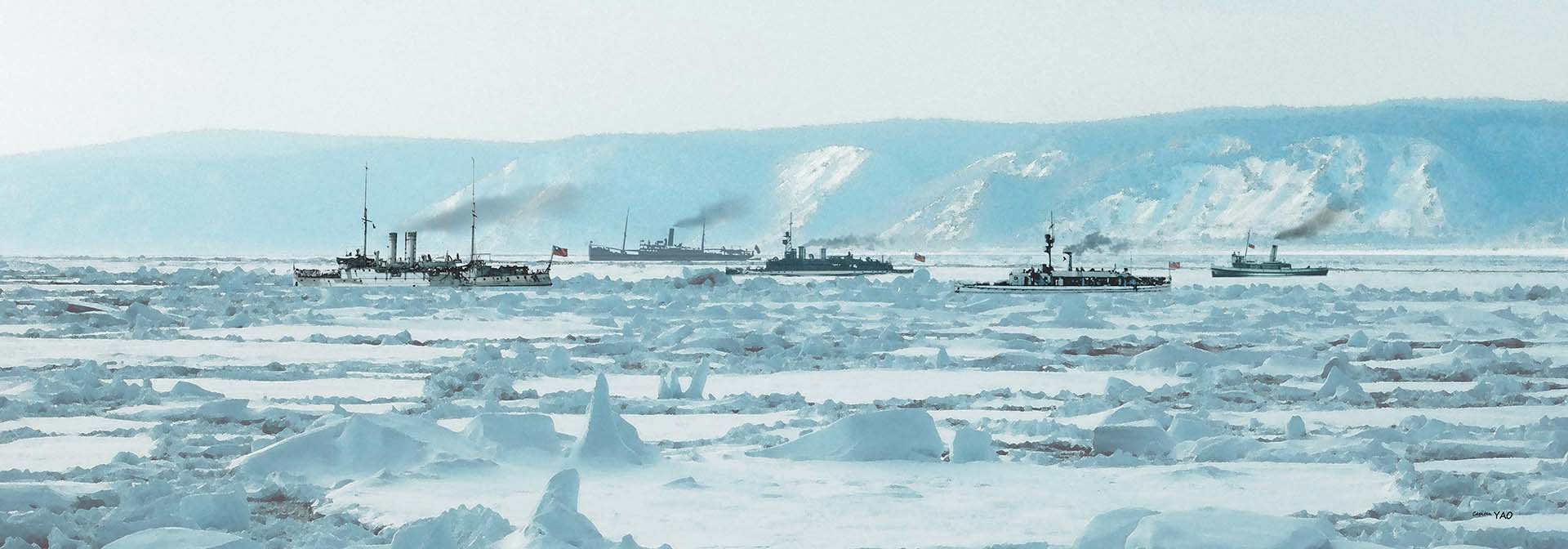
The reason for this long detour is that the estuaries of the Songhua River and the Heilongjiang River are located within Russian territory. Therefore, to enter the Songhua River by sea, one must pass through Nikolayevsk in Russia. At that time, more than 300 Japanese soldiers from the Vladivostok Intervention Forces were stationed there. In November, Nikolayevsk was besieged by more than 4,000 armed men from the Russian anarchist group Yakov Triapitsyn. More than 700 Japanese soldiers, along with local Japanese immigrants, were all massacred.
Subsequent Japanese investigations revealed that Captain Chen Shiying of the "Jiang Heng" had lent a machine gun to the Triapitsyn. As a result, the "Jiang Heng" was detained by the Japanese government. As an advisor, my father had to rush to Miaojie to handle the situation. After several negotiations, the "Jiang Heng" was finally released and arrived in Harbin the following year. This was the origin of Zhang Zuolin's Northeast Fleet.
I have a close relationship with the Northeast Fleet, which I will mention later. My father fell ill due to the exhaustion from his travels and the harsh winter in the north, so he had to resign and return to China ahead of schedule.
China's participation in World War I as one of the victorious Allied powers is beyond doubt. However, its confidence in receiving a share of the spoils after the war was probably insufficient. This was because China did not send troops to actually participate in the war, but instead dispatched 200,000 Chinese laborers to the European battlefield to assist with logistical work. Therefore, China could send troops to participate in the Allied forces' occupation of Vladivostok and could also cancel the continued payment of the Boxer Indemnity to the German Empire and Austria-Hungary. However, in order to strive for the return of Tsingtao, the former German colony in Shantung, it had to consider Japan's attitude. After all, Japan had sent troops to participate in the campaign to capture Tsingtao and suffered considerable losses. Moreover, it was still under actual occupation and would not easily give up under any circumstances.
This incident became a focal point of contention at the Paris Peace Conference, ultimately leading to the Chinese delegation's withdrawal. It also sparked the May Fourth Movement, initiated by university students in China. This movement was not only a reaction to China's frustration at the Paris Peace Conference but also an enlightenment movement for China's modernization. This is something most Western diplomats wouldn't notice, but my father did, and he explained his perspective to me, which had a profound influence on my later development in China.
|
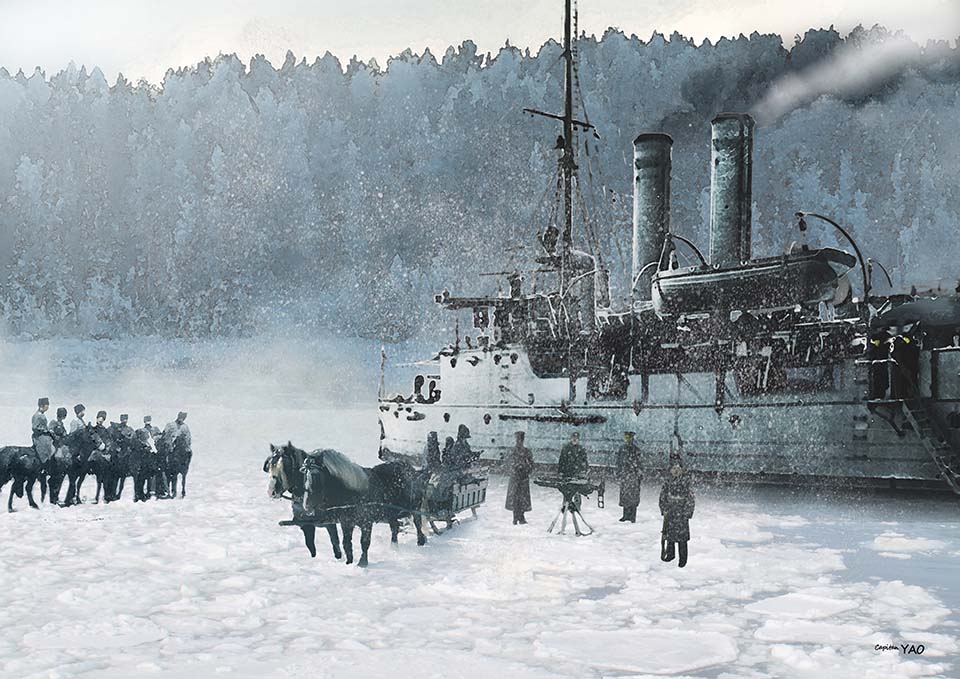 (Figure 1-10-9) The "Chianghung" was detained by the Japanese army after it lent its cannons to Russian anarchists.