3. The Assassination of the Admiral
Britain was Japan's ally and was obligated to help Japan under the contract. However, Russia was an important power in Europe, and the Russian royal family was related to the British royal family. Therefore, Britain did not want to offend them too much. Many forms of aid, such as the supply of arms and ships and the exchange of intelligence, could only be carried out behind the scenes. In this case, the responsible diplomatic officials had to use their wisdom to successfully complete the mission.
In May 1905, the Japanese and Russian fleets engaged in a decisive naval battle in the Tsushima Strait, in which Draken played a crucial role. At the time, the Russian Far East Fleet was trapped in Port Arthur by the Japanese. The Tsar dispatched the Baltic Fleet, led by Vice Admiral Zinovi Petrovich Rozhdestvensky, to the Far East from thousands of miles away via the Cape of Good Hope in South Africa to participate in the battle. Since most of the coastlines along the way were British colonies, British military units in various locations were responsible for monitoring the fleet's movements, including the number of ships, the ports it visited, and the amount of coal and supplies it carried. All this intelligence was sent in encrypted telegrams to the consulate in Yokohama, and Draken personally translated the telegrams and delivered them to the Yokosuka Fleet Headquarters for the Japanese military.
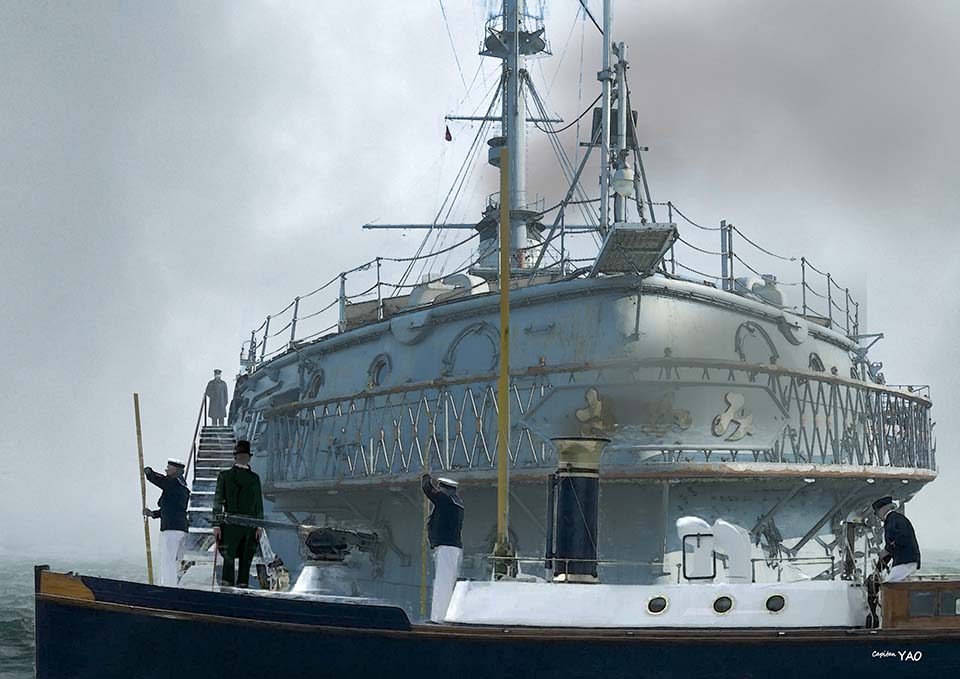
Sir Draken arrived at the dock, where a dinky boat was already waiting. He jumped aboard, and the sailors cast off towards a warship anchored in the center of the harbor. It was a newly built, massive warship with two funnels, built in Britain. Draken knew it was the flagship of the Japanese Combined Fleet, the Mikasa, because he had already seen all the detailed information about the warship sent by Britain at the consulate. The dinky boat docked alongside the Mikasa, and the sailors helped Sir Draken up the rope ladder. At that moment, a deep, powerful voice came from above the deck:
"Good morning, Sir Draken!"
"Ah! Good morning, General Togo!"
Draken looked up and saw Admiral Togo Heihachiro, commander of the Combined Fleet. He was wearing a dark blue winter military uniform, was not tall, and had a thin face with a white goatee.
Togo said, "It's cold outside, let's go inside and talk!"
In his early years, Togo Heihachiro studied at the British Merchant Marine School. Because Britain was more inclined towards China at the time, Chinese students could enter the Royal Naval College, Greenwich, while Japanese students could not get in and could only enter the Merchant Marine School. However, Japanese commanders who graduated from the Merchant Marine School defeated Chinese fleet commanders who graduated from the Royal Naval College.
In 1894, on the eve of the Sino-Japanese War, Colonel Togo Heihachiro was serving as the captain of the Naniwa. On July 25, more than 1,000 Chinese soldiers boarded the SS Kowshing, a merchant ship chartered by the Ch'ing government from the British firm Jardine Matheson, bound for Korea to reinforce the country. The ship was intercepted by the Naniwa near Fengdao Island. Although the Sino-Japanese War had not yet begun, Togo ordered the Ch'ing soldiers on the SS Kowshing to surrender. When they refused, Togo ordered the ship to be sunk, resulting in the drowning of nearly 900 Ch'ing Army soldiers and British crew members. The Sino-Japanese War thus began.
Because the matter involved the loss of British property and lives, the London Foreign Office assisted Jardine Matheson in negotiating with the Japanese side. Sir Draken thus had several encounters with Togo Heihachiro. While Britain should rightfully have sought compensation from Japan, given Japan's overwhelming victory in the Chinese theater and diplomatic considerations, Britain decided to let Japan completely absolve itself of responsibility. Ultimately, China spent a large sum of money to compensate British merchants for all their losses, causing an uproar among the victims' families. In just ten years, Togo had risen from captain to admiral, becoming commander of the Combined Fleet, leading all of Japan's naval vessels in preparation for a decisive battle against the approaching Russian Baltic Fleet. In the command cabin at the stern of the Mikasa, Togo closed the door and asked Draken, "Any new news?"
Sir Draken handed a sealed envelope to Togo, who turned around, opened it, and took out a handwritten letter. After reading it, he burst into laughter and said, "Is this true? Someone is going to assassinate me because of something that happened ten years ago?"
"The source is very certain!" Draken said. "Our intelligence from China indicates that many of the families of the Ch'ing soldiers who drowned in the SS Kowshing incident harbor resentment towards you. Recently, because your country is at war with Russia, Russian intelligence has taken advantage of this situation to help them organize an assassination squad to infiltrate Japan and harm you."
Togo said, "It is an honor for a soldier to die on the battlefield for his country, but that does not include such petty schemes. Moreover, a great war is imminent, and I have many important things to do. I am afraid I cannot do as they wish for the time being."
"General, it's best to be careful. The Russians are very skilled spies," said Draken. "That's all we know for now. I'll come back to you if I get any further intelligence." With that, Draken got up to take his leave.
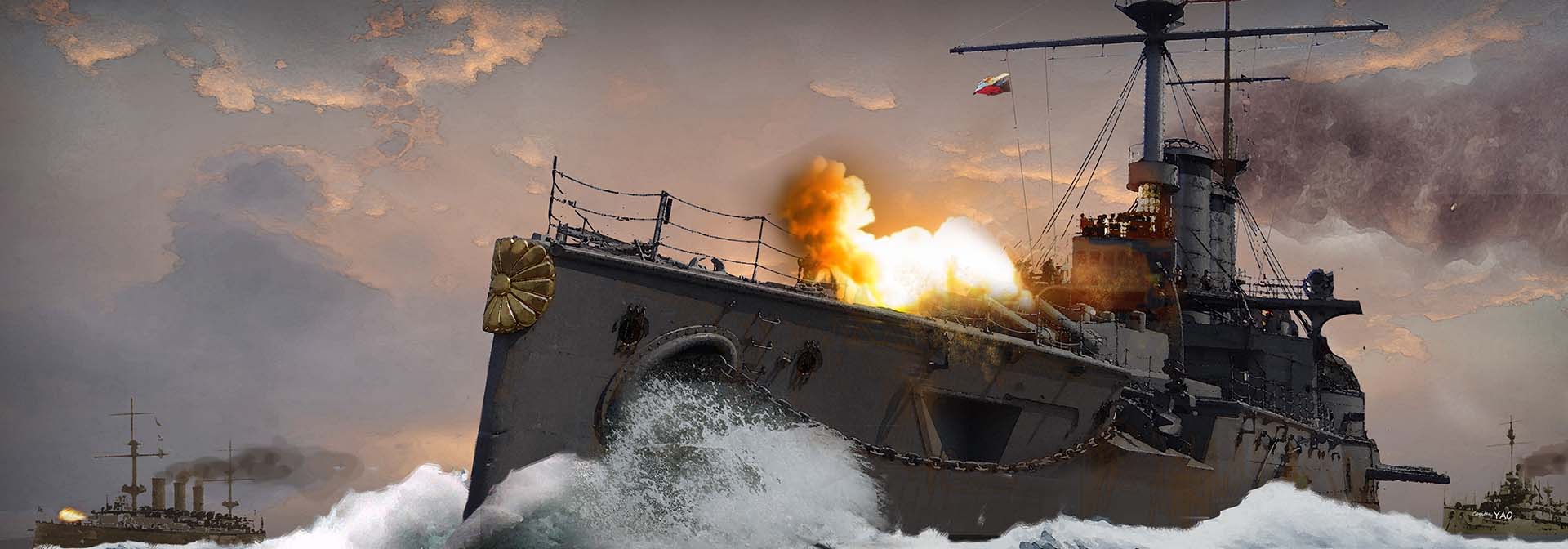
After that, Togo's fleet spent most of its time training at sea, and after a while, everyone forgot about the incident. On May 27, the two fleets finally encountered each other in the Tsushima Strait. Using intelligence provided by the British, Togo accurately tracked the Russian fleet's movements and successfully annihilated it, resulting in a great victory for the Japanese Navy.

The military attaché explained: "This is a special solvent invented by the Russians. It contains a mixture of yellow phosphorus. Once the solvent dries, the yellow phosphorus will automatically ignite. It is better than a time bomb controlled by a clock. First, it does not make a ticking sound, so it is not easy to detect. Second, it is easy to place; just sprinkle it on the target. Moreover, without a specific shape, it cannot be detected. The disadvantage is that the time is difficult to control because the drying speed varies with the environment." The Consul General, who was standing nearby, said: "Last September, the Pingyuan and the Jiyuan exploded and sank at the same location. Both of these ships were captured from the Ch'ing Empire during the Sino-Japanese War. Although the Japanese government claimed that they were hit by mines, we were very suspicious and began to investigate. We discovered the methods used by this Russian assassination group and obtained this item through secret channels!" "We deduce that they planned to pour this liquid onto the propellant charges of the Mikasa's main guns to cause spontaneous combustion, thereby triggering an explosion of the entire ammunition magazine," the military attaché explained. "This deduction is based on evidence. Propellant charges are more dangerous and easier to ignite than warheads because they are gunpowder wrapped in gauze. This solution is clearly designed specifically for propellant. As you just saw, once absorbed, it disappears without a trace, even during inspection, but once ignited, it could absolutely detonate the entire warship!" The Consul General continued, "If the target was Admiral Togo, then the most likely location would be the ammunition depot located below the rear main gun turret." Everyone looked at each other in bewilderment. Draken said, "I must hurry and inform Admiral Togo!" "No!" the consul general said. "I think we should continue to wait and see." "But Japan is our ally! How can we stand by and watch their warships be destroyed by enemy agents, potentially causing heavy casualties?" Derek said anxiously. "And why haven't we been providing Togo with intelligence on this matter, and now that it's been confirmed, are we not issuing a warning to him immediately?" "Brother, you're still too green! We used to have to rely on him to defeat the Russians, but now that the war is over, that need has disappeared; moreover, we can't let Japan's power expand too quickly, and it's in our best interest to maintain a balance with Russia." The Consul General lit his pipe and slowly replied, "Losing a capital ship or an admiral can help achieve this balance, and if Japan loses this warship, it will have to order another one from Britain, and then we can make money again." "James, I know you have a good relationship with Admiral Togo. If this news leaks out, the Consul General and I will definitely suspect you first..." the military attaché said threateningly.
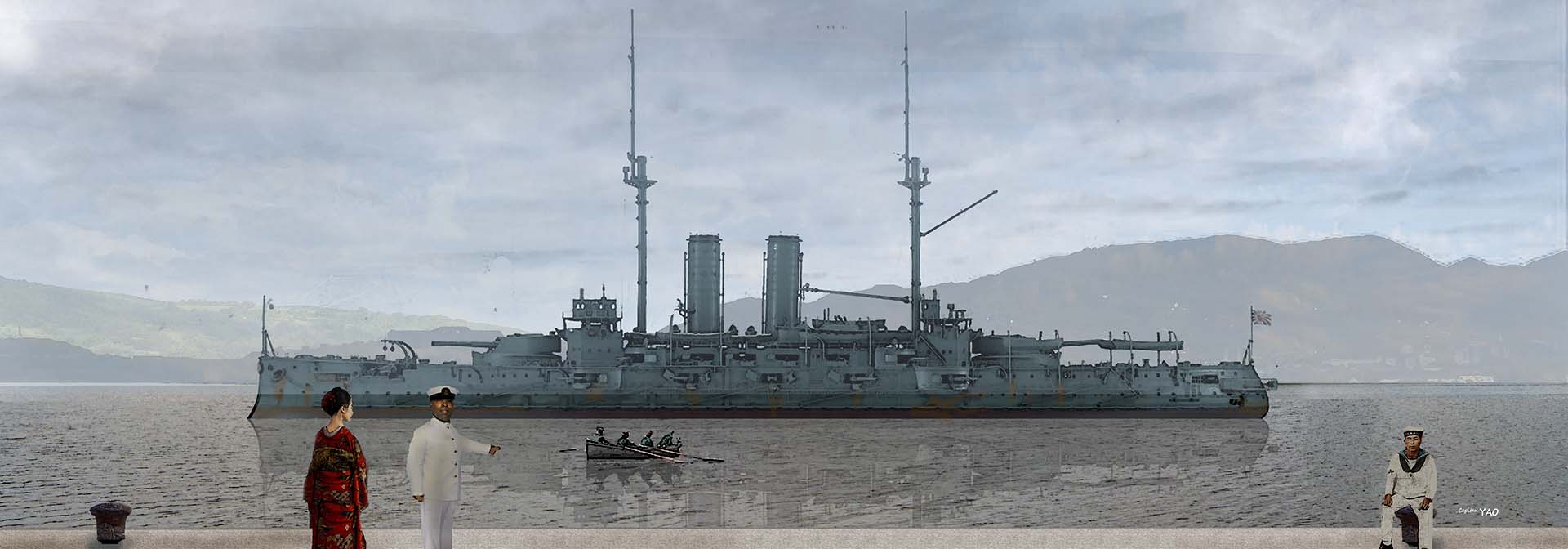
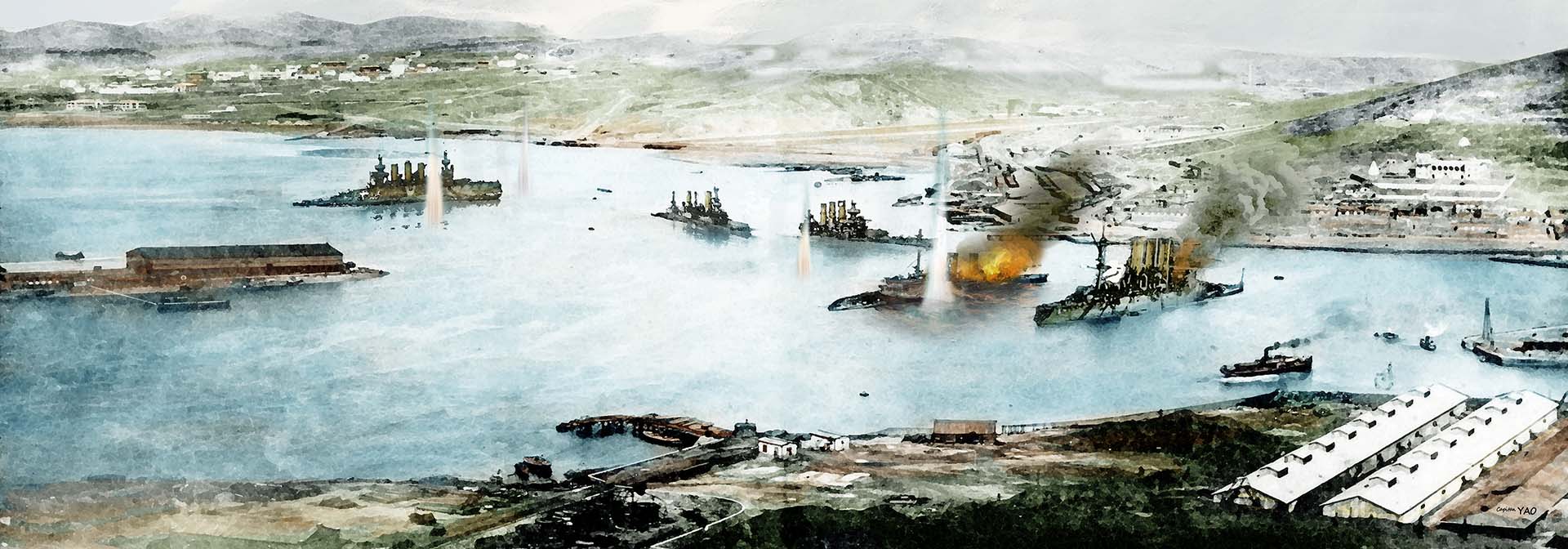
(Figure 1-3-5) After the Russo-Japanese War, the "Mikasa" returned to Sasebo Port for repairs, presenting a relaxed and peaceful atmosphere.
On September 5, Japan and Russia signed an armistice agreement. On the same day, the Mikasa completed the repairs of its wartime damaged parts in Sasebo. On the 9th, it began to replenish ammunition. Barges carried warheads and propellant charges from the shore to the ship one by one. Sailors in white work clothes busily carried the ammunition into the storage room under the turret. The meticulous Japanese officers had already numbered the ammunition for the main guns and secondary guns in batches with chalk, so anyone could tell at a glance which part of the ship the ammunition was to be transported to.
After a busy day, the next day was Sunday, a day off. Early in the morning, I saw several sergeants and a group of geishas dressed in flamboyant clothes flirting at the dock.
"Wow! What a huge cannon!" the geisha exclaimed, pointing at the Mikasa ship in the harbor.
"Then you'll have to see my cannon first," a sergeant replied lewdly. The two then chased and teased each other on the dock, the geisha's giggles drawing attention in the solemn naval port.
After the Russo-Japanese War, the Japanese Navy was generally intoxicated with the joy of victory, and military discipline began to decline. Bases that were heavily guarded during the war are now open to the general public for visits. Moreover, people with connections can even board ships for tours!
"Take me aboard the warship to see your cannons!" the geisha pleaded, tugging at the sergeant. "Hmph! You definitely won't dare!"
"Who says I'm afraid? All the officers have gone ashore to play. I'm the boss here!" the sergeant boasted, patting his chest. Then he whistled, and a small boat pulled up beside the ship. "How about it? I'll take you aboard now!"
"Wow! Yamada-kun, you're so good to me!" The geisha excitedly took the sergeant's arm and jumped onto the small boat, heading towards the "Mikasa" ship. In the distance, the sailors on the ship were lazily sunbathing on the deck.
The geisha and the sergeant boarded the ship "Mikasa." The sergeant led her to visit the aft main gun turret, and as they passed a hatch, the sergeant pointed deep inside and whispered to the geisha, "That's Admiral Togo's room!"
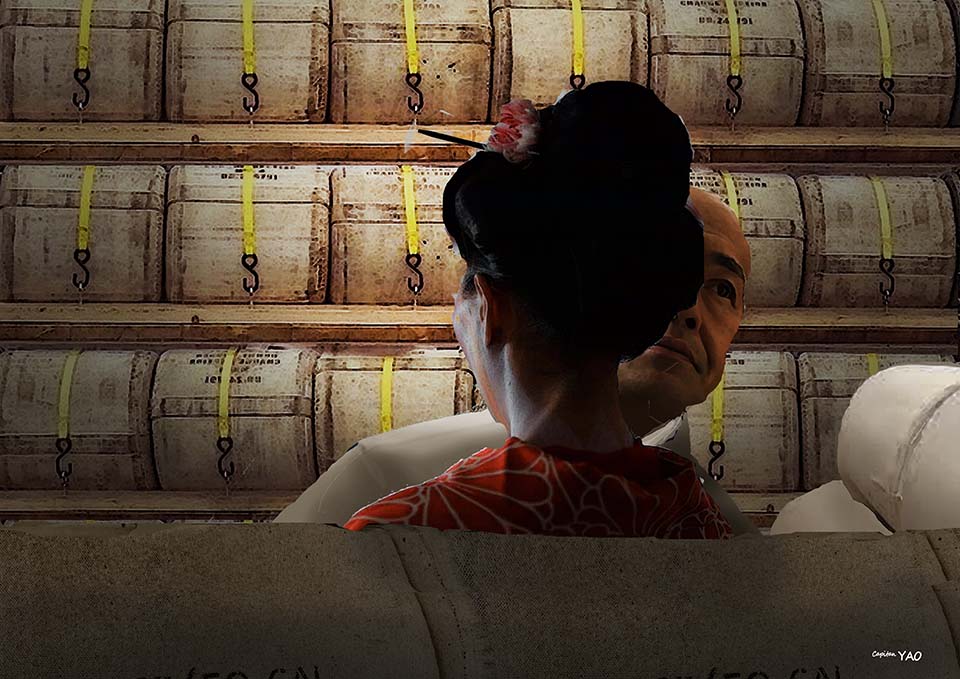
"Admiral? How scary! Let's hide!" The geisha feigned terror and pulled the sergeant towards the base of the turret. In the ammunition compartment below the turret, the sergeant boasted to the geisha about his bravery in battle. The cramped room was littered with propellant charges that had just been loaded onto the ship yesterday and hadn't been organized yet. The geisha deliberately teased,
"Of course!" The sergeant named Yamada had already been aroused by the geisha and turned around to force her into a corner, pretending to be intimate with her.
"Yamada-kun, don't rush! This is too hard, can we move it to that softer area?" The geisha was pointing to the pile of medicine packets.
"Of course!" Sergeant Yamada could no longer contain himself. He wrapped his arms around the geisha from behind and lifted her up. The two of them leaned against the pile of medicine packets and began to masturbate.
The impatient Sergeant Yamada, of course, did not notice that the geisha secretly took out a small porcelain bottle from her sleeve and sprinkled some liquid on the medicine packet. It disappeared into the medicine packet in a moment and was nowhere to be seen. Instead, the sweat and bodily fluids left by the two on the medicine packet were more obvious.
"What? That's it?" the geisha exclaimed coquettishly. It turned out that Sergeant Yamada was all bark and no bite.
Yamada waved for the geisha to leave on her own. There were many things he didn't notice, including the geisha's slightly impure Japanese accent.
At dawn on Monday, September 11, the ammunition magazine in the stern gun turret of the "Mikasa" exploded as expected. The entire warship was blown through and sank into the harbor where the water was 18 meters deep, resulting in a tragedy that killed more than 300 people and seriously injured more than 200. Sergeant Yamada was blown to pieces and his body could not be found.
The crew of the ship "Mikasa" never dreamed that they would survive the fierce Battle of Tsushima, only to be blown to their deaths just as they were tasting the fruits of victory.
However, the assassination squad's main target, Togo Heihachiro, was very lucky, as he had just been summoned to Tokyo by the Emperor shortly before the warship exploded and thus escaped the attack. After the war, Togo was promoted to Field Marshal and, along with General Nogi Maresuke, was revered as a "god of war" of Japan. He lived for nearly thirty years longer, passing away in 1934.
Although the war ended, the operations of the Sino-Russian assassination group continued. Three years later, on April 30, 1908, they used the same method as the Mikasa to sink the Matsushima, the flagship of the Combined Fleet during the Sino-Japanese War, in Penghu. The massive explosion in the stern gun turret ammunition magazine of the Matsushima in the early morning of that day killed the captain and more than 200 students from the 35th class of the Naval Academy who were on a long voyage for training.
On July 18, 1912, the Naniwa, the ship that sank the SS Kowshing, finally sank in Hokkaido. The Japanese government claimed that it had run aground, but the British government knew the real reason but could not disclose it.
Despite the many secrets that could not be made public, the Japanese navy's outstanding intelligence capabilities led to a complete victory in the battle. The Japanese government originally intended to award him a medal, but London felt it was inconvenient and had to give up. However, Japanese Foreign Minister Kobayashi still highly praised Baron Draken to the British Foreign Secretary, which had a great influence on his future development.
Because the Russo-Japanese War was the largest modern war in history at the time, many Western countries sent officers to Japan to observe. Sir Draken made many friends during these visits, many of whom later became prominent figures, such as Major General Arthur MacArthur and his son, Lieutenant Douglas MacArthur, who were sent by the United States to observe the war. Baron Draken highly praised the military character of the father and son, and this experience in Japan had a profound influence on Field Marshal MacArthur's strategic thinking in commanding the Pacific War between the United States and Japan.
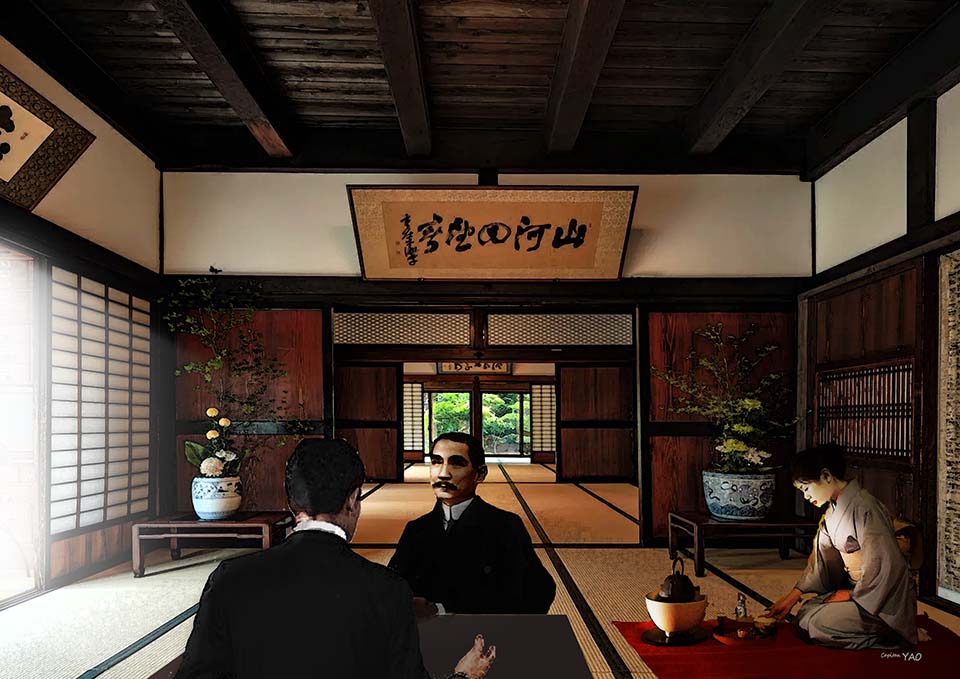
Sir Draken and Dr. Sun Yat-sen, the Chinese revolutionary, also met in Japan. Before Sun Yat-sen established the Chinese Revolutionary Alliance in Tokyo in August 1905, he had discussed the charter with Sir Draken. Sir Draken could not understand his slogan "Expel the Manchus and restore China" because it was clearly inciting national hatred. However, Sun Yat-sen said that ordinary Chinese people would not understand "democracy and republic" and that it would be easier to promote if the Han people continued the tradition of "opposing the Ch'ing and restoring the Ming" that had lasted for hundreds of years. Dr. Derek always had a very skeptical attitude towards this point.
In Japan, Sir Draken also met Liang Qichao, a royalist, with whom he was neighbors in Yokohama. Liang Qichao had fled to Japan in 1898 after his failed attempt to stage a coup with Emperor Guangxu, and lived in Yokohama running a newspaper. At the time, the British Foreign Office had instructed its Far East officials to secretly cultivate relationships with Chinese dissidents in preparation for future needs. Therefore, Draken and Sun Yat-sen's initial interactions with Liang Qichao were indeed purposeful, but they later became true friends.
Due to his outstanding performance in Japan, Sir Draken received a promotion from the Ministry of Foreign Affairs and returned to China at the end of 1906 to serve as Consul General in Tientsin, acting as the previous Consul General, Lionel Charles Hopkins, who was planning to return home due to illness. During this period, significant changes occurred in Chinese politics and society. The Chinese court was no longer able to resist the calls for reform and Westernization, and officials and members of the royal family vied to curry favor with Westerners. Baron de Rijken thus became acquainted with many nobles and high-ranking officials. Because of his better connections than others, in addition to his official duties in Tientsin, he frequently traveled to Beijing to assist the legation in handling official and private matters with Chinese government officials. Of course, his special relationship with Prince Su gave him access to more intelligence sources and connections than other diplomats.
Sir Draken's recall to China was also related to a highly confidential diplomatic maneuver at the time. Following Japan's decisive victory in the Russo-Japanese War, the balance of power among the major powers in China was significantly altered. Germany and the United States felt immense pressure from the Anglo-Japanese alliance, especially after the signing of agreements between Britain and France, and France and Russia, which led to the formation of the Entente Powers, primarily led by Britain. Fearing being squeezed out of China, Germany secretly contacted the United States and China, hoping to form an alliance to counter this. This was a highly innovative idea at the time, and a significant diplomatic maneuver. Draken's appointment as Consul General in Tientsin was specifically to ascertain the relationships between Germany, the United States, and China, and even to further disrupt them. Sir Draken was well aware of the intricacies of Chinese politics. He first invoked Li Hongzhang's "using barbarians to control barbarians" as a rallying cry, which was very persuasive. Britain was the eldest brother among the great powers, and allying with Germany would offend Britain, which was not worthwhile! Empress Dowager Cixi, who was initially very enthusiastic, lost interest upon hearing this, and the matter was temporarily shelved. In 1907, Yuan Shikai gained favor with the imperial family, and this matter was brought up again in court. Yuan Shikai was basically anti-Japanese, but because of his industrial ventures, he had good relations with the United States. In 1908, he sent his advisor Tang Shaoyi to the United States to negotiate, and the alliance of the three countries seemed to be on the verge of becoming a reality. However, things didn't go as planned. At the end of that year, Empress Dowager Cixi and Emperor Guangxu died at the same time. In addition, Sir Draken had given Japan intelligence beforehand, giving Japan an opportunity to work on its relations with the United States. Tang Shaoyi's trip to the United States ultimately ended in failure. These things happened before I was born. Some were told to me by my father, but most came from his unpublished autobiography, which recounted his legendary experiences working in the East from 1900 onwards. I'm not entirely sure why it was never published; otherwise, it would have been a very compelling book. My father gave me the original notebook of this autobiography before he passed away. Although I didn't get his permission beforehand, knowing him as I do, I'm sure he wouldn't object to me sharing this legendary tale with the public now!
|
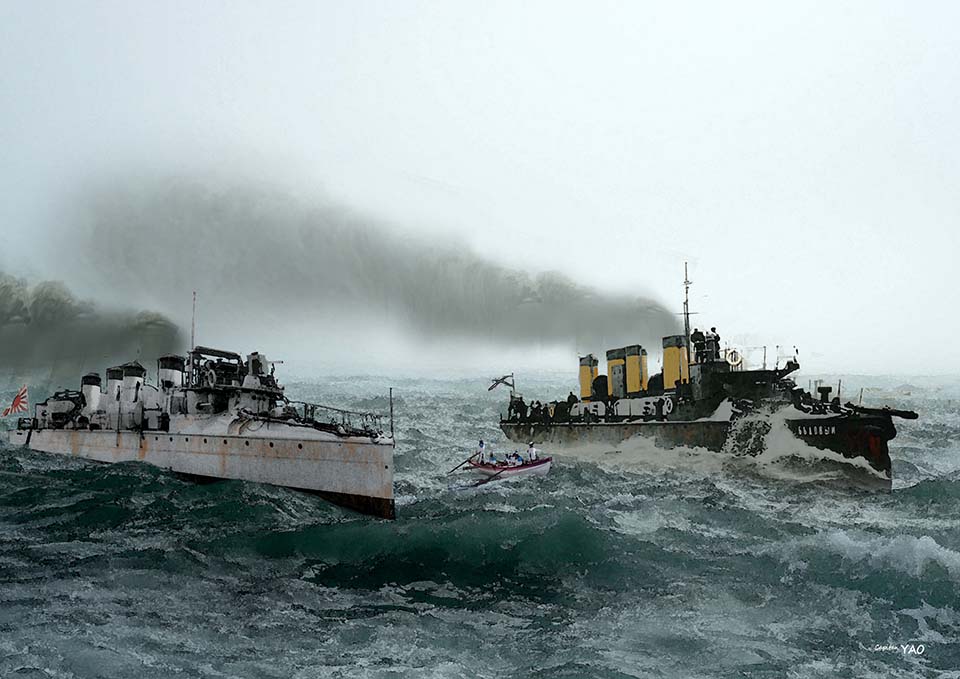 "The Russians have already departed from Saigon! However, today I bring you not intelligence about the Russian fleet, but rather information concerning the general personally. Please take a look."